

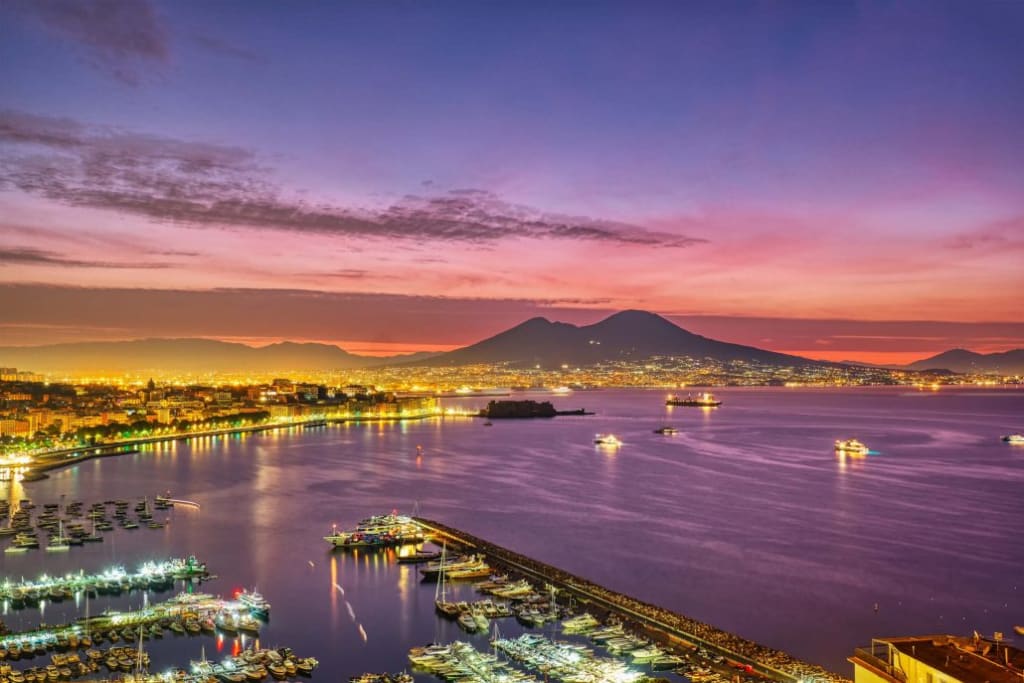
Weekend in Naples and Procida
Here’s a ready-made program for a weekend in Naples, including a visit to the island of Procida. The program includes cultural moments and experiences of the famous cuisine. It’s important to note that this is just a taste; the city and its surroundings (Capri, Pompeii, Herculaneum, Sorrento) deserve a more in-depth visit of at least a week.
For your accomodation there are luxury hotels and cheaper B&B or vacation’s houses, , you can see here
General Program:
Friday:
- Naples
Saturday:
- Pozzuoli and Procida
If the weather is bad, explore Naples instead.
Sunday:
- Naples
The program will include alternatives based on the weather, as it’s suitable for any season. Nights will be left free, so you can decide whether to relax in the hotel or experience the city’s nightlife, depending on your energy levels. In Procida, to allow for a good tour of the island and to see as much as possible, I recommend renting electric bikes. These will give you the freedom to move around and allow for potential changes in the itinerary.
Detailed Program
Friday Afternoon:
- Departure from the centrally located hotel
- Via Tribunali
- Visit to the Pio Monte della Misericordia with Caravaggio’s famous painting
- Piazza S. Gaetano, stop for a giant "babà"
- Visit to Underground Naples and the Greco-Roman Theater (single ticket), duration approximately 1.5 hours. Dinner with pizza; the city center offers plenty of great pizzerias.
Budget menu:
- Seaweed fritters and battered vegetables
- Standard pizza
- Water or beer
- Dessert or fruit
Saturday:
- Meeting at the hotel entrance at 9 AM
- Metro to Piazza Cavour
- Arrival in Pozzuoli, quick visit to the Temple of Serapis near the port
- Departure for Procida by ferry
- Tourist tour of the island
- E-bike rental at Marina Grande
- Terra Murata, guided tour of Palazzo d'Avalos (former prison)
- Quick visit to the Church of Santa Margherita Nuova
- Corricella and Elsa Morante Belvedere (where you will have lunch)
- Marina di Chiaioella
- Guided tour of Vivara
- Faraglioni
- Return the bikes at Marina Grande
- Ferry back to Naples
The lunch will be provided by the hotel (a sandwich and a piece of fruit). There isn’t enough time for a sit-down lunch at a restaurant, but if time permits, you can stop at a pastry shop or gelateria depending on the season.
In case of bad weather:
- Visit to the National Museum
- Lunch at a traditional trattoria (Da Nennella)
This is an opportunity to visit the Spanish Quarters.
Menu:
- Fettuccine with fresh tomatoes and basil
- Caprese salad (mozzarella, tomato, basil) or “parmigiana”
- Friarielli and French fries (or other seasonal options)
- Fruit
- Visit to the San Severo Chapel
- Sanità district and the Fontanelle Cemetery
All locations can be reached on foot, possibly with some rest stops.
Sunday:
- Meeting at the hotel entrance at 9:30 AM
- Take the funicular to San Martino (Vomero hill)
- Visit to the museum and Castel Sant’Elmo, with art, history, and panoramic views
- Depending on the weather and your energy, return via the scenic and ancient Pedamentina stairs or by funicular
- Street food in the Pignasecca area
- Farewell
Here a descriptions of the Places You'll Visit.
Pio Monte della Misericordia
The "Pio Monte della Misericordia" is an institution founded in 1602 by seven Neapolitan nobles who, aware of the needs of a population in need of help and solidarity, decided to devote part of their wealth and efforts to charitable works.
The Caravaggio painting, from the top of the main altar of the chapel, dedicated to the seven works of mercy, is the most notable and valuable work. Definitely visit the picture gallery on the first floor, which contains pieces of undeniable value, including a modern art section that is also quite interesting.
Underground Naples
Access to a part of the underground city is from Piazza S. Gaetano, with guided tours managed by an association. Participating in the excursion means embarking on a journey through 2,400 years of history, from the Greek era to modern times, 40 meters deep among tunnels and cisterns.
During the excursion, in addition to admiring the remains of the ancient Greco-Roman aqueduct and the air raid shelters from World War II, you can visit the War Museum, the hypogeal gardens, the "Arianna" seismic station, and other curiosities. The remains of the ancient Greco-Roman Theater can also be visited, accessible from a private property.
Temple of Serapis in Pozzuoli
Just steps from the Cumana station and the port, the Temple of Serapis is undoubtedly the symbol of Pozzuoli. There are two reasons for its popularity: first, it testifies to Puteoli's prestige in Roman times, and second, it has served as an exceptional tool for measuring bradyseism, a geological phenomenon consisting of the periodic lowering and raising of the ground level.
Procida
Terra Murata and Palazzo d'Avalos
From Marina Grande, the ferry landing, it takes only a few minutes to reach “Terra Murata”, a fortified promontory overlooking the island. Procida’s former prison is an imposing building by the sea, built at the end of the 16th century by Cardinal Innico d’Avalos.
Commissioned by the architects Cavagna and Tortelli, D’Avalos, with the construction of his palace, created the current access to Terra Murata, whose village was previously accessible only from the Asino beach, after Punta Lingua. Thanks to this connection, the urban development of the island began, leading to the creation of the Corricella village, the construction of the Convent of Santa Margherita Nuova, and the current architecture of the Abbey of San Michele.
In 1734, the noble palace was confiscated by the Bourbon rulers, who established the first royal hunting site in Procida. It became a royal residence for hunting, primarily for Ferdinand IV, before the construction of “Capodimonte” and the Royal Palace of Caserta. After serving as a royal palace for the Bourbons, the monumental complex was transformed into a military school in 1815, and then into a prison in 1830. It underwent further expansions starting in 1840 to accommodate its new function as a penal colony. After the unification of Italy, it became a maximum-security prison of the Italian state.
The Procida prison housed notable figures such as Cesare Rosaroll and Luigi Settembrini. After the fall of the Italian Social Republic, from 1945 to 1950, it held many key members of the fascist regime, including Graziani, Teruzzi, Cassinelli, and even Julio Valerio Borghese.
The monumental complex consists of the Palazzo D’Avalos, the courtyard, the guards’ barracks, the single-cell building, the guards’ pavilion, the veterans' building, the infirmary, the director’s house, and the agricultural estate known as the "Spianata," covering approximately 18,000 square meters. The fact that the palace was commissioned by a cultured Renaissance lord, following principles of beauty, and later inhabited by the enlightened King Charles III of Bourbon, stands in stark contrast to its later use as a place of punishment. Today, a simple visit reveals it as a unique place, where a strong emotional tension can be felt. In the former prison, everything remains as it was, within the cells and the Renaissance corridors, worn and frozen in time: old uniforms, shoes on the dusty floor, rusted cots, bales of cotton once processed in the workshop, and even the examination bed for minor surgeries. The old prison was closed in 1978, and the new prison was definitively abandoned in 1988.
Church of Santa Margherita Nuova
The construction of this religious site dates back to the second half of the 16th century when the Dominican monks, who owned the ancient Monastery of Santa Margherita Vecchia at "Chiaiolella", moved due to Saracen raids. The church's restoration was completed in September 2012, while the lower convent still needs to be completed. The architectural complex, situated between Corricella and Terra Murata, is in a place of extraordinary scenic beauty. The terrace opens onto the Corricella village.
Corricella village
Descending from "Terra Murata", you reach this characteristic fishing village. It has gained global fame, as evidenced by the fact that in 2015, both Apple and Microsoft used the village's seaside image to advertise their products (iPhone and tablet). This global, cost-free publicity speaks volumes about the charm of this small marina, which was also chosen by Massimo Troisi and Michael Radford to film several scenes from "Il Postino di Neruda," Troisi’s final film before his death in 1994.
Vivara Island
Vivara Island, a mysterious and fascinating piece of land connected to Procida by an old bridge, has been a protected natural reserve since 1974 and a state nature reserve since 2002. Small, wild, and unspoiled, in addition to being populated by rare plants, wild rabbits, and numerous water birds, it is also home to important archaeological findings of Mycenaean origin.
Naples
National Archaeological Museum
The National Archaeological Museum of Naples (MANN) is the oldest museum in Europe. It houses precious collections and archaeological finds ranging from the prehistoric era to the late Roman period, including historical collections from the Farnese family, the Borgias, and ancient Egypt.
San Severo Chapel
Located in the heart of the ancient center of Naples, the San Severo Chapel Museum is a jewel of international artistic heritage. Baroque creativity, beauty, and mystery intertwine here, creating a unique, almost timeless atmosphere.
“Sanità” district
The Sanità district was built at the end of the 16th century in a valley used since the Greco-Roman era as a burial place since it was outside the ancient city walls. This district is home to Hellenistic hypogea and early Christian catacombs, such as those of San Gennaro and San Gaudioso, establishing a strong relationship between man and death that has persisted through the centuries.
“Fontanelle” Cemetery
It is located at the western end of the natural valley of Sanità, just outside the Greek-Roman city, in the area chosen for the pagan necropolis and later for the Christian cemeteries. The site has preserved the remains of those who could not afford a proper burial for at least four centuries, and especially of the victims of the great epidemics that repeatedly struck the city. In this area, there were numerous tuff quarries, used until the 1600s to source the material, tuff, to build the city. The space of the tuff quarries was used starting from 1656, the year of the plague, which caused at least three hundred thousand deaths, until the cholera epidemic of 1836. Over time, the bones from the so-called "terresante" (the hypogeal burials of churches that were reclaimed after the arrival of the French under Gioacchino Murat) and from other excavations were added to these remains. The canon and ethnologist Andrea de Jorio, in 1851 the director of the San Raffaele retreat in Materdei, recounts that by the end of the 18th century, all those who had the means made arrangements to be buried in the churches. However, there was often no more space available; it happened, then, that the gravediggers, after pretending to comply with the requests and performing the burial, late at night, would put the deceased in a sack, carry them on their shoulders, and deposit them in one of the many tuff quarries. However, following the sudden flooding of one of these galleries, the remains were dragged out into the open, bringing the bones into the streets. The bones were then reassembled in the caves, a wall and an altar were built, and the place remained designated as an ossuary for the city.
Today, one can count 40,000 remains, but it is said that under the current floor there are compressed bones for at least four meters in depth, arranged in an orderly manner at the time by specialized gravediggers. In March 1872, the cemetery was opened to the public and entrusted by the municipality to Canon Gaetano Barbati, who, with the help of Cardinal Sisto Riario Sforza, organized the remains according to the type of bones (skulls, tibias, femurs) and set up the first quarry like a provisional church, awaiting the construction of a stable temple. In the 1960s, during the years of the Second Vatican Council, the parish priest of the Church of the Fontanelle, Don Vincenzo Scancamarra, concerned about the feticism inherent in the cult of the "pezzentelle souls," sought advice from the Archbishop of Naples, Cardinal Corrado Ursi. On July 29, 1969, a decree from the ecclesiastical court for the cause of saints prohibited the individual cult of the skulls, considered a pagan belief, allowing a mass to be celebrated once a month for the souls in purgatory and a procession to be held inside every November 2, the day of commemoration of the dead. It was not the decision of religious institutions, but the gradual devotional oblivion that caused the cemetery to slip into obscurity. For years in a state of abandonment, it was secured and reorganized in March 2002, but it was never reopened to the public except for a few days a year, especially on the occasion of the Neapolitan “Maggio dei Monumenti.” On May 23, 2010, a peaceful occupation by the residents of the neighborhood convinced the municipal administration to reopen it. Since that day, the cemetery has been truly accessible again.
Museum of San Martino
The Neapolitan Republic of 1799 changed the fate of the Certosa di San Martino, as the monks, accused of republican sympathies, were removed from the monastery, which was subsequently definitively suppressed in the aftermath of the Unification of Italy. When it became a National Monument in 1866, its director, Giuseppe Fiorelli, transformed it into the "Historical Museum of the City and Kingdom of Naples."
From all areas of Campania, all sorts of valuable testimonies of Naples’ history and its artistic heritage began to arrive, which were later expanded by private donations and public entities, but unfortunately, the museum was not very well visited. People would climb up to San Martino, enjoy the breathtaking view, glance absently at the majestic Castel Sant'Elmo, but were not attracted to the museum. Then, in 1877, there was a turning point when a certain knight Michele Cuciniello, a playwright of little fortune but very wealthy by family standards, decided to donate his nativity scene to the Museum of San Martino. The only compromise that had to be made to acquire this nativity scene was to create an 18th-century style setting within the museum to serve as a backdrop for his collection. He donated no less than 300 pieces to the museum. From that moment on, people increasingly visited the museum primarily to see this extraordinary nativity scene. Today, the museum features, in addition to the nativity scene, an exhibition of carriages, a naval section, the Alisio collection (views of the city), the recently opened Gothic undergrounds, a section of 19th-century Neapolitan paintings, and the “loggia of the prior” from which one can enjoy one of the most beautiful views of the city and the gulf. There is also a beautiful cloister that is worth the visit by itself.
Castel Sant'Elmo
The castle dominates the city from the highest point of the Vomero hill; from it, one can enjoy a splendid panorama. Built entirely of tuff, it conveys a sense of power and robustness when observed as a whole. It is recommended to take the elevator up and walk down, discovering its interesting and panoramic walkways.
It is a medieval castle built around 1300 in the same location where there was, in the 10th century, a chapel dedicated to Saint Erasmus, from which Eramo, Ermo, and then Elmo derive. Originally a Norman observation tower (called Belforte), it was commissioned by Robert of Anjou to architect Tino da Camaino in 1325, and the construction of the Palatium castrum was completed in 1343 under the reign of Joanna I of Anjou. Since then, the castle has been besieged several times due to its strategic position and control over the roads of Naples, and it was a military target, especially during the struggle between the Spaniards and the French for the conquest of the Kingdom of Naples. Between 1537 and 1547, it was rebuilt on the orders of the Spanish viceroy Don Pedro De Toledo and took on its current star-shaped layout with six points. In 1587, a lightning strike hit the castle, destroying the residences of the castellans and soldiers and the internal church. The building was then rebuilt between 1599 and 1610 by architect Domenico Fontana. Between the 17th and 18th centuries, the castle became a prison, where philosopher Tommaso Campanella was also imprisoned, and it was the site of revolutionary movements in 1799 when it was taken by the people and besieged by the republicans who proclaimed the Neapolitan Republic in the Piazza d'Armi. After the fall of the republic, it became a prison again, housing Giustino Fortunato, Domenico Cirillo, and Luisa Sanfelice, and it remained a military prison until 1952. Only in the 1980s did the fortress become a structure of cultural and museum interest, and since 1982 the entire monumental complex has been entrusted to the custody of the Superintendence for Artistic and Historical Heritage of Naples and was opened to the public in 1988. It currently hosts exhibitions and temporary art displays, as well as festivals and theater and music reviews. Additionally, it is the permanent home of the "Museo Napoli Novecento," an evolving museum that collects works created by Neapolitan artists throughout the 20th century, including sculptures, paintings, and graphic experiments. Many parts of the castle are accessible for free; for others, a ticket is required. In this program, purchasing the ticket is optional, and it will be evaluated based on the available time.
Street Food in Naples
You want to eat cheaply and quickly? There is no shortage of options: “cuoppo” (a thick paper cone) filled with various fried foods (vegetables or fish), “frittatine di pasta” (pasta omelets), “crocchè di patate” (potato croquettes), “palle di riso” (rice balls or arancini), the famous “taralli” made with lard, pepper, and almonds, and “pizza a portafoglio” (wallet pizza, either margherita or marinara) which is not easy to eat without damage. Moving on to desserts, there are “graffe” (fried doughnuts), the famous “babà” (a rum-soaked cake), and “sfogliate” in both “riccia” and “frolla” versions.
About the Creator
Claudio Laviano
I have always been good at writing and now I dedicate myself mainly to this activity. I have two blog sites where I publish articles (justforrich.com and succoyoutube.it). I live in Italy, near Naples.
Keep reading
More stories from Claudio Laviano and writers in 01 and other communities.
Chess at Petraio
Don Ciro and Don Luigi, old friends nearing 70, lived in old houses in the small village perched on the steps of Petraio, an unique and isolated area of Naples. Every day, when the weather allowed it, at exactly 5 PM, they would unleash their two red chairs, tied with a chain to a water pipe, because in Naples, they take everything, sit across from each other, and start their chess game. Without a table, the chessboard rested on the patient legs of whoever had the white pieces.
By Claudio Laviano2 years ago in Fiction
Generative AI in App Development: Use Cases Driving Business Innovation
Remember when we actually wrote code? I mean really wrote it. Character by character. Fighting with syntax errors because you missed a semicolon in line 402. Looking back from where we stand in 2026, those days feel like the Stone Age, don't they? It’s only been a few years, but the landscape of app development has shifted so violently that "developer" barely means the same thing anymore.
By Sherry Walker6 days ago in 01




Comments
There are no comments for this story
Be the first to respond and start the conversation.