
ApeX Protocol Just Brought Wall Street to DeFi — With Chainlink Data Streams
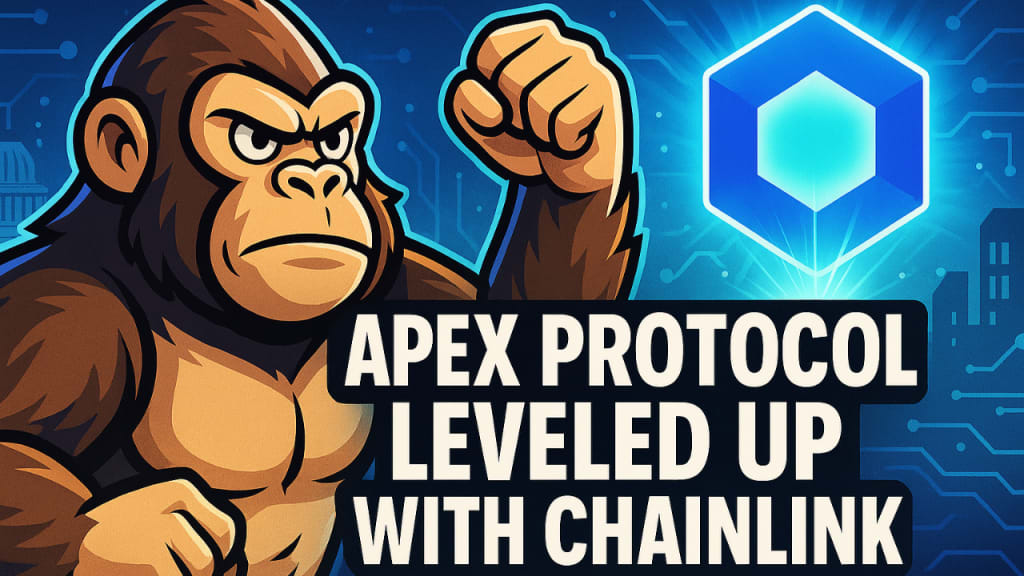
ApeX integrates Chainlink Data Streams to launch real-world asset perpetuals across five major chains.

DeFi has been chasing one dream for years:
on-chain trading that feels as fast, smooth, and reliable as the centralized exchanges dominating traditional markets.
Today, that future just got a lot closer.
ApeX Protocol — one of the fastest-growing decentralized derivatives platforms — has officially integrated Chainlink Data Streams to power real-world asset perpetuals across five blockchains: Arbitrum, Base, BNB Chain, Ethereum, and Mantle.
This is more than a partnership.
It’s a technological leap.
For the first time, institutional-grade market data is flowing directly into DeFi at sub-second latency, enabling traders to execute RWA perpetuals with near–CEX responsiveness.
This is the moment decentralized derivatives stop playing catch-up — and start competing head-to-head.
Chainlink Data Streams: The Infrastructure Upgrade DeFi Needed
Chainlink Data Streams isn’t just another oracle product.
It’s the premier, low-latency on-chain data pipeline trusted by giants like Aave, GMX, and Lido — securing over $26 trillion in transaction volume.
That’s the type of infrastructure institutions rely on.
By integrating Data Streams, ApeX replaces slow, multi-minute price feeds with sub-second updates — the kind of speed professional traders demand, and the kind of performance DeFi has historically lacked.
In simple terms:
ApeX can now process and price real-world asset markets the way Nasdaq or CME would — but on-chain.
This is what RWA trading was missing.
The Technical Breakthrough Across Five Chains
ApeX didn’t just integrate faster data.
It integrated smarter data.
Rather than relying on a single price point, Chainlink delivers liquidity-weighted bid-ask spreads, giving ApeX more granular pricing inputs, more accurate risk parameters, and tighter execution.
For traders, this means:
More accurate entry and exit points
Less slippage
Better protection during volatility
A trading experience that matches centralized platforms
And because the integration spans Arbitrum, Base, BNB Chain, Ethereum, and Mantle, traders can choose their ecosystem without sacrificing data quality.
No fragmentation.
No inconsistency.
No trade-offs.
Just professional-grade execution — everywhere.
A Real Validation: Traditional Finance Already Trusts Chainlink
This isn’t theoretical.
Major institutions like Swift, Mastercard, and UBS are already using Chainlink infrastructure in pilot programs and production deployments.
That’s unheard of in crypto.
ApeX evaluated multiple oracle solutions but ultimately selected Chainlink for a reason:
Proven track record
High-frequency data delivery
Transparent data pipeline
Multi-chain support
Institutional-grade reliability
This is the infrastructure Wall Street wants.
Now it’s the infrastructure DeFi has.
Why This Matters for Traders
The integration unlocks several game-changing advantages:
1. Real-world assets finally feel tradable on-chain.
No more laggy updates. No more stale oracles.
2. Sub-second data feeds mean tighter spreads and faster fills.
Exactly what derivatives traders need to survive volatility.
3. Decentralization without compromise.
This isn’t a centralized API feeding a blockchain.
This is a decentralized oracle network securing billions.
4. Multi-chain access with consistent quality.
Trade RWAs on Arbitrum, Base, Mantle, BNB Chain, or Ethereum — the data remains identical.
DeFi has talked about matching centralized execution for years.
This is the first real step in that direction.
ApeX Strengthens Its Position Inside the Mantle Ecosystem
ApeX isn’t integrating this technology in a vacuum.
It follows their APE Season 1 farming event, strategic token buybacks totaling $8.08 million, and collaborations with Mantle-native projects like UR.
The protocol isn’t just improving its trading engine —
it’s solidifying itself as a core component of the Mantle ecosystem.
With Chainlink Data Streams now powering RWA perpetuals, ApeX becomes one of the first platforms capable of offering institutional-grade RWA derivatives in a decentralized environment.
This is how ecosystems are built.
Not with slogans — with infrastructure.
The Bigger Picture: DeFi Is Growing Up
This integration is quietly signaling something profound:
DeFi infrastructure has matured.
Oracle networks are now fast enough.
Data pipelines are now secure enough.
Execution quality is now strong enough.
For the first time, DeFi can offer:
Advanced derivatives
Real-world asset exposure
Sub-second data updates
Transparent, decentralized pricing
All in a single platform.
This is the beginning of on-chain markets that don’t just mimic traditional finance —
they compete with it.
Final Line
ApeX’s integration of Chainlink Data Streams is more than a technical upgrade — it’s a declaration that decentralized derivatives trading is ready for prime time.
Author’s Note
This article was created with the assistance of advanced AI — a tool I will continue using to break down complex DeFi infrastructure, analyze protocol upgrades, and deliver deeper insight into the next evolution of on-chain markets.
About the Creator
Crypto Robot
Welcome to Crypto Robot! 🤖
Stay ahead of the game with the latest crypto news, financial advice, and actionable investment insights. Whether you're a trader or just starting your crypto journey, Crypto Robot is here to guide you.
Keep reading
More stories from Crypto Robot and writers in 01 and other communities.
iPhone 18 Pro Leaks Drama: The Dynamic Island Confusion Explained
The iPhone 18 Pro is already stirring up controversy, and it all started with a viral video from FPT. The renders showed off what looked like a major display redesign—one where the Dynamic Island had been shifted over to the left side of the screen. Unsurprisingly, the internet went into meltdown mode.
By Info Post Gate8 days ago in 01
melania trump documentary
The release of Melania, a new documentary centered on First Lady Melania Trump, has drawn global attention even before its official debut. Promoted as an intimate portrait of one of the most private figures in modern American politics, the film aims to offer audiences a rare glimpse into her personal and public life. Yet the project has sparked discussion not only about its subject but also about the evolving role of political storytelling in contemporary media.
By Saboor Brohi 4 days ago in 01




Comments
There are no comments for this story
Be the first to respond and start the conversation.