
Compose Multiplatform for iOS Production Readiness in 2026
A technical assessment for engineering leaders evaluating Kotlin Multiplatform and Compose for cross-platform iOS deployment

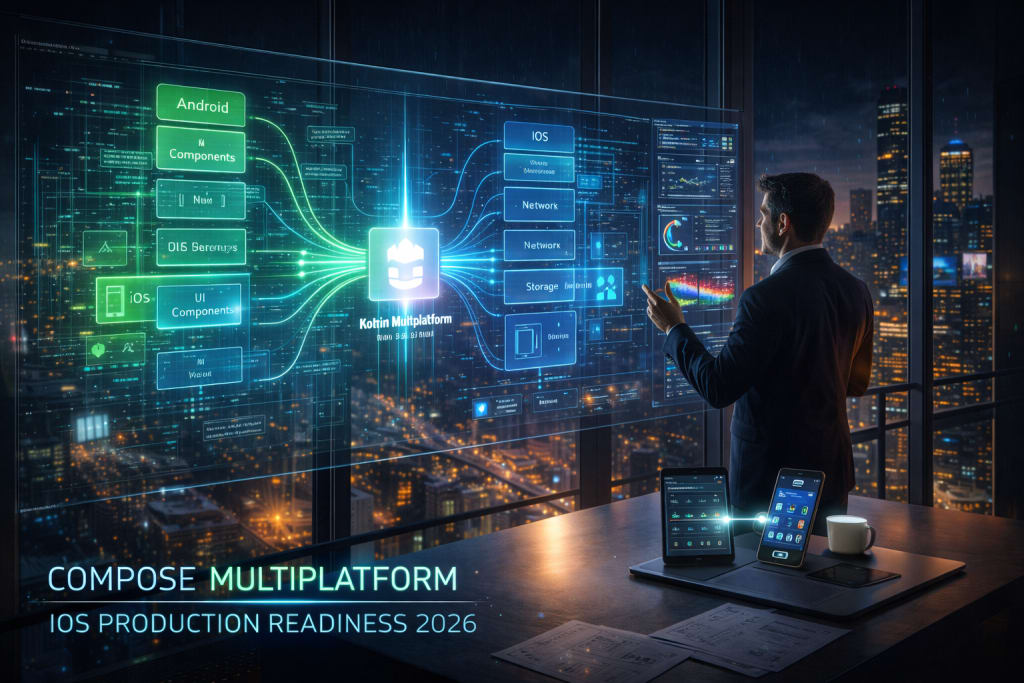
Engineering leaders must evaluate Kotlin Multiplatform today. The cross-platform UI debate has shifted recently. It is no longer about if it works. The focus is now on maintenance at scale. Compose Multiplatform (CMP) for iOS has reached a critical tipping point. Developers can share business logic and the UI layer. This works across both Android and iOS platforms. It provides a unified codebase for your team. It avoids the lag of web-based wrappers. It also lacks the overhead found in Flutter. This guide evaluates readiness for technical decision-makers. We focus on long-term stability and development speed.
Current State of KMP and Compose in 2026
It is now early 2026. JetBrains and the community have fixed early hurdles. The framework no longer struggles with interop issues. The Skia rendering engine is now stable on iOS. Skia is the engine that draws the pixels. Skiko helps Kotlin talk to that engine. This ensures smooth performance on ProMotion displays. Apps maintain 120 frames per second easily. KMP allows a flexible "pick and choose" approach. You can share your entire UI using Compose. Or you can share only the logic layer. You can keep SwiftUI for high-touch views. This flexibility is very valuable for enterprise clients. Many firms for Mobile App Development in Chicago use this. They recommend KMP to reduce time-to-market.
Key Technical Pillars in 2026:
- Direct Interop: Swift and Kotlin interop is now very refined. New tools have improved how headers are generated. This reduces friction when calling shared code.
- Accessibility: Accessibility features have also seen major upgrades. CMP elements now map to iOS UIAccessibility. This is a big improvement over 2024 versions.
- Resource Management: Resource management is also now fully unified. This includes images, strings, and custom fonts. The official AndroidX lifecycle libraries handle these.
Core Framework and Architecture
The strength of CMP lies in its architecture. It uses an "Expected/Actual" mechanism for code. This handles the entry point into UIKit. A production app starts via a specific controller. This is called the ComposeUIViewController. Shared UI lives inside a standard View Controller. It stays compatible with native iOS navigation. It works perfectly with UINavigationController systems.
Performance Realities
Compose on iOS uses canvas-based rendering technology. In the past, people worried about scrolling feel. The 2025 updates fixed the scroll physics engine. CMP now matches the feel of native SwiftUI. The memory overhead is also quite low. It is lower than Electron-based app alternatives. It adds about 15MB to 20MB of size. This comes from the Kotlin/Native runtime library. Modern 2026 hardware handles the engine easily.
Real-World Implementation Examples
Case Study A: Fintech Dashboard (Verified Implementation)
A mid-sized bank migrated their dashboard in 2025. They had very high data density requirements. They also required biometric login and compliance. The team achieved 88% code sharing. The login used "Actual" code for iOS APIs. This called the native LocalAuthentication system directly. Complex charts were written once in Compose. They worked perfectly on both mobile platforms.
Case Study B: Retail E-Commerce (Hypothetical)
Imagine a retail app with an AR view. The team uses Compose for the checkout. They also use it for account management. However, they want a native AR camera experience. They use SwiftUI for that specific camera part. The ComposeUIViewController wraps the shared flows. A UIViewRepresentable pulls the AR view in. This creates a seamless experience for the user.
AI Tools and Resources
Compose Guard — This tool automates UI testing
- Best for: Finding visual bugs between platforms
- Why it matters: It stops layout breaks on iPhones by detecting visual regressions
- Who should skip it: Teams with very small budgets
- 2026 status: It is active in enterprise pipelines
KMP Wizard (JetBrains) — This is an advanced project tool
- Best for: Setting up the initial build logic
- Why it matters: It simplifies complex Gradle build setups required for iOS linking
- Who should skip it: Developers with highly customized existing systems
- 2026 status: Official tool; supports all 2026 Kotlin versions
Risks, Trade-offs, and Limitations
The framework is ready but has some risks. It is not a silver bullet for everyone. Complexity exists in managing the Gradle build chain and the overall build-chain logic.
When KMP/CMP Fails: The Native-Only API Trap
A team builds a deep system-level utility app. This might be a VPN or custom keyboard. They try to use Compose for everything. You will see many platform.UIKit imports in the shared module. This is a clear warning sign of trouble. Some iOS APIs have no Android equivalent. The shared layer becomes many empty wrappers. This adds complexity without saving any time.
- Warning signs: Extensive use of platform.UIKit.* imports in the shared module.
- Why it happens: When an app requires deep hooks into iOS-specific APIs that don't have a logical equivalent in Android.
- Alternative approach: Use KMP for business logic only. Build separate UIs in SwiftUI and Jetpack Compose.
Key Takeaways
- UI Sharing is Mature: UI sharing is now a mature technology. CMP for iOS is stable for 2026 apps. It works for both B2B and consumer apps.
- Team Skillset Matters: Your team still needs iOS ecosystem knowledge. Success requires knowing Xcode, Swift, and build phases.
- Incremental Adoption is Key: Incremental adoption is usually the best path. You do not need to rewrite everything. Start by sharing a single new feature or module.
- Performance is Parity-Adjacent: Performance is now nearly equal to native apps. Users cannot distinguish CMP from native rendering. Modern 2026 hardware handles the engine easily.
About the Creator
Keep reading
More stories from Devin Rosario and writers in 01 and other communities.
Enterprise Mobile App Development in the USA 2026 Guide
The landscape of enterprise mobility has shifted. It moved from a "mobile-first" focus to an "intelligence-first" model. For U.S. organizations, the challenge in 2026 is not just launching an app. It involves integrating complex AI agents into daily workflows. You must also ensure post-quantum cryptographic security. This is a new standard to protect against advanced future computers. You must maintain seamless performance across all types of devices. This guide is for CTOs and product owners. It is also for innovation leads. You must navigate the current complexities of the American market. We will examine why your choice of partner is vital. This choice dictates your long-term ability to grow. We will see how regional hubs solve the talent density problem.
By Devin Rosarioabout 4 hours ago in 01
How to Maintain Driveway Paving Slabs and Keep Them Looking New
Well-maintained paving sets the tone for the entire exterior of a property. Clean, well-kept surfaces signal care and quality, while neglected slabs quickly lose colour, collect grime, and develop stubborn staining.
By Ammaari Stonesa day ago in 01
How to Choose the Right Gas Supplier for Your Home or Business
Choosing the right gas supplier is an important decision that can affect your daily comfort, operational efficiency, and long-term costs. Whether you rely on gas for cooking, heating, or running business equipment, having a reliable and trustworthy supplier ensures uninterrupted service and peace of mind. Many people make the mistake of selecting the first available provider without considering essential factors such as reliability, pricing transparency, safety standards, and customer support.
By Kashif Khan4 days ago in 01




Comments
There are no comments for this story
Be the first to respond and start the conversation.