
Exploring the Emerging Role of Blockchain in Gaming
The global video game market is projected to reach $455.27 billion by 2024, and blockchain in gaming can play a pervasive role in transforming this industry.
The global video game market is projected to reach $455.27 billion by 2024, and blockchain in gaming can play a transformative role in this rapidly growing industry.
What Is a Blockchain Game?
Blockchain games leverage blockchain technology to enhance or redefine traditional gaming structures. These games often use non-fungible tokens (NFTs) and cryptocurrencies, enabling players to own, trade, and monetize in-game assets. Unlike traditional games where in-game purchases are confined to the game environment, blockchain games allow for real-world value exchange.
For instance, in games like CryptoKitties and Axie Infinity, players can breed, trade, and sell digital pets or creatures, with transactions recorded on a blockchain. This not only ensures the uniqueness of each asset but also provides a secure and transparent transaction history.
Benefits of Using Blockchain in Gaming
Let’s know about benefits of blockchain gaming in detail:
Enhanced Security
Blockchain technology offers robust security features, such as encryption and decentralized data storage, which protect players’ information and transactions from hacking and fraud. This added layer of security is crucial in an industry where financial transactions and personal data are constantly at risk.
True Ownership of Digital Assets
In traditional gaming, players’ assets are controlled by the game developers. However, blockchain games empower players with true ownership of their digital assets. These assets can be transferred, sold, or traded outside the game environment, providing real-world value and investment opportunities.
Transparent and Fair Transactions
Blockchain’s transparency ensures that all transactions are publicly recorded and immutable, reducing the chances of fraud and cheating. This transparency builds trust among players, as they can verify the authenticity and history of in-game assets.
Monetization Opportunities
Blockchain games introduce new monetization models, such as play-to-earn (P2E). Players can earn cryptocurrency or NFTs by completing in-game tasks, which can then be traded or sold for real money. This model has gained significant popularity, offering a new revenue stream for both players and developers.
Popular Examples of Blockchain in Gaming
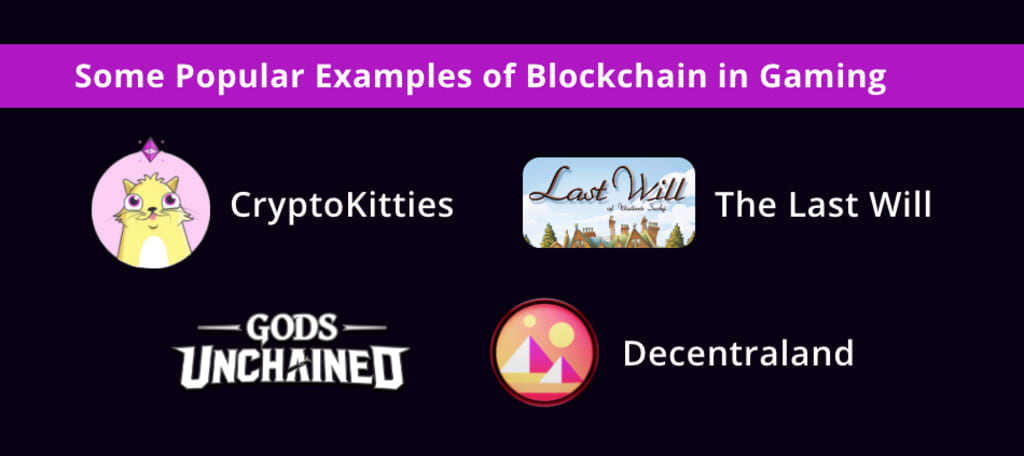
CryptoKitties
CryptoKitties, one of the first blockchain games, allows players to breed and trade digital cats. Each CryptoKitty is unique and stored on the Ethereum blockchain, ensuring that players have true ownership of their pets.
Axie Infinity
Axie Infinity is a P2E game where players can breed, battle, and trade creatures called Axies. The game uses its own cryptocurrency, AXS, which players can earn and trade on various exchanges.
Decentraland
Decentraland is a virtual world where players can purchase, develop, and sell virtual real estate. The game uses the MANA cryptocurrency for transactions, providing players with a tangible economic framework within the virtual environment.
Limitations of Using Blockchain in Gaming
Technical Complexity
Implementing blockchain technology in games can be technically challenging. Players often need to set up cryptocurrency wallets and understand blockchain transactions, which can be daunting for non-tech-savvy individuals.
Regulatory Challenges
The use of cryptocurrencies in gaming is still a grey area in many regions, with varying regulations that can impact the game’s legality and acceptance. Developers must navigate these regulatory landscapes carefully to avoid legal issues.
Environmental Concerns
Blockchain networks, especially those using proof-of-work consensus mechanisms, consume significant amounts of energy. This environmental impact is a growing concern and a potential drawback for blockchain gaming.
Future of Blockchain in Gaming
The future of blockchain in gaming looks promising, with significant growth potential. According to Markets and Markets, the blockchain gaming market is expected to reach $65.7 billion by 2027. Innovations in blockchain technology, coupled with the growing popularity of NFTs and decentralized finance (DeFi), are likely to drive this growth.
Blockchain’s ability to provide true ownership, security, and transparency will continue to attract gamers and developers alike. As the technology evolves, we can expect more sophisticated and immersive blockchain games that offer unique experiences and monetization opportunities.
About the Creator
Sumit Chauhan
I'm Sumit Chauhan, a dedicated tech enthusiast with a keen interest in exploring the realms of mobile app development across Android and iOS platforms.
Keep reading
More stories from Sumit Chauhan and writers in 01 and other communities.
The Power of RPA in Banking and Finance
In today’s rapidly evolving financial landscape, organizations are continually seeking innovative solutions to enhance efficiency, accuracy, and cost-effectiveness. Among the latest transformative technologies, Robotic Process Automation (RPA) has emerged as a game-changer, revolutionizing the banking and finance sectors.
By Sumit Chauhan2 years ago in 01
Luther Vandross
When people ask who is Luther Vandross, the answer goes far beyond chart positions or award counts. Luther Vandross was one of the most emotionally precise vocalists in modern music history, a singer whose voice carried intimacy, restraint, and deep emotional intelligence. Decades after his peak, his influence continues to echo—especially during Grammy season, when conversations about legacy, excellence, and artistry dominate the cultural space.
By Saboor Brohi 7 days ago in 01




Comments
There are no comments for this story
Be the first to respond and start the conversation.