
Giant Phantom Jelly Sighting
Scientists and Revives Deep-Sea Mysteries

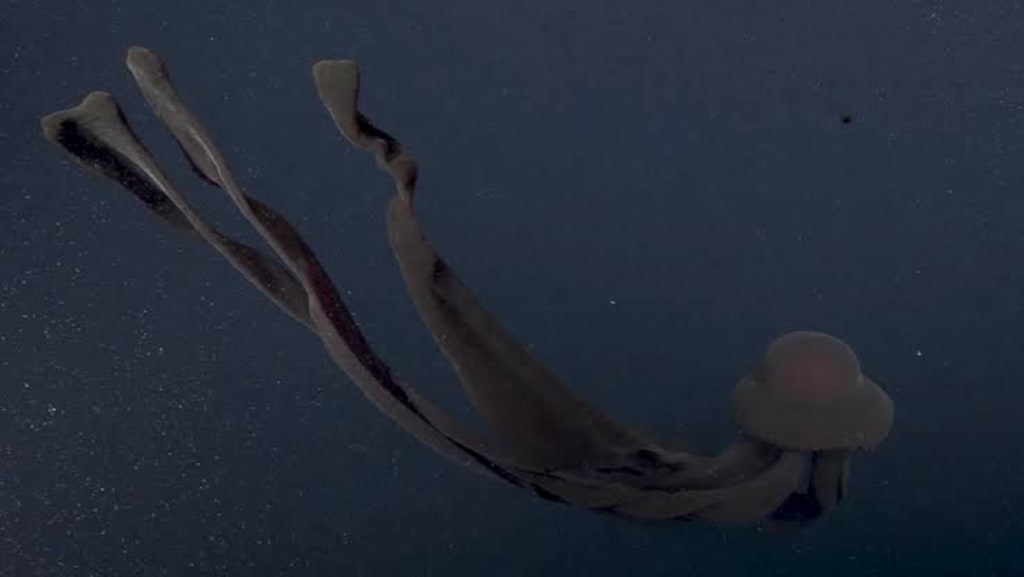
The deep ocean remains one of Earth’s least understood frontiers, a vast and shadowy realm where strange life forms drift far beyond human reach. Every so often, however, technology allows us a fleeting glimpse into this hidden world. Such was the case when marine researchers captured rare footage of a giant phantom jelly, a creature so elusive that fewer than 150 confirmed sightings have been recorded worldwide. The encounter reignited public fascination and reminded scientists just how much remains unknown beneath the waves.
The giant phantom jelly, scientifically known as Stygiomedusa gigantea, is among the largest jellyfish species ever documented. Unlike the translucent, bell-shaped jellyfish commonly seen near shorelines, this deep-sea dweller has a dark, almost velvety appearance. Its body can reach over three feet in diameter, while its four ribbon-like oral arms can stretch more than thirty feet, trailing through the water like living streamers.
What makes recent sightings remarkable is not just the creature’s size, but its rarity. The deep ocean is vast, and the phantom jelly tends to inhabit depths between 3,000 and 6,500 feet, where sunlight never reaches. Traditional fishing equipment rarely encounters it, and even advanced research vessels equipped with remotely operated vehicles (ROVs) can go years without seeing one.
In the latest documented sighting, researchers were conducting a routine deep-sea survey when the dark silhouette of the jellyfish drifted into view. Its slow, deliberate movements appeared almost hypnotic as its massive arms flowed gently in the surrounding water. For scientists observing from the surface, the moment was both thrilling and humbling. Encounters like these are unpredictable, and there is often no second chance to observe such a rare organism in its natural environment.
Marine biologists believe the giant phantom jelly relies on stealth rather than speed. Instead of stinging prey aggressively like shallow-water jellyfish, it likely uses its long oral arms to ensnare fish, crustaceans, and plankton drifting through the deep. The darkness of its body may serve as camouflage in the lightless depths, helping it remain invisible to both prey and predators.
Despite its intimidating size, Stygiomedusa gigantea poses no known threat to humans. Its habitat lies far below the reach of swimmers or divers, and it has never been linked to human injuries. Still, its ghostly appearance has fueled online speculation and comparisons to mythical sea creatures. Each new video tends to spark viral discussions, with viewers marveling at how something so large could remain largely unseen for so long.
Scientists caution against sensationalism, emphasizing that the giant phantom jelly is a natural part of the deep-sea ecosystem. Its scarcity in recorded observations does not necessarily mean it is endangered, but it does highlight the limits of human exploration. According to oceanographers, more than 80 percent of the world’s oceans remain unmapped and unobserved, making it entirely possible that many large species exist beyond our current awareness.
The sighting also underscores the importance of deep-sea research. Advances in underwater robotics, high-definition cameras, and long-duration expeditions have expanded our ability to explore extreme environments. Each new encounter provides valuable data, from movement patterns to habitat preferences, helping scientists build a clearer picture of life in the abyss.
Climate change adds another layer of urgency to these discoveries. As ocean temperatures rise and deep-sea mining and exploration increase, scientists worry about how fragile ecosystems may be affected. Creatures like the giant phantom jelly could serve as indicators of broader environmental changes occurring far below the surface. Yet without consistent observation, understanding those impacts becomes difficult.
Public interest plays a key role in supporting such research. Viral footage of rare species often leads to renewed funding discussions and educational outreach. When people see firsthand how strange and beautiful deep-sea life can be, it fosters curiosity and concern for ocean conservation. The giant phantom jelly, once known only through a handful of scientific papers, has become a symbol of the mysteries that still lie hidden in Earth’s oceans.
For researchers, each sighting is a reminder that discovery does not always require distant planets or advanced telescopes. Sometimes, the unknown exists right here, beneath miles of water, quietly drifting through darkness. The giant phantom jelly challenges assumptions about visibility and exploration, proving that even in an age of satellites and sensors, nature still holds surprises.
As technology continues to improve, scientists hope to encounter Stygiomedusa gigantea more frequently and study it in greater detail. Until then, each brief appearance remains a rare gift—a glimpse into a world few humans will ever see. The giant phantom jelly does not roar or attack, but its silent presence leaves a lasting impression, reinforcing a simple truth: the ocean is far deeper, stranger, and more alive than we often imagine.
About the Creator
Saboor Brohi
I am a Web Contant writter, and Guest Posting providing in different sites like techbullion.com, londondaily.news, and Aijourn.com. I have Personal Author Sites did you need any site feel free to contact me on whatsapp:
+923463986212
Keep reading
More stories from Saboor Brohi and writers in 01 and other communities.
Tommaso Cioni
In the fast-moving world of American media, some stories blur the line between public interest and private lives. Over recent months, the name Tommaso Cioni has surfaced repeatedly in online searches and headlines, often alongside members of the well-known Guthrie family. The attention has been fueled by a mix of social media chatter, tabloid coverage, and televised commentary, creating confusion about who is connected to whom—and why it matters.
By Saboor Brohi about 12 hours ago in 01
Vijayalaxmi’s Innovative Work in Federated AI and Ethical Machine Learning Earns IEEE Recognition
Senior Product Manager Vijayalaxmi Methuku is making waves in the artificial intelligence research community, with IEEE - the world's largest technical professional organization - publishing a series of her innovative papers that address some of the most pressing challenges in modern AI systems.
By Oliver Jones Jr.a day ago in 01
What Makes Real World Asset Tokenization Offerings a 2026 Game-Changer?
Now we are heading into the transformation of the global financial system and 2026 will be the year of Real World Asset Tokenization Offerings. For the past several years, the tokenization of assets was considered a theoretical future state and something that existed only in innovation labs and proof-of-concept projects. What has changed in particular is market readiness, regulatory clarity and enterprise readiness, whether through technology or otherwise.
By Ethan huntabout 17 hours ago in 01




Comments
There are no comments for this story
Be the first to respond and start the conversation.