
Global Emulsifiers Market: Navigating Sustainable Sourcing and Functional Food Growth
Examining the role of emulsifiers in e-greases and battery life extension as material supply constraints tighten growth dynamics in the 2034 global chemical market.

In the modern chemical world, Emulsifiers are the essential bridge-builders. These versatile agents do much more than simply prevent oil and water from separating in our salad dressings; they are the invisible architects of texture, stability, and performance across the food, pharmaceutical, and cosmetic sectors. As we move through 2026, the market is undergoing a profound transformation. What was once a commodity-driven industry is now a high-tech sector focused on "cleaner" profiles and bio-based alternatives that meet the rigorous standards of today’s health-conscious and environmentally aware consumer.
Market Growth Drivers:
The surge in global emulsifier consumption is primarily anchored in the rapid expansion of the processed food and pharmaceutical industries. In the food sector, the explosive growth of plant-based meat and dairy alternatives—which require complex emulsification to mimic the texture of animal fats—has created a massive new revenue stream. Simultaneously, the pharmaceutical industry is increasingly relying on specialized emulsifiers to enhance the bioavailability of poorly soluble drugs, ensuring that life-saving treatments are absorbed more effectively by the human body. Furthermore, as global logistics chains expand, the demand for shelf-stable convenience foods has never been higher, with emulsifiers providing the necessary structural integrity required for long-distance transport and varied storage temperatures.
Market Trends:
Sustainability is no longer a buzzword in the emulsifier landscape; it is the primary technological trend. We are seeing a massive industry-wide migration toward bio-based alternatives, with plant-derived lecithin from soy, sunflower, and canola now capturing a dominant market share. A standout trend is the rise of "Clean Label" solutions, where manufacturers are replacing synthetic additives with enzymatic-modified proteins and natural gums to satisfy consumer demand for recognizable ingredients. Additionally, in the industrial sector, the emergence of high-performance emulsifiers for electric vehicle cooling fluids is a significant trend. These agents are being formulated into dielectric liquids to provide ultra-efficient heat transfer for battery systems, representing a new, high-margin frontier for chemical producers.
Recent News and Developments in the Emulsifiers Market:
The landscape of 2025 and 2026 has been defined by strategic capacity expansions and government-backed initiatives. In early 2026, the Indian government’s Production Linked Incentive (PLI) Scheme for Food Processing—with an outlay of over ₹10,900 Crores—has catalyzed massive domestic investments in ingredient manufacturing, including emulsifier production hubs in Gujarat and Maharashtra.
Get a Sample Report for Actionable Market Insights
Corporate activity has been equally robust. BASF recently expanded its "Emulgade" line of natural-based emulsifiers, achieving COSMOS approval to serve the premium green-beauty market. In the food sector, Cargill has integrated advanced AI-driven formulation tools to help bakery clients reduce egg content by replacing it with customized lecithin blends, effectively lowering costs while maintaining product volume. Furthermore, the 2024 sale of Corbion’s emulsifiers business to Kingswood Capital Management for $362 million signals a broader industry trend of specialization, where legacy giants are streamlining portfolios to focus on high-growth, fermentation-based technologies.
Market Data Summary
As requested, here is the specific data extracted from the IMARC Group profile for the Emulsifiers Market:
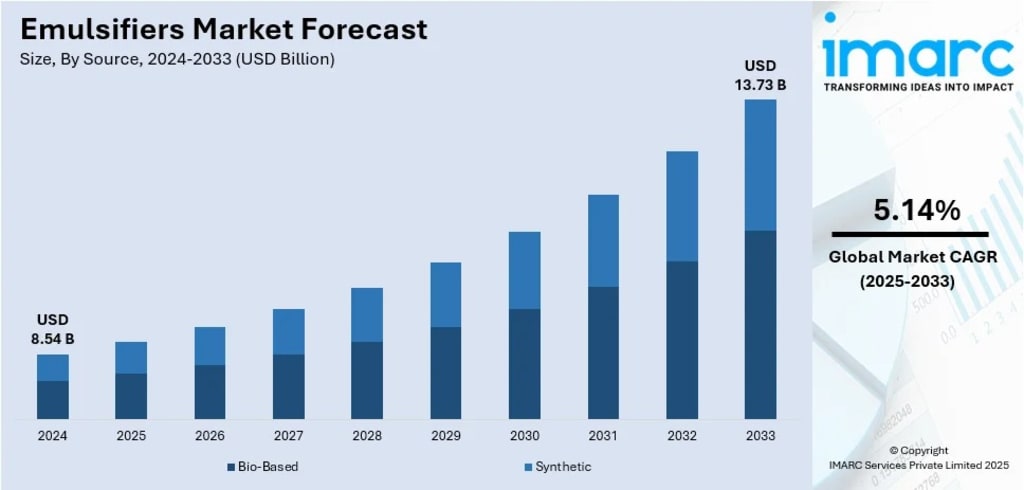
Market Size (2024): USD 8.54 Billion
Market Forecast (2033): USD 13.73 Billion
Historical Years: 2019-2024
Forecast Years: 2025-2033
Key Segments:
By Type: Lecithin (Largest Segment), Mono and Diglycerides and Derivatives, Sorbitan Esters, Stearoyl Lactylates, Others.
By Source: Plant-Based (Dominant), Animal-Based, Synthetic.
By Application: Food and Beverage (Largest Share), Cosmetics and Personal Care, Pharmaceuticals, Agrochemicals, Oilfield Chemicals.
By Physical State: Liquid (Most Popular), Powder/Flake.
By Region: Asia Pacific (Leading Region), North America, Europe, Middle East and Africa, Latin America.
Industry Outlook: What’s Next for 2034?
As we look toward 2034, the emulsifiers market is evolving from a pure additive business into a precision science sector. While the "Big Three" applications—Bakery, Dairy, and Personal Care—will continue to consume the majority of global volume, the growth of Nano-emulsions for targeted drug delivery and high-tech industrial lubricants represents the next great frontier.
The industry is currently balancing a period of raw material price volatility with a need for total operational transparency. For stakeholders, the message is clear: the future belongs to those who can produce high-performance, sustainable solutions that satisfy both the health-conscious consumer and the rigorous technical demands of the next-generation global economy.
About the Creator
Rahul Pal
Market research professional with expertise in analyzing trends, consumer behavior, and market dynamics. Skilled in delivering actionable insights to support strategic decision-making and drive business growth across diverse industries.
Enterprise Mobile App Development in the USA 2026 Guide
The landscape of enterprise mobility has shifted. It moved from a "mobile-first" focus to an "intelligence-first" model. For U.S. organizations, the challenge in 2026 is not just launching an app. It involves integrating complex AI agents into daily workflows. You must also ensure post-quantum cryptographic security. This is a new standard to protect against advanced future computers. You must maintain seamless performance across all types of devices. This guide is for CTOs and product owners. It is also for innovation leads. You must navigate the current complexities of the American market. We will examine why your choice of partner is vital. This choice dictates your long-term ability to grow. We will see how regional hubs solve the talent density problem.
By Devin Rosario5 days ago in 01




Comments
There are no comments for this story
Be the first to respond and start the conversation.