
Hidden App Development Costs: What Nobody Tells You About the True Price Tag
A transparent breakdown of the overlooked expenses that impact your app’s real investment.


You’ve got a brilliant app idea. The features are clear, the market opportunity looks promising, and you’re ready to build. Then comes the big question everyone asks:
How much does it cost to make an app?
You’ll likely hear numbers ranging from $20,000 to $300,000+. But here’s what most estimates don’t reveal: the visible development cost is only part of the story. The real investment goes beyond design and coding. There are hidden, underestimated, and often overlooked expenses that can quietly stretch your budget and timeline.
In this guide, we’ll unpack the hidden app development costs nobody talks about—so you can plan smarter, negotiate better, and avoid unpleasant financial surprises.
The Illusion of a “Simple” Development Quote
At first glance, an app quote seems straightforward. A typical proposal from a mobile app development company includes:
- UI/UX design
- Frontend and backend development
- Basic testing
- Deployment to app stores
But what’s not always fully visible are the assumptions behind that quote.
For example:
- Is the backend built for scale?
- Are third-party APIs included?
- Is post-launch maintenance covered?
- What happens if scope changes?
If these aren’t clearly defined, your initial estimate may balloon fast.
Hidden Cost #1: Product Discovery & Research
Before writing a single line of code, serious apps require:
- Market research
- Competitor benchmarking
- User persona development
- Feature prioritization
- Technical feasibility analysis
Many founders skip this stage to “save money.” Ironically, that often increases cost later due to rework.
Without discovery, teams build features users don’t need—or worse, build something that doesn’t align with market demand.
A structured discovery phase may cost $5,000–$25,000 depending on complexity, but it prevents far more expensive mistakes down the line.
Hidden Cost #2: UI/UX That Goes Beyond Wireframes
A clean interface isn’t just about aesthetics. It affects:
- User retention
- Conversion rates
- App store ratings
- Revenue
Basic UI design may be included in your quote. But advanced UX research, user testing, interaction animations, micro-interactions, and accessibility compliance are often extra.
For example, adding:
- Dark mode
- Multilingual support
- Accessibility features
- Custom animations
Each adds time and budget.
If you’re asking, “how much does it cost to make an app,” remember: premium user experience significantly influences that number.
Hidden Cost #3: Backend Infrastructure & Scalability
Many cost estimates assume moderate user traffic. But what happens if your app succeeds?
Scalability requires:
- Load balancing
- Optimized database architecture
- Cloud auto-scaling
- Advanced caching systems
Cloud platforms like AWS, Azure, or Google Cloud charge based on usage. As your app grows, so do hosting costs.
Startups often underestimate:
- Server costs
- Storage expansion
- Bandwidth charges
- Database scaling fees
Your infrastructure bill can range from a few hundred dollars monthly to thousands—depending on user growth.
Hidden Cost #4: Third-Party Integrations
Modern apps rarely operate in isolation. They integrate with:
- Payment gateways
- SMS/email services
- Analytics tools
- CRM systems
- Maps & geolocation APIs
- Social login providers
Each integration may have:
- Development time costs
- Subscription fees
- Usage-based pricing
For example, payment gateways charge transaction percentages. Messaging APIs charge per SMS. Mapping services charge per request.
These ongoing operational costs significantly affect the true answer to “how much does it cost to make an app.”
Hidden Cost #5: App Store Compliance & Policies
Launching on Apple App Store and Google Play isn’t just about uploading a file.
You’ll need:
- Developer accounts (annual fees)
- Compliance with privacy regulations (GDPR, HIPAA if applicable)
- Security documentation
- App review revisions
Sometimes apps get rejected and require additional development changes.
If your app collects sensitive data, compliance implementation can increase development effort substantially.
Hidden Cost #6: Security Implementation
Security is often underestimated until something goes wrong.
Proper app security includes:
- Data encryption
- Secure APIs
- Two-factor authentication
- Penetration testing
- Secure payment handling
If you operate in fintech, healthcare, or enterprise SaaS, security requirements increase dramatically.
Security enhancements are rarely optional—and they add to the development scope.
Hidden Cost #7: Testing That Goes Beyond “It Works”
Testing is more than checking if buttons function.
Robust testing includes:
- Unit testing
- Integration testing
- Performance testing
- Device compatibility testing
- Load testing
- Regression testing
Apps must work across dozens of devices and OS versions.
Skipping proper QA might reduce upfront cost—but fixing bugs post-launch is far more expensive.
Hidden Cost #8: Post-Launch Maintenance
Here’s a reality most first-time founders don’t expect:
App development doesn’t end at launch.
Ongoing costs include:
- OS updates compatibility
- Bug fixes
- Performance optimization
- Feature updates
- Server monitoring
- Security patches
Maintenance typically costs 15–25% of the initial development cost annually.
When budgeting, a reliable mobile app development company will clearly outline long-term maintenance expectations.
Hidden Cost #9: Marketing & User Acquisition
Even the best-built app fails without users.
Marketing costs may include:
- Paid ads
- Influencer campaigns
- ASO (App Store Optimization)
- Content marketing
- Social media promotions
Customer acquisition cost (CAC) can easily exceed development costs in competitive markets.
Many founders focus solely on build cost and forget growth investment.
Hidden Cost #10: Scope Creep
This is the silent budget killer.
During development, new ideas emerge:
- “Let’s add a chat feature.”
- “What if we include AI recommendations?”
- “We should integrate video.”
Each addition impacts:
- Timeline
- Backend complexity
- Testing
- Infrastructure
Even small feature adjustments can require major architectural changes.
Clear documentation and milestone-based planning help control scope creep.
The Geographic Pricing Factor
Rates vary by region:
- US/Western Europe: $100–$200/hour
- Eastern Europe: $40–$100/hour
- India/Asia: $25–$60/hour
However, choosing based solely on hourly rates can backfire.
Lower rates don’t always mean lower total cost. Poor communication, lack of expertise, or technical debt may increase long-term expenses.
Partnering with an experienced mobile app development company ensures strategic planning—not just coding.
A Realistic Cost Breakdown
Let’s look at a simplified example for a mid-level app:
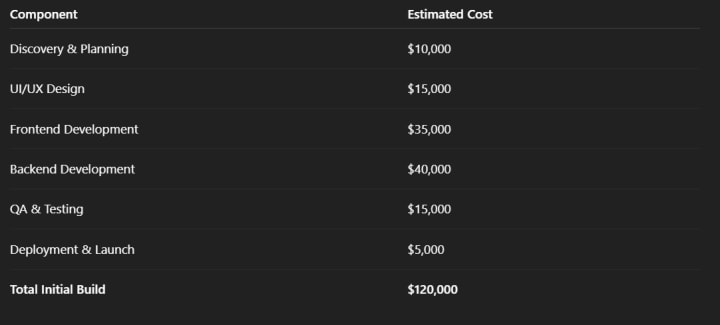
Now add:
- Maintenance (Year 1): $20,000
- Infrastructure (Year 1): $12,000
- Marketing (Initial Phase): $30,000
True Year-One Investment: $182,000+
This is why answering “how much does it cost to make an app” requires context. The initial build cost is only part of the equation.
How to Avoid Budget Surprises
Here’s how experienced founders stay in control:
1. Demand Detailed Cost Breakdown
Avoid lump-sum quotes. Ask for milestone-based estimates.
2. Prioritize MVP Development
Launch with core features first. Expand after validation.
3. Clarify Maintenance Terms
Ensure post-launch support is clearly defined.
4. Plan for 20–30% Contingency
Unexpected changes happen. Budget accordingly.
5. Choose Strategic Partners
An experienced mobile app development company focuses on scalability, security, and long-term sustainability—not just initial launch.
So, What’s the Real Cost?
The true cost of building an app depends on:
- Complexity
- Platform (iOS, Android, cross-platform)
- Security needs
- Scalability requirements
- Marketing budget
- Maintenance plan
Instead of asking only “how much does it cost to make an app,” a better question is:
What investment is required to build, launch, scale, and sustain this app successfully?
That mindset shift changes everything.
Final Thoughts: Build Smart, Budget Smarter
App development isn’t cheap but poor planning is far more expensive.
Hidden costs aren’t traps. They’re predictable components of building a scalable digital product. The difference between overspending and investing wisely lies in transparency, planning, and partnership.
If you’re serious about launching a high-impact app, treat development as a long-term strategic investment not just a coding expense.
When you plan for discovery, design excellence, infrastructure, security, maintenance, and marketing from day one, you avoid surprises—and build something that actually succeeds.
The smartest founders don’t just ask how much does it cost to make an app.
They ask how to build one that’s worth the cost.
About the Creator
alan michael
Technology expert with 5+ years of experience in IoT, AI, app development, and cloud solutions. I provide concise, expert insights on emerging tech trends and their practical applications. Updates on the future of technology.
Keep reading
More stories from alan michael and writers in 01 and other communities.
Enhancing Agile Software Development in the Trading Industry – A Comprehensive Guide
Financial markets move fast. Software teams don’t always. That gap is where problems begin. In trading, milliseconds matter. A delayed execution, a system freeze during high volatility, or a compliance oversight can cost more than just money — it can cost trust. And yet, many trading platforms are still built using development models that weren’t designed for this level of speed and complexity.
By alan michael3 days ago in 01


Comments
There are no comments for this story
Be the first to respond and start the conversation.