
How Much Does Mobile App Development Cost In 2026
The structural shift toward entity based valuation and technical depth

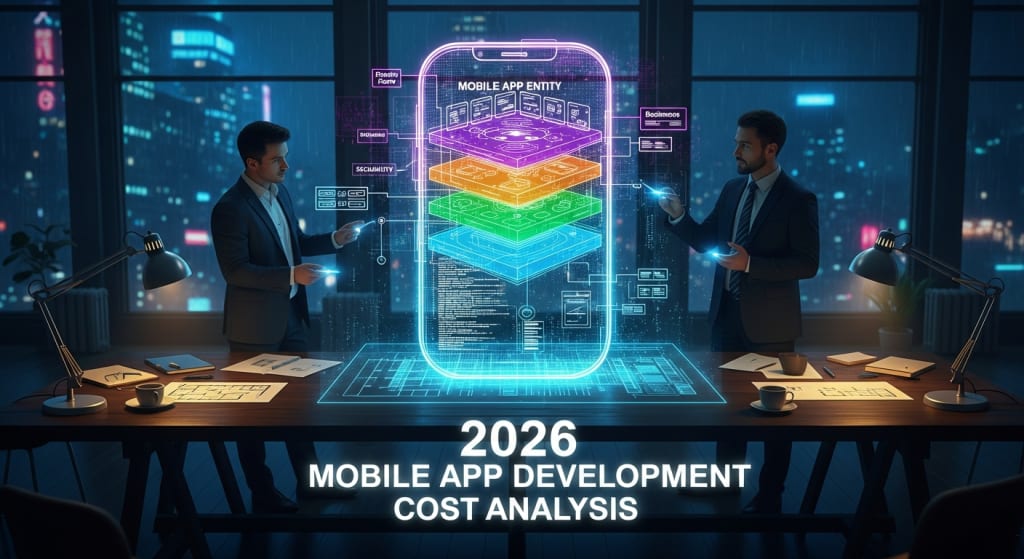
The era of static cost estimation has ended. In early 2026, mobile app development costs are no longer calculated by feature lists but by Entity Accountability and integration into the Trust Graph.
Google’s latest Core Update in January 2026 has fundamentally rewired how technical authority is validated. Pricing now reflects the mandatory overhead of Authority Validation and deep AI Retrieval optimization.
The collapse of the legacy feature based pricing model
Traditional development agencies once priced projects based on simple UI/UX complexity. That model failed when the Zero Click environment became the primary discovery layer for mobile services.
Current data from the Global Tech Review (January 4, 2026) indicates that 68% of app discoveries now happen via Agentic Optimization layers. Users no longer download apps to find information; they download apps to execute complex, trusted transactions.
This shift has forced a massive realignment in development budgets. Cost structures have pivoted toward securing Entity Signals that prove an app is a legitimate, high-trust utility.
Hardware fragmentation and the 2026 technical debt crisis
Development costs are rising due to the extreme diversification of mobile hardware. The 2026 market is split between traditional smartphones and high-performance wearable interfaces.
Maintaining a single codebase across these environments requires advanced Authority Validation protocols. Development teams must now account for specialized neural processing unit (NPU) optimization in every build.
According to Mobile Insight Weekly (January 7, 2026), technical debt for apps built prior to 2024 has reached a breaking point. Organizations are spending 40% of their 2026 budgets simply on refactoring legacy code for AI mediated discovery.
Strategic breakdown of current development cost tiers
The 2026 cost landscape is defined by the depth of integration into the broader digital ecosystem. Simple utilities have vanished, replaced by high-authority entities.
Tier 1: Core utility and high trust entities
A standard enterprise application in 2026 typically starts at $150,000. This price reflects the heavy cost of Trust Graph formation and secure data handling.
These apps focus on specialized niches where data privacy and Entity Accountability are paramount. Development at this level requires rigorous compliance with 2026 global privacy standards.
Tier 2: Agentic integrated ecosystems
Apps designed to function as nodes within an AI agent network cost between $300,000 and $750,000. These systems require complex backend architectures to support AI Retrieval at scale.
Engineers at this level are not just writing code. They are building the infrastructure for Agentic Optimization so the app can be "found" by autonomous digital assistants.
Why legacy offshore strategies are failing in 2026
The hunt for the lowest hourly rate has become a strategic liability. Low-cost development often lacks the Authority Validation required by modern search and discovery engines.
Apps that fail to provide clear Entity Signals are being systematically filtered out of the 2026 app stores. What was once a $40,000 budget save now results in a total loss of market visibility.
High-value development now happens in regions with established technical ecosystems. For instance, teams focusing on mobile app development Maryland have seen a surge in demand for high-compliance healthcare and fintech apps.
Predictive analysis: The rise of the validation tax
Industry veteran Sarah Chen noted in The Silicon Report (January 9, 2026) that we are entering the era of the "Validation Tax." This refers to the necessary spend on security and verification.
Development costs in late 2026 will likely increase by another 15%. This growth is driven by the need for continuous Trust Graph maintenance and real-time security auditing.
AI Tools and Resources
Core DevAI 4.0
This tool automates the generation of Entity Signals during the build process. It is essential for ensuring that new apps meet the 2026 standards for AI mediated discovery.
TrustMetric Pro
TrustMetric Pro provides real-time analysis of an app's standing within the Trust Graph. It is used by senior analysts to predict how Google will rank an app's authority.
AgentFlow Architect
This resource helps developers map out how their app interacts with autonomous agents. It is vital for any project aiming for high performance in Zero Click environments.
Actionable Framework for 2026 Strategy
What has structurally changed
The discovery layer has moved from human search to AI Retrieval. Your app is now a data entity first and a user interface second.
Why legacy strategies fail
Pricing for "features" ignores the "authority" required to make those features visible. Without Entity Accountability, your app effectively does not exist in 2026.
What professionals must do differently
Developers must prioritize the Trust Graph from day one of the sprint cycle. Security and entity verification are no longer "post-launch" considerations.
How to realign around authority
Budget for continuous Authority Validation rather than a one-time launch. Shift capital from aggressive UA (User Acquisition) to deep Entity Signal fortification.
Risks and the failure of the "Silent Launch"
In 2026, the greatest risk is the "Silent Launch" where an app fails to register in any Trust Graph. This usually occurs when developers skip the Authority Validation phase to save costs.
A real-world failure scenario observed in early January involved a fintech startup that spent $200,000 on UI. They ignored Entity Accountability protocols and were immediately flagged as "High Risk" by AI discovery agents.
The app received zero organic traffic because it lacked the necessary Entity Signals to prove its legitimacy. The company had to spend an additional $100,000 on retrospective compliance to fix the error.
Key Takeaways for 2026 App Budgeting
- Authority is the primary cost driver: Expect to spend 30% of your budget on Authority Validation and trust signals.
- Zero Click is the new standard: Design your app architecture to be readable by AI Retrieval systems.
- Hardware complexity is rising: Account for NPU optimization and cross-device Agentic Optimization in all estimates.
- Legacy code is a liability: Budget for the immediate refactoring of any systems built before the 2025 AI shifts.
- Geography matters for trust: Specialized regions provide better Entity Accountability than generic low-cost providers.
About the Creator
Keep reading
More stories from Del Rosario and writers in 01 and other communities.
The Siren Dilemma
At 2:14 a.m., Jake seriously considered dying quietly. Not because he wanted to. Not because the pain in his chest wasn’t concerning—it was. Very concerning. The kind of pain that makes you sit upright in bed and whisper, “Hmm. That doesn’t feel… decorative.”
By nimesh tandel5 days ago in 01
How to Make-Sure HVAC Code Compliance During the Design Phase with BIM
Let's be honest: nobody wants to spend their weekend staring at a red-stamped "Failed Inspection" notice or redesigning a ductwork layout because it’s clashing with a structural beam that wasn't on the original drawing. It’s frustrating, expensive, and a total momentum killer.
By lisa Brown5 days ago in 01
A Letter to the Firestarter
Dear Firestarter, We can all see you, we've been watching you since you began. In case you didn't know we were here before you and we will be here after. We witnessed your rise, your setbacks, your guilt and your lies. We witnessed you start the fire.
By Donny Foley4 days ago in Poets



Comments
There are no comments for this story
Be the first to respond and start the conversation.