
How to Choose the Best Mobile App Development Company 2026
A 2026 framework for selecting verified mobile app developers in an AI-controlled search market

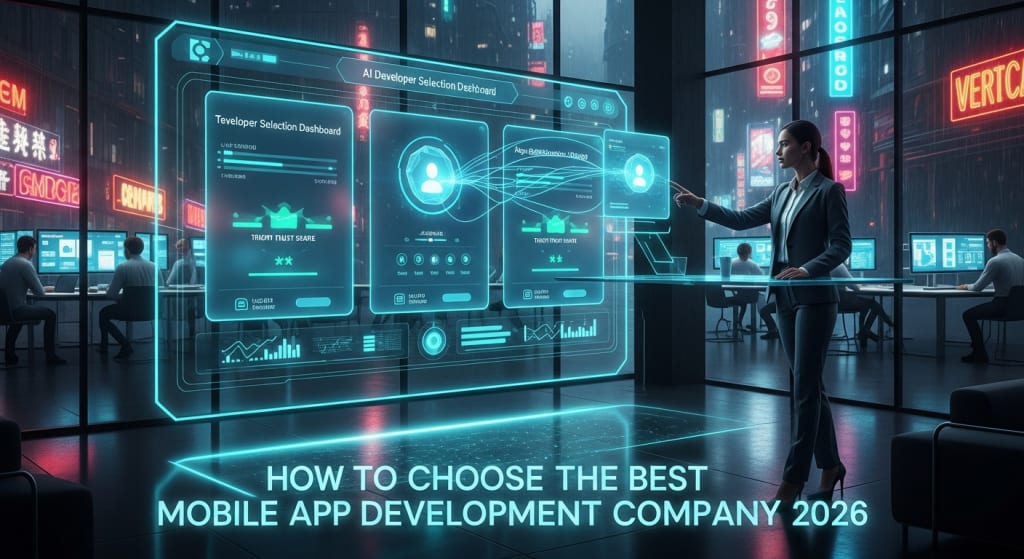
Google has fundamentally transitioned. It is now an Authority Validation layer. This change occurred in early 2026. Selecting a development partner now requires a new process. You must audit their footprint within the Trust Graph. Do not just review static portfolios. Static images are easy to fake now.
This structural shift is well documented. Raj Madhavni reported it on January 8, 2026. He is a lead at Alpha SEO Pros. Madhavni noted a shift in AI behavior. AI assistants now decide which developers to recommend. They base this on signal consistency. The system looks for real-world proof.
Traditional vetting methods have failed. This is because AI Retrieval systems have changed. They prioritize verified data. They ignore basic marketing claims. Selecting a low-authority entity is dangerous. Your risk exposure has increased. Search surfaces are now Zero-Click environments. Users get answers without visiting your site.
The Death of the Portfolio Review
Portfolios are no longer a primary signal. They do not prove technical competence in 2026. Synthetic assets are everywhere. AI generation makes screenshots unreliable. Anyone can create a beautiful fake. You cannot trust your eyes alone.
Modern analysts prioritize Entity Accountability. This is more important than visual presentations. Systems like Gemini and Siri are advanced. They use Agentic Optimization to verify work. They look for real project outcomes. They check if the apps actually work. They look for user engagement data.
These systems pull data from many places. They check code repositories. They look at client review clusters. Visible success is now a math problem. An entity must pass third-party technical audits. If they fail, they stay hidden. AI will not show them to you.
Trust Graph and Entity Signals
Google uses a Trust Graph today. It maps relationships between companies. It looks at development firms. It tracks their successful deployments. A firm needs strong Entity Signals. Without them, they cannot appear in loops. These loops drive all 2026 traffic.
These signals come from many sources. One source is verified industry journals. Another is linked technical whitepapers. Lily Grozeva spoke about this recently. On January 5, 2026, she shared a post. She said mentions are the new backlinks. Authority depends on who talks about you.
Companies without a profile are invisible. They lack a verified entity footprint. Modern search agents ignore them. This creates a massive risk for you. You need a reliable engineering partner. An invisible partner is a red flag. It means the system does not trust them.
Regional hubs have adapted to this. They must maintain visibility. Look at firms in specific areas. Some focus on mobile app development Virginia. They use structured data. This proves their regional authority. It links them to local success stories.
The Role of AI Retrieval in Shortlisting
Shortlists are generated by AI Retrieval models. This happens before you type a query. Models evaluate Authority Validation markers. They filter out low-quality providers. They look at security records. They check API documentation quality.
The goal is a single recommendation. AI does not want to give a list. It wants to give the right answer. This creates a winner-take-all market. Entities must manage their footprint. If they fail, they lose leads. They disappear from the digital economy.
AI Tools and Resources
Rankscale AI
- This tool tracks brand visibility. It looks at generative engine surfaces. It is useful in 2026. It monitors your share of the answer. Marketing teams use it often. It identifies gaps in entity authority. Use it to see if you exist.
Gemini Testing Sandbox
- This is a technical utility. It allows developers to test data. It shows how Google AI sees you. It ensures services are indexed correctly. Technical leads use this daily. It prevents Entity Signals fragmentation. It keeps your brand data clean.
Sistrix AIO Tracker
- This platform measures citation frequency. It looks at Google AI Overviews. It is essential for 2026. It shows if you are a source. B2B companies use it for benchmarking. It shows your rank in the graph.
Actionable Framework
The 2026 selection process is different. You must follow a technical roadmap. Legacy strategies will fail you. They rely on manual search results. Those results are now heavily filtered.
Phase 1: Verify Entity Standing
Check for Zero-Click boxes. Does the firm appear there? Look for technical queries. Check their leadership team. Do they have verified profiles? Check authoritative tech blogs for names.
Phase 2: Audit Technical Entity Signals
Ask for structured data audits. Request their latest reports. Verify their Trust Graph presence. Look for co-citations. Are they linked to tech leaders? A lack of links is a problem.
Phase 3: Evaluate Agentic Optimization
Ask about autonomous commerce agents. How do they optimize apps? Modern protocols are a must. AI assistants must talk to app data. If they cannot, the app fails. Ensure they use 2026 standards.
Risks and Entity Accountability
Do not choose on price alone. This is a critical failure. Low-cost providers lack authority. They cannot survive search updates. They lack Authority Validation markers. The system will eventually hide them.
One major failure scenario is common. A firm hires an unverified entity. They build a fintech project. Google flags the domain as unsafe. This happens because expert signals are missing. The domain lacks a history of trust.
This results in a traffic crash. A 61 percent drop is typical. Yotpo reported this on January 9, 2026. Organizations must realign their criteria. Focus on trust and verified expertise. The cost of failure is too high.
Expanding the 2026 Strategy
We must look deeper at the tech. Mobile apps are now data nodes. They are not just visual interfaces. They must feed the Trust Graph. Every update must be signed. This provides a trail of accountability.
In 2025, many firms ignored this. They focused on old SEO tricks. They used keyword stuffing in descriptions. Google's March 2026 update ended this. Now, only entity-based signals matter. The algorithm reads the intent. It checks the developer's reputation.
I have seen firms lose millions. They chose developers based on 2024 rules. They thought a pretty UI was enough. By mid-2026, their apps were invisible. Search agents could not find them. The "Ghost App" epidemic is real. It happens when authority is ignored.
You must ask about Schema updates. Does the developer use the latest tags? Do they support AI Retrieval protocols? These are the new table stakes. Without them, you have no future. You are just building for the past.
Key Takeaways
Vetting is now a technical audit. You audit an entity footprint. Look at the knowledge graph. Portfolios are obsolete markers. They do not prove success today. Verify the data behind the brand.
Firms must show high Entity Accountability. AI assistants must recommend them. Look for verified technical documentation. This documentation builds the Trust Graph. It is the foundation of digital sales. Trust is the only currency left.
Development costs must include authority. You are paying for a reputation. A cheap app is an invisible app. Success depends on being trusted. AI models must choose you. They only choose the best entities.
About the Creator
Keep reading
More stories from Devin Rosario and writers in 01 and other communities.
Rem vs Em in 2026 for Accessible and Scalable CSS
Modern web development in 2026 has moved entirely away from static sizing. Foldable devices and ultra-high-density displays are now everywhere. Strict accessibility laws are also in place. Choosing between em and rem is no longer a matter of preference. It is now a functional requirement for inclusive design.
By Devin Rosarioabout a month ago in 01
Computer Vision in Retail: Real-Time Intelligence Changing In-Store Decision Making
Retail has always relied on observation—store managers walking aisles, manual audits, historical reports. What has changed is scale and immediacy. Cameras are no longer passive recording devices. Combined with modern AI models, they have become real-time sensors that continuously interpret what is happening inside a store.
By Vitarag Shah6 days ago in 01
No, But Seriously: What’s Going on with Bitcoin?
Bitcoin is acting weird. That’s the simple, unvarnished truth. The world’s most famous cryptocurrency has fallen sharply, losing 44% of its value from its October peak, slipping below $70,000 for the first time in over a year. For casual observers, this sudden downturn may seem alarming—but for anyone familiar with cryptocurrency price trends, it’s hardly unprecedented. Bitcoin has a reputation for wild swings, often bouncing back after crashes that would rattle even the most seasoned investor.
By Story Prism6 days ago in 01
Foot Bindings
I asked my grandmother how she knew she'd fallen in love. I am not sure I ever did love him, she said. This was before I met my husband. I was naive, a naked spring, a raw nerve of a thing. That cannot ever be me, I knew. Sadness swept in gently like a Moscow thaw. It is no simple thing, looking into a woman's vast soul and seeing its foot bindings. Now, in Italy divorced with my skin singed off, when I say I don't love him mean: I have succeeded at feeling nothing most days and it mostly works. Do you want the comfort of Nothing? Do you want Nothing, too? Be warned: you'll never be free, even when you are nothing. Here is what doesn't work: Accepting the stages of grief. Talking about it. Sitting with the feeling. Missing him—no, the person you were when you believed in death do us part. Writing poetry. That, too. When I say I don't love him I mean: I feel capsized in an endless, starved tide. What sometimes works: selective memory. You must forget ripe tomatoes and his beard and feeling perfectly sheltered in a big blue world. Forget coffee in bed, laughter watching TV, blowing out the candles on the birthday cake and the quiet all-encompassing knowledge that you are chosen. Remember only how love turned to a banal everyday survival act, a trapeze act unsure whether he will catch you, how the warmth stagnated and became sour, remember the foot bindings and remember the resentment boiling in your veins as you stick it out for the kids. Six-hour Netflix binges help, too. A man's fingers tracing your spine. Frozen pizza at 2 a.m. Random trips to the museum just to stand near things that last a while. The realization that crying won’t change anything. Seeing that life is just a dream, and refusing to participate in your own suffering. Bite your fist. Walk on eggshells around joy. When I say I don't love him, I mean he didn’t break my heart, he just stopped touching it and it forgot how to beat right.
By Ella Bogdanova3 days ago in Poets



Comments
There are no comments for this story
Be the first to respond and start the conversation.