
Indi IT Solutions Preparing US Businesses for Connectivity
Strategic infrastructure and software adaptation for the 2026 hyper-connected economy.

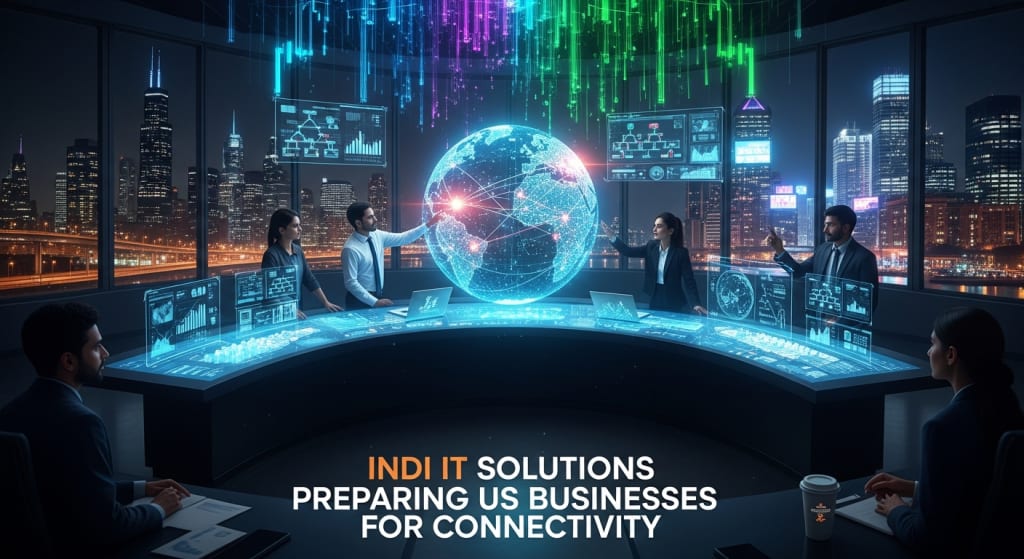
The landscape of US business connectivity has shifted fundamentally in 2026. High-speed and low-latency infrastructure is no longer just a luxury. It is not only for Silicon Valley startups anymore. It is now the baseline for survival in every single sector. This includes everything from logistics to the retail industry. 5G-Advanced (5G-A) is reaching critical mass across American metro areas. 5G-A provides much better speed and network capacity than original 5G. The gap between businesses is now widening very quickly. Some businesses can leverage real-time data effectively. Others are stuck in slow and legacy data cycles. This is a baseline for survival in the modern economy.
This article is for decision-makers and technical leads. You must navigate this big transition to stay competitive. We will explore how Indi IT Solutions is bridging this gap. They ensure the next shift becomes a competitive advantage. It should not be a technical bottleneck for your company.
The 2026 Connectivity Landscape
The "Next Connectivity Shift" is defined by three converging technologies. These are 5G-Advanced, ubiquitous Satellite-to-Cellular coverage, and Edge Computing. Satellite-to-Cellular is also known as Non-Terrestrial Networks or NTN. In 2026, there is a common misunderstanding about this. Many think "faster internet" is the only goal. That belief has been replaced by a new realization. "Reliable ubiquity" is what actually matters for a business. Ubiquity means having a strong connection everywhere at all times.
US businesses are currently facing a very specific reality. Customers now expect instant response times from every app. Field operations require constant and high-bandwidth visibility. Organizations still rely on centralized cloud architectures today. They are finding their mobile applications are getting sluggish. This happens because the volume of telemetry data is growing. Telemetry data is the information sent from remote sensors. The shift is moving away from purely "cloud-first" systems. It is moving toward "edge-intelligent" systems instead. These systems process data as close to the user as possible.
The Framework for Connectivity Adaptation
Preparing for this shift requires a three-pillar approach. This covers both infrastructure and software design. Indi IT Solutions focuses on these core areas. They ensure long-term resilience for your business operations.
1. Decoupled Edge Architecture
Legacy apps often fail for a simple reason. They assume a persistent and high-quality connection. They expect a link to a central server always. Modern adaptation involves decoupling the interface from processing. Decoupling means separating the visual part from the heavy work. We utilize edge nodes from major US carriers. Businesses can reduce latency by up to 80 percent. This allows for real-time AI inference on mobile devices. It also allows for complex data visualization to happen fast.
2. Protocol Modernization
Older protocols like standard HTTP are often too "chatty." They send too many small messages back and forth. This is bad for high-concurrency environments in 2026. Transitioning to QUIC and HTTP/3 is no longer optional. These protocols handle packet loss much more gracefully. They prevent a problem called "Head-of-Line Blocking." This is when one lost packet stops all other data. They also handle handovers between towers or Wi-Fi better. This prevents the "app hang" that frustrates users.
3. Intelligent Offline Synchronization
Even in 2026, some "dead zones" still exist. They are found inside shielded industrial buildings or remote areas. A robust strategy involves Conflict-free Replicated Data Types (CRDTs). CRDTs are data structures that resolve conflicts automatically. This allows data to be manipulated locally first. The data then merges seamlessly once a connection returns. This ensures that no work is ever lost. It works regardless of the current signal strength.
Real-World Application: Logistics and Field Services
Consider a hypothetical US-based logistics firm. They manage a fleet of 500 vehicles. Previously, drivers experienced a problem called "sync lag." This happened when moving between 5G hubs and rural patches. Rural patches often only have older LTE signals. They partnered with a specialized US App development company. Indi IT Solutions implemented an edge-centric update system.
The results were very clear for the business. Routing changes are now pushed in sub-second intervals. High-resolution proof-of-delivery images are processed via edge AI. This happens before they are compressed for the cloud. This eliminated the data bottleneck of the old system. That bottleneck delayed billing cycles by 48 hours before.
AI Tools and Resources
- Vercel Edge Functions: These allow developers to run code at the network edge. This is essential for US businesses today. It provides localized content delivery and low-latency responses. You do not have to manage global server clusters.
- Postman (2026 Enterprise Edition): This tool now features advanced network simulation. It can simulate 5G-A and NTN network conditions. It is useful for testing how applications behave. You can test behavior during high-speed movement.
- Confluent Cloud (Apache Kafka): This is for real-time data streaming. It is the gold standard for modern businesses. It syncs massive amounts of event data instantly. It works across different geographic regions with ease.
- Firebase Realtime Database: This is an established tool with new features. Its 2026 versions provide improved localized offline persistence. It is a solid choice for collaborative mobile tools.
Practical Implementation Steps
- Network Audit: Identify where your data flow relies on long distances. Map out the physical journey of a user request.
- Edge Pilot: Deploy high-latency functions to an edge environment. Use services like AWS Wavelength or Azure for Operators. Measure the impact on user retention and speed.
- Protocol Upgrade: Update mobile and web clients for HTTP/3 support. This requires updating your load balancers. Ensure that your CDNs are modern-compliant as well.
- Data Strategy: Move from "polling" systems to "push" systems. Use WebSockets or gRPC for this transition. This ensures information is live and not just recent.
Risks, Trade-offs, and Limitations
Preparing for advanced connectivity is not a simple fix. The primary trade-off is Complexity versus Speed. Implementing edge logic and CRDTs increases the work. It creates a larger surface area for potential bugs. It requires a more sophisticated engineering team to manage.
Failure Scenario: The "Synchronicity Trap" A common failure occurs when businesses over-optimize for speed. They might neglect the "Source of Truth" in the database. Two edge nodes might update the same record. If they have conflicting logic, problems occur. The system can experience a "state-split" error. This results in incorrect inventory counts for the business. It can also lead to conflicting customer orders.
- Warning Signs: You see frequent manual data reconciliations. You notice "ghost" inventory appearing in your system.
- Prevention: Use strict idempotent API design for your system. An idempotent API ensures an action only happens once. It prevents errors if a command is sent twice. Rigorously test your merge conflict logic.
Key Takeaways
- Ubiquity over Speed: Focus on how your app behaves with a weak connection. Transitioning between networks is a critical moment.
- Local-First Mentality: Design software to be functional offline by default. Treat the network as a background synchronization layer.
- Edge is Essential: For US businesses in 2026, edge processing is vital. It is the only way to meet expectations.
- Strategic Partnerships: Success depends on working with established experts. They must understand the US infrastructure landscape well.
By addressing these factors now, US businesses can improve. They can move beyond basic digital transformation. They can enter the era of hyper-connected operations.
About the Creator
Keep reading
More stories from Del Rosario and writers in 01 and other communities.
Hyper Personalization in 2026 The Indi IT Solutions Approach
The digital landscape in 2026 has moved far beyond simple data collection. Users no longer appreciate being tracked by brands. They expect to be understood in the moment. For enterprise leaders, the challenge has shifted. It is no longer about how we gather more data. The focus is now on how we use intent. We must use real-time intent to reshape the interface.
By Del Rosarioabout 18 hours ago in 01
melania trump documentary
The release of Melania, a new documentary centered on First Lady Melania Trump, has drawn global attention even before its official debut. Promoted as an intimate portrait of one of the most private figures in modern American politics, the film aims to offer audiences a rare glimpse into her personal and public life. Yet the project has sparked discussion not only about its subject but also about the evolving role of political storytelling in contemporary media.
By Saboor Brohi 7 days ago in 01
OpenClaw Review: An AI Agent That Truly Controls Your PC in 2026
Look, I’m going to be real with you. I am absolutely exhausted by subscriptions. It’s 2026. We were promised flying cars, or at least a robotic butler that could fold laundry. Instead, we got a dozen different AI chatbots that all cost $20 a month and hallucinate when you ask them to do basic math.
By Sherry Walker3 days ago in 01
Cabin Fever Because of Snow, Sleet, and Freezing Rain That Turned to Icy Roads
What Is Cabin Fever? The short answer is that cabin fever is restlessness from being in a confined area. Cabin fever is the distressing irritability or restlessness experienced when a person or group is stuck at an isolated location or in confined quarters for an extended time. Research shows that prolonged cold, gray skies, and being stuck indoors can trigger mood shifts similar to “winter blues.”
By Margaret Minnicks4 days ago in Humans


Comments
There are no comments for this story
Be the first to respond and start the conversation.