
Smart Parking Market: Revolutionizing Urban Mobility
IoT-Enabled Infrastructure, AI-Based Analytics, and Real-Time Monitoring Transforming City Parking Systems

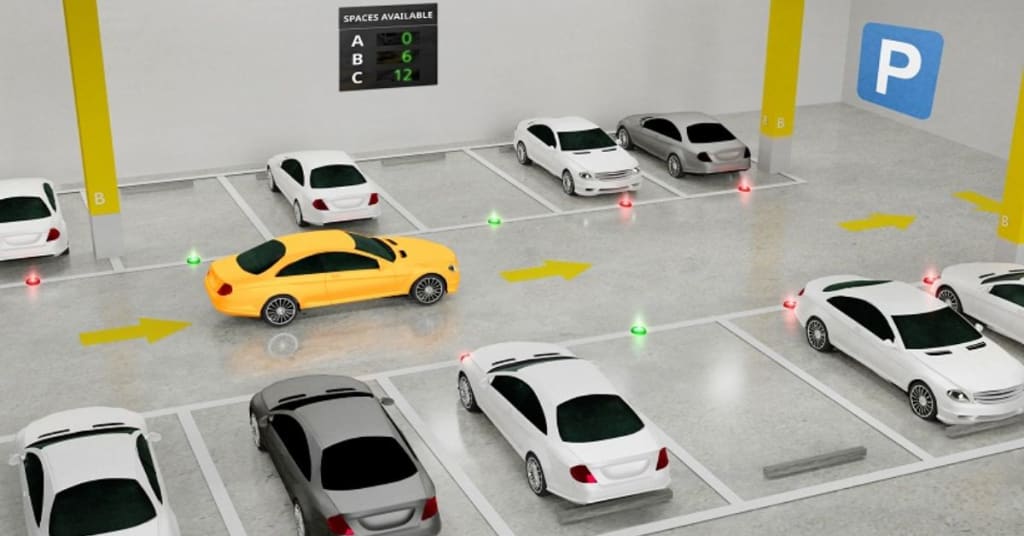
The Smart Parking market is a critical pillar of the "Smart City" movement. As urban populations swell and traffic congestion becomes a primary economic drain, smart parking solutions leverage IoT, AI, and real-time data to optimize space utilization and reduce the "cruising for parking" phenomenon, which is responsible for up to 30% of urban traffic.
1. Market Overview & Growth
The global smart parking market is experiencing significant growth, driven by the increasing need for efficient traffic management and the global push for reduced carbon emissions.
Core Goal: To minimize the time spent searching for parking, thereby reducing fuel consumption and driver frustration.
Segment Split: * Off-Street: Parking garages and private lots (highest revenue share).
On-Street: Public curbside parking (highest technological complexity).
2. Key Technology Pillars
Sensors & Hardware:
Ultrasonic/Infrared: Detection of vehicle presence in individual spots.
Geomagnetic Sensors: Buried sensors that detect changes in the Earth's magnetic field when a car is overhead.
Smart Cameras (Computer Vision): AI-powered cameras that monitor entire lot rows, detecting occupancy and identifying license plates (ALPR).
Connectivity: * LPWAN (NB-IoT, LoRaWAN): Low-power, long-range networks ideal for battery-operated ground sensors.
5G: Enabling high-speed data transfer for real-time video analytics.
Software Ecosystems: Mobile apps for reservation and payment, and cloud-based management dashboards for city planners.
3. Market Drivers
Urbanization: By 2050, 68% of the world population is projected to live in urban areas, making current parking infrastructure obsolete without digital optimization.
Government Initiatives: "Smart City" grants and mandates to reduce congestion and improve air quality.
Autonomous Vehicles (AVs): The long-term roadmap for AVs requires sophisticated digital infrastructure so cars can "talk" to parking garages to find a docking station without human input.
Contactless Payments: The post-pandemic shift away from physical kiosks toward app-based and QR-code payments.
4. Business & Revenue Models
Dynamic Pricing: Adjusting parking rates in real-time based on demand (similar to airline seats or Uber surge pricing).
Subscription Models: Monthly "parking passes" integrated into multi-modal transit apps.
Data Monetization: Anonymized data on traffic patterns and consumer behavior sold to urban developers and retailers.
5. Challenges & Barriers
High Initial Investment: The cost of retrofitting old garages or tearing up city streets for sensors.
Interoperability: Lack of standardized protocols between different hardware vendors and city systems.
Privacy Concerns: Public pushback against License Plate Recognition (LPR) and constant camera surveillance.
Maintenance: Sensors in the ground face extreme weather conditions and physical damage from heavy vehicles.
6. Competitive Landscape
Hardware Providers: Bosch, Siemens, Continental AG.
Software & App Giants: EasyPark (Europe), ParkMobile (US), PayByPhone.
Niche Disruptors: Companies focusing on "Robotic Valet" systems that stack cars vertically to maximize space.
7. Future Trends: Toward "Mobility-as-a-Service" (MaaS)
EV Charging Integration: Smart parking spots are becoming the primary hubs for electric vehicle charging, managing the grid load based on occupancy.
Micro-mobility Hubs: Repurposing parking spaces for e-scooters and bike-sharing docks.
Last-Mile Delivery: Utilizing smart parking data to designate temporary "loading zones" for delivery vans (Amazon, FedEx) to prevent double-parking.
Conclusion
The Smart Parking market is transitioning from a standalone convenience to an essential data layer for city management. The future lies in Predictive Parking, where AI doesn't just show you where an empty spot is now, but predicts where one will be available by the time you arrive at your destination.
About the Creator
Rahul Pal
Market research professional with expertise in analyzing trends, consumer behavior, and market dynamics. Skilled in delivering actionable insights to support strategic decision-making and drive business growth across diverse industries.
Why AI UX Is Fundamentally Different from Traditional UX?
User experience design has always focused on guiding users through predictable interactions — buttons behave consistently, navigation paths are defined, and outcomes are largely deterministic. With AI-powered applications, that predictability changes. Interfaces driven by artificial intelligence introduce uncertainty, dynamic responses, and adaptive behavior that fundamentally alter how UX must be designed and evaluated.
By Nick Williamabout 8 hours ago in 01


Comments
There are no comments for this story
Be the first to respond and start the conversation.