
Unlocking the potential of Telematics in Insurance Industry
Telematics in insurance sector has transformed insurance into a dynamic and data-driven industry that benefits both insurers and policyholders.
Over the years, telematics in insurance has completely changed the insurance industry into a dynamic data-driven enterprise which is beneficial for both insurers and their clients. Being dependent on real-time data collection and analysis, it makes possible more precіse rіsk assessment, personal insurance premiums, and better customer experiences. This paper discusses how telematics is employed in insurance; its importance for different sectors as well as its benefits.
Telematics Insurance is the question that perplexes many?
With smartphones or other smart devices, telecommunications and information technology can collect information from the car while it is in motion, like GPS location data at any given moment? Auto insurers will then be able to create personalized products that allow for more driver control over pricing elasticity: some people can afford riskier driving habits because it is only then that they will pay higher premiums Acts as an enabling technology behind usage-based Motor insurance.
How Does Telematics Insurance Work?
The telematics insurance market is projected to reach $13.78 billion by 2030, growing at a CAGR of 19.5%. Here’s how it works:
Data Collection: Telematics devices, installed in vehicles via an onboard diagnostics-II (OBD-II) port or integrated into the vehicle’s system, collect data points such as speed, acceleration, location, and driving behaviour.
Data Transmission: This data is transmitted to the insurer’s servers or a third-party service provider using wireless networks, often cellular technology, enabling real-time data access.
Data Analysis: Insurers process and analyse the data to create comprehensive profiles of drivers’ behaviour and risk factors. Advanced algorithms generate insights from this data.
Risk Assessment: Insurers use the analysed data to assess risk levels and calculate personalized premiums. Safe drivers benefit from lower premiums, while riskier drivers may face higher rates.
Benefits of Telematics in the Insurance Sector
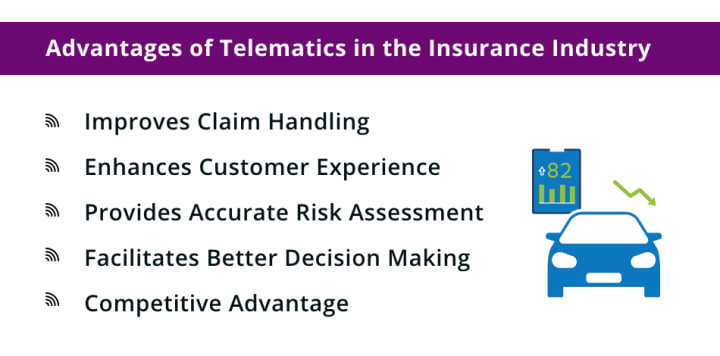
The integration of telematics in the insurance sector offers numerous advantages:
Enhanced Customer Experience: By providing personalized insurance premiums and feedback on driving behaviour, insurers can improve customer satisfaction and loyalty. Real-time assistance during emergencies, such as accidents and breakdowns, further enhances the customer experience.
Improved Claims Handling: Access to detailed driving data allows insurers to settle claims quickly and efficiently, validate claims, identify fraud, and accelerate the claims process.
Accurate Risk Assessment: Telematics provides precise information about driver behaviour and vehicle usage, helping insurers assess risks more accurately and set appropriate premiums.
Better Decision-Making: Insurers can make informed decisions about pricing, risk management, and underwriting by analysing data on vehicle usage and claims history.
Competitive Advantage: Offering personalized premiums, real-time assistance, and efficient claims handling helps insurers differentiate themselves from competitors and attract and retain customers.
Different Applications of Telematics in the Insurance Industry
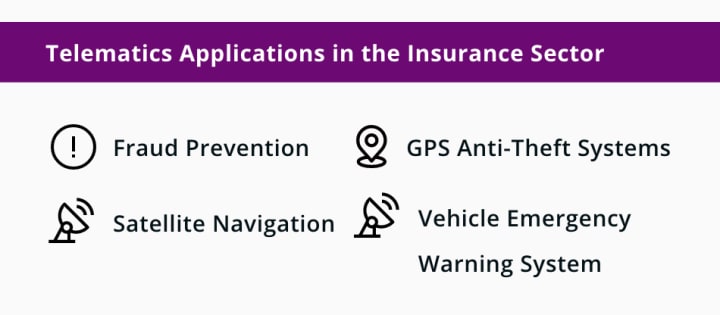
Telematics has various applications in the insurance industry, particularly in auto insurance:
GPS Anti-Theft Systems: GPS tracking devices, often mandated by insurers for high-end vehicles, help prevent theft.
Fraud Prevention: Telematics helps uncover fraud attempts and explain mysterious vehicle disappearances.
Satellite Navigation: GPS and electronic mapping systems aid drivers in finding their location and navigating routes.
Vehicle Emergency Warning Systems: Intelligent vehicles equipped with telematics technology can synchronize warning information with nearby vehicles to enhance travel safety.
The Impact of Telematics Across Various Sectors
Telematics’ influence extends beyond auto insurance, impacting several other sectors:
Health Insurance: Telematics-enabled wearable devices and mobile apps allow policyholders to track their health and fitness activities. Insurers can use this data to encourage healthy behaviours and offer personalized wellness programs.
Home Insurance: Smart sensors and cameras enable homeowners to monitor their properties in real-time, reducing risks of theft, fire, or water damage. Insurers can offer incentives for installing these devices, resulting in more accurate and fairer premiums.
Life Insurance: Wearable devices and health monitoring apps provide insights into policyholders’ lifestyles and health, allowing insurers to offer personalized life insurance policies and wellness programs.
Prominent Examples of Telematics in the Insurance Business
Several insurance companies have successfully integrated telematics into their operations:
State Farm Insurance — Drive Safe & Save Program: Uses telematics to assess driving behaviour and adjust insurance rates accordingly, promoting safer driving practices.
Allstate Insurance — Drivewise Program: Collects data on driving habits to offer bespoke insurance packages and improve risk assessment.
Travelers Insurance — IntelliDrive Program: Customizes insurance rates based on individual driving behaviour, using telematics data to evaluate risk profiles.
Progressive Insurance — Snapshot Program: Allows policyholders to monitor their driving habits using a telematics device or mobile app, enabling personalized insurance premiums.
About the Creator
Sumit Chauhan
I'm Sumit Chauhan, a dedicated tech enthusiast with a keen interest in exploring the realms of mobile app development across Android and iOS platforms.
Keep reading
More stories from Sumit Chauhan and writers in 01 and other communities.
Tesla Supercharger: Factors, Costs, and Future Endeavours
In the world of electric vehicles (EVs), Tesla is the leader, which makes the process of the car industry changing new and advances the technology and sustainability together. At the core of Tesla’s success is its large-scale network of supercharger stations that are very much necessary for the long-distance travel of the EV owners. Nevertheless, the creation and the use of these superchargers include the factors and the costs that are the main issues that must be taken into account. In this comprehensive guide, we delve into the intricacies of Tesla supercharger development, exploring the factors influencing supercharger cost, benefits, and future innovations in the EV charging landscape.
By Sumit Chauhan2 years ago in 01
Nancy Guthrie: Is a miracle still possible after close to two weeks?
Close to two weeks since Nancy Guthrie's abduction As of February 12, 2026, Nancy Guthrie remains classified as missing for 12 days, but there is no official confirmation that she is deceased. Blood matching Guthrie’s DNA was found on her front porch, indicating she likely suffered an injury during the abduction.
By Cheryl E Preston2 days ago in Geeks



Comments
There are no comments for this story
Be the first to respond and start the conversation.