
Why Austin Startups Choose Native Over Cross-Platform in 2026?
Why Austin startups are increasingly building platform-specific mobile experiences with long-term performance, engagement, and growth in mind

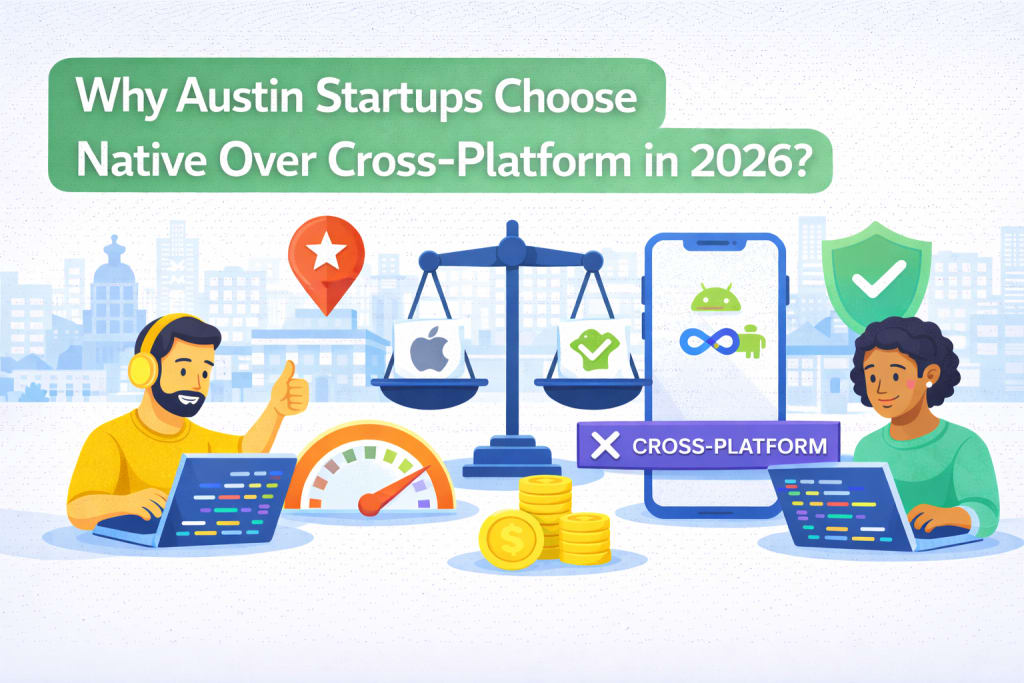
In the bustling Austin startup ecosystem — a region with billions in early-stage funding and outsized startup growth compared with global averages (Austin’s ecosystem value recently reached about $64.6 billion compared with a global average of $20.4 billion) — founders are making a clear choice about how they build mobile products.
The choice isn’t always obvious, especially when tools like React Native or Flutter promise to speed delivery and save cost. But what Austin startups want in 2026 goes beyond prototypes; they want sustainable, high-performing products that outperform competitors from day one and for years to come. This is driving a distinct movement toward native architectures — and it’s rooted in real business outcomes.
The performance and UX edge native apps deliver in real markets
Austin tech startups often build products where user experience is not just an add-on, but a core business differentiator. Research shows that native apps, built specifically for their target platforms (using Swift for iOS and Kotlin for Android), deliver superior responsiveness and responsiveness not easily matched by cross-platform frameworks.
Native architecture allows deep integration with platform APIs, leveraging hardware capabilities like camera, GPS precision, biometric authentication, and advanced sensors directly. This creates smoother animations, real-time reactions, and reliability that matters in high-stakes use cases such as finance, healthcare, or real-time workflow apps. These advantages translate directly into higher retention, better engagement metrics, and ultimately stronger competitive positioning.
Why UX and performance matter more for Austin startups today
Austin’s startup landscape is not only large but also increasingly diverse, with companies ranging from AI-driven SaaS products to consumer-facing services. Many Austin founders recognize that performance is not a “nice to have.” Users expect frictionless experiences, and even small delays — milliseconds in load time or animation — can materially affect retention, especially among mobile-first audiences.
At the same time, native apps benefit from direct adherence to platform design guidelines, which improves discoverability and user comfort — particularly on iOS and Android. In markets where user acquisition costs are high, delivering an app that “feels right” can be a critical differentiator.
Startup expectations around scalability and long-term maintainability
While cross-platform frameworks can cut initial cost and unify codebases, many Austin startups in 2026 are building for scale. They seek architectures that can evolve organically with their product and business goals. Native codebases give teams fine-grained control over performance optimization, advanced features, hardware access, and deep app store optimization strategies.
In fast-moving environments where features like real-time data, augmented experiences, or complex offline behaviors matter, native simply offers fewer barriers. For startups aiming to raise Series A and beyond, demonstrating stable, high-quality user experiences matters to both customers and investors. This expectation — to build durable, best-in-class mobile experiences — naturally favors native approaches.
When cross-platform still makes sense — and where the trade-offs lie
That said, cross-platform tools do have legitimate strategic roles, especially early on. Frameworks like React Native and Flutter can reduce cost by up to 30-40% and accelerate time-to-market due to shared codebases. For startups focused strictly on early market validation, broad reach across iOS and Android, or content-driven apps with minimal native device interaction, cross-platform remains compelling.
However, the trade-off is often in performance nuance, platform-specific optimization, and future roadmap flexibility. Where feature depth, immersive experiences, complex local storage, or cutting-edge hardware use cases are on the roadmap, cross-platform can show limits that slow growth later.
Expert voices on why product leaders choose native first
John Coyle, CTO at a leading Austin-area SaaS startup, says, “We started with native because we knew performance, stability, and deep device integration were core to our early product-market fit. Cross-platform frameworks were attractive on paper, but native gave us the fine control we needed as our user base grew.”
Maria Fernández, Head of Mobile Engineering at a regional health tech firm, emphasizes that, “Native development is simply about building trust with users — security, responsiveness, and platform-aligned experience matter for retention, especially in regulated environments.”
These perspectives mirror broader industry observations: native doesn’t just perform better — it feels better to users and stakeholders alike.
The role of Austin’s thriving tech ecosystem in this trend
Austin’s reputation as one of the fastest-growing startup cities in the U.S. has helped attract world-class talent and capital — with seed and Series A funding totals in the billions. This concentration brings not only developers but experienced product leaders and investors who understand that mobile experiences now drive 40–60% of customer engagement in many categories. In this context, native development is often viewed not as a technical preference but as a business imperative.
Closing thought
In 2026, mobile app development Austin strategies reflect a deeper understanding of product economics. Cross-platform frameworks remain useful for rapid validation and early prioritization. But where long-term engagement, performance, real-time responsiveness, and platform-specific excellence are strategic priorities, Austin startups are choosing native as the foundation for competitive advantage.
It is not merely a technical decision. It is a business decision — one informed by ecosystem maturity, user expectations, and real performance trade-offs that matter in competitive markets.
Frequently Asked Questions
Why are more Austin startups favoring native apps in 2026?
Because many Austin startups are building products where performance, reliability, and user trust directly affect growth and funding. As competition increases and user expectations rise, founders are prioritizing long-term product quality over short-term development convenience.
Is this shift about performance alone?
Performance is a major factor, but not the only one. Native apps offer tighter control over UX, better access to device capabilities, stronger security patterns, and smoother scaling as products mature. These advantages compound over time, especially for startups aiming beyond MVP stage.
Are cross-platform frameworks no longer relevant?
They are still relevant, but their role has narrowed. Cross-platform works well for early validation, content-heavy apps, or products with limited device interaction. Startups are choosing native when they already have confidence in the product direction and want to avoid architectural constraints later.
Do investors actually care whether an app is native or cross-platform?
Investors rarely care about the framework directly, but they care deeply about outcomes. Native apps often demonstrate better stability, performance metrics, and user retention, which strengthens investor confidence during due diligence and later funding rounds.
How does user experience influence this decision?
User experience is central. Native apps follow platform-specific interaction patterns more closely, which makes them feel familiar and responsive to users. In competitive markets, even small UX advantages can meaningfully impact retention and reviews.
Isn’t native development more expensive upfront?
Often, yes. Native development typically costs more initially because it requires separate codebases and specialized skills. However, many Austin startups find that native reduces long-term costs by avoiding performance workarounds, framework limitations, and large refactors later.
How does scalability factor into the choice?
Native architectures tend to scale more predictably for complex features like real-time updates, offline behavior, hardware-heavy use cases, and advanced animations. Startups planning rapid feature expansion often choose native to avoid hitting framework ceilings mid-growth.
What types of startups benefit most from native apps?
Startups in fintech, health tech, mobility, productivity tools, and any product relying on real-time interaction or sensitive data benefit the most. These use cases demand stability, speed, and platform-level security that native handles more naturally.
When does cross-platform still make sense for Austin startups?
Cross-platform makes sense when speed to market is the top priority, budgets are tightly constrained, or the product is primarily informational with limited native feature use. It is also useful for validating ideas before committing to deeper investment.
Is it risky to start cross-platform and switch to native later?
It can be. Many startups underestimate the cost and complexity of rewriting an app once users, data, and integrations are in place. This risk is one reason more Austin founders are choosing native earlier, even if it means slower initial delivery.
How does the Austin ecosystem influence this trend?
Austin’s ecosystem has matured. Founders have access to experienced engineers, product leaders, and investors who have seen the long-term effects of architectural decisions. That shared experience has shifted preferences toward approaches that hold up under scale.
What is the biggest misconception about native vs cross-platform?
The biggest misconception is that the choice is purely technical. In reality, it is a business decision tied to growth strategy, funding expectations, user trust, and long-term operating costs.
What should founders ask before deciding?
Founders should ask how long they expect the product to live, how complex features will become, how sensitive performance is to user satisfaction, and how painful a rewrite would be in two years. Honest answers usually point clearly toward one approach.
About the Creator
Nick William
Nick William, loves to write about tech, emerging technologies, AI, and work life. He even creates clear, trustworthy content for clients in Seattle, Indianapolis, Portland, San Diego, Tampa, Austin, Los Angeles, and Charlotte.
Keep reading
More stories from Nick William and writers in 01 and other communities.
Mobile App Development Orlando: iOS vs Android Cost Comparison
The first sign the comparison was flawed didn’t come from engineering. It came from accounting. We were months past launch, reviewing what should have been a predictable cost curve, when one platform’s line refused to settle. Nothing dramatic. No runaway spending. Just a persistent pattern of small overruns that added up quietly.
By Nick Williama day ago in 01
How to Maintain Healthy Skin Between Home Salon Appointments
In a rapidly evolving life in Ras Al Khaimah during the year 2026, looking good is a key part of your social status. We have moved away from the old way of driving to busy shops because we value our time more than ever before. This is why people are always searching for the best home salon services near me in Ras Al Khaimah to fix their schedules. However, a professional visit is only one part of the total plan for your skin health. You must take care of your skin between these visits to ensure you get the best return on your money. This post provides the best daily plan to keep your skin looking sharp and healthy in the unique weather of the Northern Emirates.
By Julia Ching6 days ago in 01




Comments
There are no comments for this story
Be the first to respond and start the conversation.