
The Talking Rooster
How a Little Rooster’s Big Words Turned a Quiet Village Upside Down
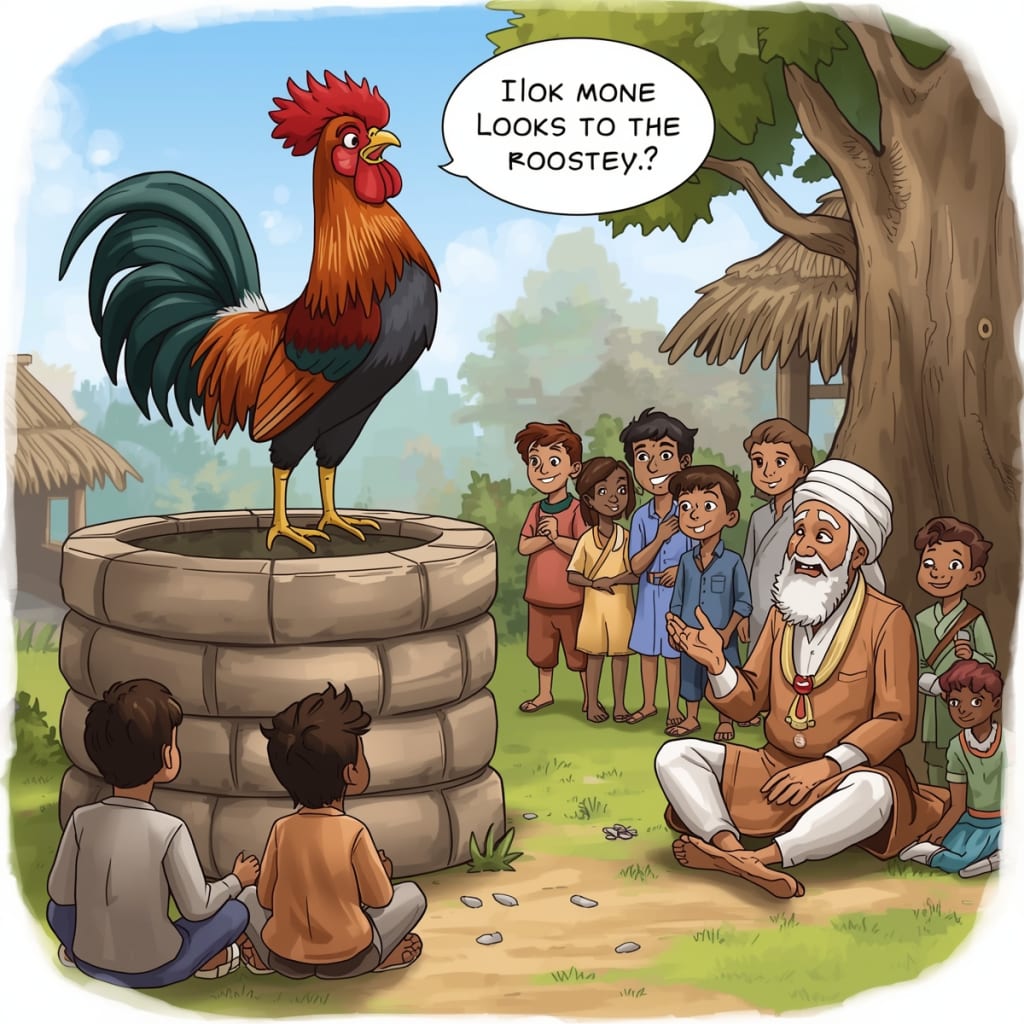
For centuries, villages have been known for their peaceful routines—morning sunlight, the rustling of trees, children running in open fields, and of course, the familiar sound of animals. But the small village of Noorabad became famous overnight because of something no one could have imagined: a rooster that could speak like a human. What started as a strange discovery soon turned the entire village into a place of wonder, chaos, and unexpected life lessons.
Noorabad was a calm village where people lived simple lives. The farmers woke up early, children went to school on dusty roads, and the villagers gathered near the old banyan tree every evening. Among the many animals in the village, one belonged to a farmer named Ghulam Din. He had a bright red rooster named “Surkhay.” Surkhay looked like an ordinary rooster, but villagers always joked that he seemed a bit too intelligent—he listened carefully, observed everything, and reacted as if he understood human conversations.
One cool morning, something unbelievable happened. As Ghulam Din was spreading grain for his chickens, he heard a clear voice behind him say, “You missed a spot!” Startled, he turned around but saw no one except Surkhay calmly pecking the ground. Confused, he shrugged it off as imagination, but then the voice came again: “I said, you missed a spot.”
Ghulam Din froze. His grain basket fell to the ground. His eyes widened. Surkhay looked directly at him and repeated, “Good morning!”
The farmer screamed and ran straight to the village square. Within minutes, almost everyone had gathered outside his house. Together they watched Surkhay as he strutted forward proudly and said, “Why is everyone staring? Haven’t you seen a rooster talk before?”
The villagers gasped in disbelief. Some ran away in fear, others stood frozen, and a few children laughed with excitement. Noorabad had officially become the first village with a talking rooster.
Very soon, Surkhay became the center of attention. Journalists visited. Scientists arrived with notebooks. Curious travelers flooded the village. Everyone wanted to hear him speak. At first, Surkhay enjoyed the attention. He shared funny stories, cracked jokes, and even imitated the voices of villagers, which made everyone laugh. The children adored him, and the adults treated him like a rare treasure.
But fame comes with complications. As the days passed, Surkhay began hearing arguments among villagers about who should “own” him. Some believed he belonged to the entire village, not just to Ghulam Din. Others wanted to take him to the city for money. People began fighting, forming groups, and competing for influence. It all started turning ugly.
Surkhay noticed the growing tension and felt responsible. After all, before he started speaking, everyone lived peacefully. Now the village was divided. He realized he had to do something.
One evening, Surkhay stood on the top of the old well where villagers gathered every sunset. He crowed loudly—not the way he talked, but a traditional rooster call that immediately caught everyone’s attention. When the villagers settled down, he cleared his throat and spoke with seriousness.
“Listen, everyone. When I first spoke, all of you laughed together. Now you fight over me. Is this what you want Noorabad to become? A place of anger and greed?”
His words cut through the silence. The villagers looked at one another with guilt and shame. Surkhay continued, “I am just a rooster. My voice may be unusual, but your humanity is far more important. If you can’t live together peacefully, then my speaking is not a blessing—it is a burden.”
Ghulam Din stepped forward and placed a comforting hand on the rooster. The villagers slowly began apologizing to one another. The fights dissolved, misunderstandings cleared, and the laughter returned to Noorabad. Surkhay’s speech had done something remarkable—it brought unity back to the village.
Eventually, the excitement settled, and life returned to its beautiful simplicity. Surkhay still spoke, but mainly to help children learn new words or entertain families during evening gatherings. He refused to be taken away for fame or money. Noorabad, once known only for its quiet lifestyle, became a symbol of unity and unexpected miracles.
The talking rooster taught a powerful truth: Extraordinary things can happen anywhere, but how we respond to them defines who we are. In the end, the real story was not about a rooster who could speak—but about a village that remembered the value of harmony, kindness, and togetherness.
About the Creator
Keep reading
More stories from darus sahil and writers in Art and other communities.
Lion and Clever Rabbit
Once upon a time, in a vast, lush, and thriving forest, there lived a mighty lion. This lion was the undisputed king of all the animals in the forest. His strength and power made him feared by every creature. Every day he went hunting, and if any animal crossed his path, it became the target of his anger. No animal dared to come near him, and everyone thought that if the lion became angry, no one could possibly stand against him.
By darus sahil2 months ago in Art
Actor Andreas Szakacs on AI Cinema as Szakacs Films Prepares Echoes of Tomorrow for May 2026
Szakacs Films is stepping further onto the international stage with the announcement of several new global projects, led by the upcoming feature film Echoes of Tomorrow, currently targeting a May 2026 release. The announcement reflects a broader creative shift for the company, signaling a deliberate move toward future-focused storytelling that engages with emerging technologies and contemporary cultural questions.
By Andreas Szakacs3 days ago in Art
The Locked Room
The Locked Room “There are spirits in the locked room upstairs, which is why no one goes there.” This incident happened almost thirty years ago and it is something I experienced myself. At that time, I had come to Sukkur for my job. My maternal uncle lived there, so I stayed at his house for a few days until I could arrange separate accommodation. I had come to my uncle’s house after many years. In childhood, I used to visit occasionally with my mother.
By Sudais Zakwan7 days ago in Art




Comments (1)
A chicken spoke like a human 🤣❤️ But humans spoke with greed and conflict. In the end, Surkhai made them truly human. A beautiful lesson with laughter