
In Conversation with I’ve Never Been Here Before and June Henry
DIY punk musicians get chatty

After discovering new up and coming folk punk voice of a queer generation June Henry (@luckyjunehenry on Instagram) through my partner’s Spotify, June Henry inadvertently put me onto another up and coming voice of a queer generation, I’ve Never Been Here Before (@iveneverbeenhereb4), by sharing a video from their tour together of I’ve Never Been Here Before performing her song I Am Not Scary. During the break they had on their most recent tour, I was lucky enough to be able to sit down with them both on Google Meet and interview them.
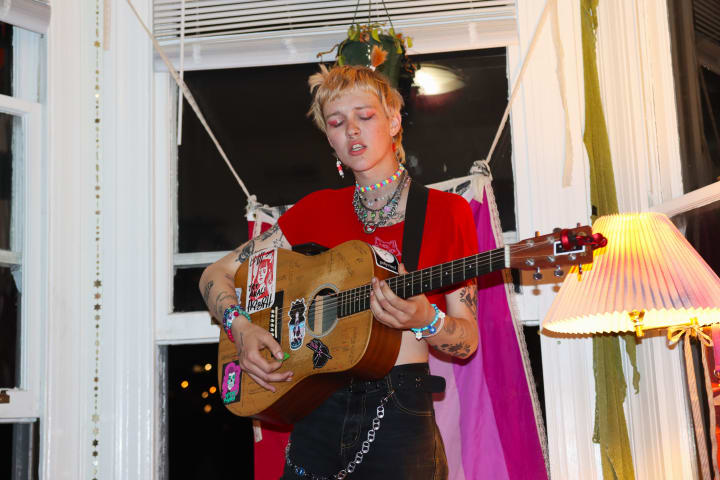
I’ve Never Been Here Before is a genre blending musician whose name is Manalia, and June Henry is a folk punk singer/songwriter called Jamie. They both perform DIY music with deep themes related to the experiences of growing up queer and of existing in the world as a queer person.
We got stuck into our conversation really easily, and they were both so open with me.
Onyx: What is your musical training, or what was the pipeline for you DIY gigging?
Manalia: I played in a church band at 11 and taught myself how to play guitar in my room. I started playing shows after getting kicked out and met people who introduced me to DIY. I played my first house show in January 2023 and booked my first tour in August 2023. The third tour I ever booked was our first run together in the Pacific Northwest.
Jamie: I started playing music as a pretty young kid, we got a piano from our neighbour who was moving. I would play songs by ear and my mom wanted me to learn, so she found me a piano teacher, but I really struggled with reading music …. I went to camp - Amplify Lawrence, part of the network of Girls Rock - I went to that in 2015 and was a vocalist at camp and then was in some bands with camp friends after that. I started performing solo as August Henry with a ukulele and started playing guitar as a freshman in high school. I released one album as August Henry and then released an album as June Henry in my senior year of high school. I took cello lessons when I was older but still struggled with reading music, but I had to stop playing cello due to chronic pain. My first tour was with Odie Leigh in May and June of 2023, she just messaged me on TikTok and was like, “hey, do you want to do this?” so I went with my dad who was a roadie. He was involved in DIY music scenes, so I inherited some of his knowledge. I was also in a bell choir in second grade.
Onyx: Who are your main musical influences and inspirations?
Manalia: I was always obsessed with music, but I was at first only allowed to listen to Christian bands, so I would obsessively listen to that. Then I learned about folk music like Bob Dylan and Josh Ritter … They made me want to learn to play guitar when I listened to more of this storytelling folk music, it was a lot of lyricism for me that got me started. When it comes to the music I make now it was musicians like Postal Service… Baths’ song No Eyes was direct inspiration for It’s Raining Again, I love screamo, cybergrind… Vantana Row… even Ed Sheeran first album, and I love My Chemical Romance . I’m into most genres, but definitely lean towards experimental electronic stuff and anything that makes me feel like I don’t know what is happening or how it’s happening. Plus, she got me back into folk punk in October last year.
Jamie: The earliest music I got into was Bright Eyes… our common ancestor is Bright Eyes. Where It’s At by Beck, Song 2 by Blur, At the Bottom by Bright Eyes… I loved the Sound of Music… We’re Going to Be Friends by the White Stripes was the first song I taught myself on piano… We had Brandi Carlile’s album with the orchestra when I was little. Androgynous by the Replacements was huge in my early gender discovery. I was given an iPod by my lesbian neighbour and got into Johnny Cash then too. I also loved Justin Bieber, I loved the androgyny of his voice at the time. Current day, I like a lot of Sleater-Kinney, Broken Social Scene, and Liz Phair. Fiona Apple, too.
Onyx: Who is your intended audience? Is your actual audience generally the same as your intended audience?
Manalia: Probably one of my favourite parts about touring is booking primarily trans bills and that tends to have the effect of bringing out a primarily trans and queer audience, and it’s just being a trans artist whose music is mainly about being trans it’s just better to play that for other trans and queer people. Most especially I want anyone who is scared and not supported by the people around them to hear my music. Human Bog by Baths is one of the songs that carried me through the hard times and was instrumental in allowing me to exist in my brain before I could exist outside of my brain.
Jamie: I think it’s rare that my music would appeal to someone who doesn’t have common ground with me… I have some songs that seem like they would go on a bigger Spotify playlist, but the nature of my songwriting is that I’m talking about these trans experiences and these detrans experiences and my complicated relationship with my gender… When I first started talking about those things in my music I wasn’t hearing other people talking about these things except for the people who were being paid by Fox News. My music reached other people who were also having these feelings and I didn’t know those people existed because I felt very alone. Now those are the people I have in mind when I’m making my music, but that’s not how it started, and it’s been really cool to have that community grow.
I do have some random cishet boys in my audience who just vibe with me because I used to cover Bladee… it’s so funny to me.
Onyx: Talk to me about your favourite songs versus your fans’ favourite songs of yours.
Manalia: My most popular song is I Am Not Scary, and I think when I made it I was like, “wow, this one is weird and different,” because normally when I write music I have a guitar and then I synth the guitar parts, but that song was made very fast and without much thought and it was meant to be an interlude sort of… I definitely didn’t intend for that one to be a big one but when I was making it I thought it was cool. I had one for a while called They Burnt Her Clothes and that one was like the first one I made with my setup so I was a little surprised that people liked it so much. I’m glad this tour has made people listen to I Am Just a Girl more, that one is now the most listened to on Cherarys Songs.
Jamie: My most popular song is void-adjacent by a lot. I have a complicated relationship with it, it was like a minute long voice memo, you can hear me setting up my phone… It was a voice note that I sent to my first partner (who I’ve written some scathing songs about) and they said it was going to be something… It’s definitely not the best thing I’ve ever made in terms of technical skill or in my opinion lyricism, but I’m at peace with void-adjacent being my most popular song. I hope when people listen to it they feel encouraged to check out other songs. But if people just listen to void-adjacent and they only listen to it that’s fine.
Onyx: How do people tend to find your music?
Manalia: Most everything has come from touring. I started touring before I really had any following, I had less than a thousand followers on Instagram, less than a hundred listeners on Spotify, I was very small when I did my first tour, but regardless I figured I knew enough people that I could book ten shows, and then basically after that haven’t stopped touring. I’ve taken like five total months out of touring since I started, and that will continue for a while, so that’s definitely been the main way people have found me is that I’ve just probably played a show in their city. Once I started touring with Jamie this year and booking longer tours and consistently being like “I am doing things, here’s new music, I am doing more things,” so if people don’t pay attention at first then my name is probably going to pop up again.
Jamie: It's definitely a lot through void-adjacent. One of the coolest things to hear, though, is the way that my music has spread through word of mouth. I can tell when a friend group has been put onto my music, I can spot when a friend has been dragged along to a show and then becomes obsessed… the way my music is recorded can be hard for people to connect to if they’re not used to that sort of music, but the live experience is different. The way I initially built an audience was unfortunately through TikTok gender discourse, and occasionally posting covers and original songs on there and on YouTube and Reddit, and I definitely got attention posting my Bladee covers.
Onyx: How did you two find each other?
Manalia: She was my ex’s favourite musician, and I decided I was going to tour with this person, so I DM’d her, and I was like, “hey, I’m going on a tour with these folk punk artists, we have a car, it’s gonna be six dates, do you want to do this?” and she happened to see the DM and was down and then the folk punk band dropped out and we ended up touring with some cybergrind band. Now we’ve done four tours together.
Jamie: I didn’t know about her until she DM’d me and she sent me a link to They Burned Her Clothes which I liked, and also she did a cover of my song Symmetry. I decided I was just going to drop out of university and see what other possibilities I had. I’m so glad I’ve been able to do these tours and travel so much because I hadn’t really travelled before. That was my second tour, first DIY tour… It definitely helped me see that the DIY stuff is viable for me because I didn’t like the other side of things with the music business…
Onyx: How does it feel having such a vast and deeply personal body of work available to those who wish to listen? It is so brave, real, raw, vulnerable, and scary for you both to share so openly what you do with the world.
Manalia: We just have these needs to write songs… The first song that’s really I’ve Never Been Here Before in my mind is Unremarkable, which was when my parents first told me that doing music was unremarkable. It’s never felt constructed in any way, it’s always just been where I’m at. The album Grl I wrote during the first year of my transition… Cherarys Songs are a lot of old songs… It was just writing about shit being hard but doing it anyway. If I wasn’t writing about that stuff I would just be writing fake stories… and I guess I do write some fake stories about made up demons but that relates to my perception of the world.
Jamie: It’s hard… It’s something that is very necessary for me to do, like Manalia said, I don’t know what else I’d be writing about… and I’ve done some work with myself about separating myself from my body of work. And it is inherently autobiographical, it’s from my perspective, I am not being fair in my music… which has caused issues in my interpersonal relationships. It’s less challenging to know that strangers have access to these songs, but it’s more challenging to know that the people who are or were in my life who can and do engage with these songs. And I’m not someone who can wait to release a song… Being squad with me isn’t for the weak. And I don’t know if that’s ethical, but it is what it is. An artist is going to make art of what they see.
Onyx: How does it feel being in our weird internet age where even though you have vague fame you are still expected to use the internet as your diary and let your fans/followers see aspects of your real life/personality? How do you cope with that weird pressure and pseudo community?
Manalia: I basically don’t, I turned my music account into just a place for posters and gig announcements… I made a personal account, and that’s private. But I kind of want to do more, like videos talking about my music, because I feel like some of the context of what I’m creating is important. In California I have the biggest community that I had found online and became close with in real life, and touring really brings the internet community to life.
Jamie: It’s something I’m trying to pivot away from, because my main account was my personal account for a while too, and one thing that really changed was when I made the decision to not be public about my detransition… because I was super public about my first transition and it was a big thing for me to be public about my medical history and everything about me was so visible… so many people have so much information about a lot of my life, I realised it wasn’t safe. When I first came out with my music as June, I was going by June in my real life too, but after about a year I made a change and decided to go by a different name in my real life to keep myself safer. It’s tricky though because the personal information is what people connect with, and recently I made a long video about my gender that people responded to really positively, but again, that’s another set of thousands of eyes on me… It’s a double edged sword.
Onyx: How are you coping with the demands of your real life, and how do you make things happen? I see that one of you is doing university online…
Manalia: I like planning things, I like booking tours… I wasn’t sure how to do it, and I wasn’t going to wait for someone to say, “hey, go on a tour with me,” so I had to learn how to do it. I’m currently booking my longest tour immediately after this with an artist called Dicq Beats… I got invited by an artist in Denver for another long tour too… It’s definitely demanding and a lot of work but I love touring and getting to meet people and it just happens to be something my brain is pretty capable of handling - sending emails, organising information - and I get to get these amazing experiences out of it. I’m in college for legal studies, I’m taking online courses and I’m almost done. I’ve noticed last time I was home that some connections fell apart a little because I was disappearing but I’ve been making connections on tour, and I still have my core people who I know will be there for me, and when I am home I’m surrounded by very cool trans community. Touring is what I want to do so I’m going to throw every ounce of what I have into doing that.
Jamie: I’ve gone full time with music within the last six months and I’m still trying to figure out what I do with my life besides music. I’ve done fast food, I’ve worked at my dad’s restaurant, I’ve done retail… There was a time that there was a real grind with making music my life but now I’ve got some passive income from streaming and I’m touring… Being able to stay in touch with people is hard to do, and my relationships feel like the most concrete thing in my real life outside of music. I sent a lot of letters over tour so far… I’m hoping to get more involved with mutual aid stuff in the community, too. One day I’m hoping to have a family, which is a funny thing for a DIY musician to say.
Onyx: You both seem to be very community focused and consistently use your platforms and privilege to uplift underrepresented voices. Whose voices would you like the chance to uplift with this interview?
Manalia: Definitely everyone should follow Iris Bilinsky and everything Iris shares. I’m always just trying to uplift anyone in the community who I feel is making art that is genuine. I’m trying to book tours for people who don’t always have the resources to book tours for themselves. I’m always trying to use touring as an opportunity to uplift trans artists and people who won’t always be represented. We’ve talked a lot this tour about uplifting more POC artists in future tours, and how to do better at finding these people. I also want to share resources more for people, like how to book tours and stuff like that. I want to help more people feel like they don’t have to just play local shows for ten years or something before someone notices them.
Jamie: I’ve been involved with zines and zine culture for the last decade and I’d love to do more of that.. We have a friend Yazan who lives in Gaza, and he just released another poetry collection that Iris Bilinksy and their partner have put into a zine so they can fundraise for the family to leave Gaza… artists who live in the Appalachians and in the Midwest and places where they’re told they can’t be happy queer people… as someone who intends to live and die in the Midwest, that’s really important to me. There’s this great band called Packhorse Librarian from Kentucky, they’ve been a recent fave of mine, and I’m always hoping that newer artists like that especially younger queer people can feel like they can go to me about parts of doing DIY music and I want to be able to help pass along the knowledge… it’s cliche knowledge is power, but there’s so many things people would be capable of doing if they knew it was an option.
Onyx: What do you have to say to your intended audience, and what do you have to say to anyone else who is listening? What’s your advice to other queer artists?
Manalia: make art, share that art, be confident that it matters. If you’re confident that it matters, other people will think it matters. I’m gonna do what I do no matter what, and I want trans people who wanna make art to feel like they can and like they can share it. Create more art that resonates specifically for trans people. Don’t put made up barriers around sharing that art once you’ve made it. Release shit, don’t put barriers around your art, it’s best if it’s just in existence, and it can get better over time.
Jamie: The barriers to entry are not as high as they want you to think that they are. You do not need someone in a position of authority to make this work, you literally just need a phone, Instagram, your voice memos app. Iris Bilinsky makes all her music on iOS Garage Band… a lot of people can fall into the trap of investing a ton of money into equipment and paying for management and stuff that you’re told that you need to be successful, when really that can bog you down and make things more expensive… just put stuff out there. Don’t worry about it being perfect. You’re always going to look back at it wondering what you were doing so just put it out there. Get the cheapest DistroKid subscription you can, release the voice notes. Just share it.
Onyx: What are your musical goals, both short and long term?
Manalia: I’m trying to learn how to drum so I can play drums with my music… I want to make an actual band, I’d like to play in a screamo band. I’ve got tours coming up I’m hoping to do and be proud of. I don’t know when I’ll have time to make that much new music until next Spring but I always try to make some things on tour. We’re working on a collab, me and June Henry and Everybody’s Worried About Owen and the Last Arizona that I’m producing…
Jamie: I’m unsure of the nature of the progression I’m looking for, but for the near future, I’m looking to release an album and a collection of 100 voice memo songs which I want to have out by my 21st birthday, the 29th of December. We’ll see if DIY music can help me get my house and family, or if I need to go back to school to figure that out.
Onyx: Finally, what are your current or upcoming projects/gigs/tours you want to promote?
Manalia: We have five shows in the Pacific Northwest left, our tour ends on November 3rd. I’ve Never Been Dicq Before is coming out on the 1st of November. The I’ve Never Been Dicq Before Tour starts November 10th and goes until January 3rd on the West Coast and out to the Midwest.
Jamie: my album Infinite Money Glitch should be coming out on the 29th of December and my 100 songs which I think I’m going to call Infinite Music Glitch, as my birthday gift to the world. I’m hoping to get my merch site back up and running in November since I’ll be home until January… junehenry.bigcartel.com
Jamie and Manalia’s tour with Everybody’s Worried About Owen finished up in early November, but you can catch Manalia touring in a lot of places all over the States this winter, and you can stream I’ve Never Been Here Before and June Henry on Bandcamp and Spotify - including new songs from both artists, I've Never Been Dicq Before and Harvest.

About the Creator
Onyx Ocean
230 Hour certified yoga teacher, AS in Early Childhood Education, author, Lvl 3 Beach School Leader, Bachelor's Degree of Arts (Hons) in Education Studies, PGCE in Further Ed, 150 Hr TEFL.
All stories may contain affiliate links.
Keep reading
More stories from Onyx Ocean and writers in Beat and other communities.
Ludacris and Nelly draw backlash over bookings at MAGA-coded music festival
Ludacris and Nelly headlining a mostly right-wing event is good for them. It’s also great for the genre of hip hop. The two rap veterans have showcased their talents on other stages. Why can’t they perform for mostly MAGA folks and grab that bag?
By Skyler Saunders24 days ago in Beat
Humble Sound Records: A New Force in American Music
In the ever-evolving landscape of American music, a fresh and ambitious voice has emerged: Humble Sound Records. Founded in 2024 by Grammy-award recording artist, songwriter, and producer James Artissen, Humble Sound Records (often abbreviated HSR) has quickly attracted attention for its blend of artistic freedom, strategic partnerships, and a catalog that bridges genres and generations. Based in Atlanta, Georgia, the label has positioned itself as a vibrant imprint committed to creative expression and musical innovation.
By Shay McNaire 2 days ago in Beat


Comments
There are no comments for this story
Be the first to respond and start the conversation.