
Modern Rap Serves Time in a Regressive Rehab Program, c/o the Prison-Industrial Complex
Hip-Hop culture's dependence on mainstream popularity has caused a strange new demand for rappers who'll do the crime...yet, they're terrified of the time.

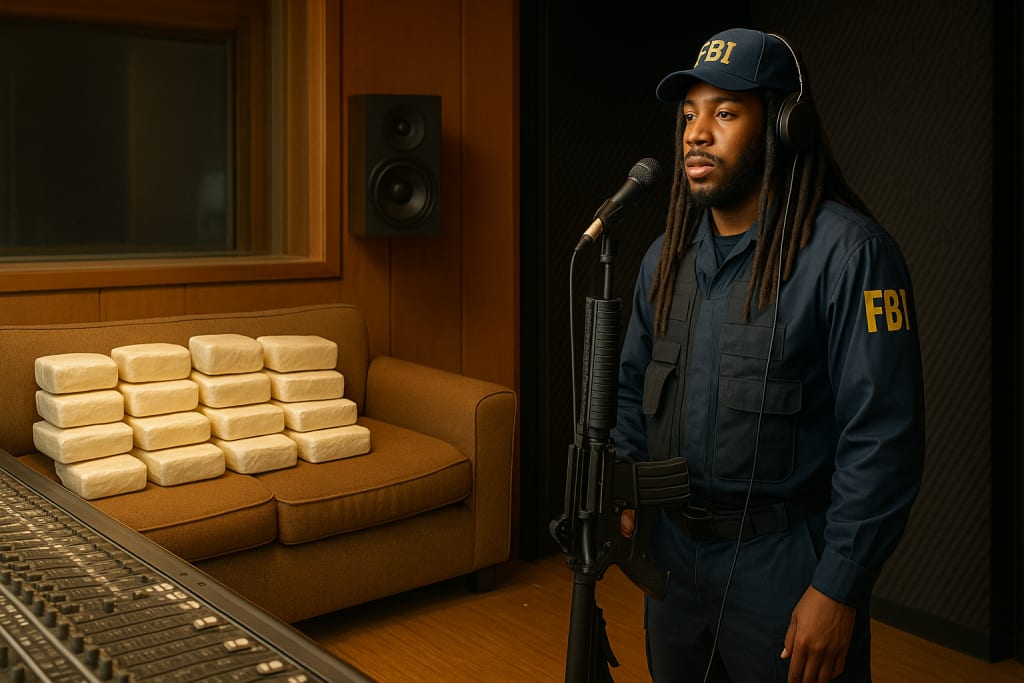
In the era where perception often trumps reality, modern rap finds itself in a paradoxical predicament: artists are praised for playing gangsters, yet panic when faced with the consequences of gangster life. Once a platform for marginalized voices to speak truth to power, hip-hop today seems caught in a feedback loop, regurgitating performative rebellion while actively sidestepping the realities it once sought to expose. At the heart of this shift lies a tangled relationship between rap culture, the commodification of crime, and the looming shadow of the prison-industrial complex.
The golden age of hip-hop thrived on authenticity. Rappers were expected to reflect their environment—not invent it. From N.W.A’s raw reportage of South Central Los Angeles to Nas painting pictures of the Queensbridge Projects in New York City with lyrical finesse, early rap was less about myth making and more about survival storytelling. In stark contrast, modern rap is saturated with aestheticized violence, designer drugs, and borrowed trauma. The stakes have shifted: clout now outweighs credibility.
Take a glance at today’s charts and social media feeds, and you’ll see a new archetype—the “play-affiliated” rapper. These are young artists who flirt with criminal personas not necessarily because they’ve lived that life, but because the persona sells. Guns in music videos, veiled threats on Instagram Live, and courtroom dramas are all part of the marketing machine. Ironically, many of these artists come from relative comfort and, when legal trouble actually lands, they pivot from hardened masculine gangsters to terrified, female-dominated young men; scrambling for plea deals and PR clean-ups.
This is the crux of the problem: crime has become cosplay, and the justice system is the final boss these artists never trained to face. A generation raised on social media stunts and algorithmic approval is ill-equipped to handle the very real consequences of their branding. In some ways, the entire genre has become a regressive rehab program—one in which artists simulate the pain and paranoia of criminal life, only to fold under the actual weight of incarceration.
There’s a morbid irony here. The prison-industrial complex, long critiqued by hip-hop as a tool of systemic oppression, now plays a curious supporting role in the modern rapper’s career arc. Arrests boost streaming numbers. Mugshots become merchandise. Legal woes are repackaged as marketing fodder. Labels, ever the opportunists, stand to benefit when an artist is caught up—drama drives engagement, and engagement means revenue.
But this comes at a steep cultural cost. As rap postures harder and harder toward street credibility, the community loses its grip on the genre's more radical possibilities. The revolutionary DNA of hip-hop—the part that once called out police brutality, mass incarceration, and racial injustice—is diluted by a performative machismo that serves capitalism more than it challenges the status quo. In glorifying the surface-level aesthetics of crime, the culture risks becoming a parody of itself.
And the system is happy to oblige. The court of public opinion works in tandem with the literal courts to adjudicate these young, childlike stars. Prosecutors scour lyrics for evidence. Fans, who once demanded authenticity, now lap up dramatized crime like it’s just another episode in a reality series. The real tragedy? We’ve conditioned a generation of Black youth to believe that criminal entanglement is part of the rite of passage toward legitimacy in hip-hop. In the golden-era, it was about avoiding it.
This isn’t to say that rappers aren’t accountable for their choices. But when you view the broader picture—the industry’s complicity, the audience’s appetite for drama, and the media's voyeuristic coverage—it becomes clear that modern rap is less a subversive voice and more a character trapped in a script written by profit-driven institutions. Regardless of what any apologist's more liberal explanation would suggest, the healthiest mantras are simple: Don't do the crime if you can't do the time. Also, the dangers outside the glitz still exist: Don't testify against co-defendants, my guy. If you don't you'll live. If you do, you could damned sure die.
Fortunately, some are breaking the cycle. Artists like J. Cole, Noname, Little Simz, and Joey Bada$$ have reclaimed space for introspective, politically-aware lyricism that resists criminal glamorization. Others, like Kendrick Lamar, navigate both worlds—shedding light on trauma while refusing to sensationalize it. Their success signals hope for a path forward, though their visibility is often dwarfed by the louder, messier narratives of rappers entangled in real-life indictments.
There’s also a growing push back from within hip-hop itself. The genre has always evolved through internal critique—battles, diss tracks, and ideological clashes are part of the culture’s DNA. Now, younger fans and artists are beginning to question the toxic cycles: Why are we still celebrating self-destruction? Why do our heroes only become martyrs once they’re locked up or shot down?
Ultimately, modern rap’s flirtation with crime culture isn't a reflection of street life—it’s a distortion of it, shaped by market demands and algorithmic reinforcement. The artists are as much victims as they are architects of the current mess. Caught between the lure of fame and the grip of real-world consequences, they exist in a bizarre limbo where they’re groomed to do the crime—but when it's time to do the time, their entire persona collapses.
Hip-hop doesn't need another cautionary tale. What it needs is a cultural detox—a conscious uncoupling from the systems that profit off its pain, and a re-centering of its revolutionary roots. The genre was born in the ashes of neglect, shaped by resistance, and fueled by truth. It deserves more than to be reduced to a pipeline feeding the prison-industrial complex.
If rap is going to serve time, let it be time spent in reflection, in resistance, repentance, and in radical re-imagining—not behind bars, but ahead of its curve.
References:
Khan, U. (2022). A guilty pleasure: The legal, social scientific, and feminist verdict against rap. Theoretical Criminology.
American Bar Association. (2020‑21). The Music of Mass Incarceration. Landslide Magazine.
Young, M. A. (2023, December 13). All Eyez on Rap & Hip‑Hop: Analyzing How Black Expression is Criminalized. Vermont Law Review (blog).
Tsang, T. The commodification of hip‑hop culture and rap music. jfa Human Rights Journal.
Going Black: The Commodification of Hip‑Hop Culture. (2018, Dec 3). Postscript Magazine.
Prison Legal News. (1999, Nov 15). The Cultural Commodification of Prisons.
Pitchfork. (2017, Nov 13). How Hip‑Hop is Fighting for Prison Reform.
About the Creator
Victor Trammell
Mr. Trammell is an award-winning digital media producer, freelance journalist, and author. Formerly, he wrote national radio content for the Michael Baisden Show. He also served as Senior Editor at the Your Black World online news network.
Keep reading
More stories from Victor Trammell and writers in Beat and other communities.
Lil Baby to Win Quincy Jones Humanitarian Award at Second-Annual Music in Action Awards Gala
On Thursday (September 15), the Black Music Action Coalition (BMAC) unveiled the inclusion of new awardees for the second-annual Music in Action Awards Gala, which recognizes individuals, organizations, and firms that specifically employed their visibility to positively promote social change steadily for the past 12 months.
By Victor Trammell3 years ago in Beat
Jupiter’s Moon Europa May Be Supplying Its Ocean With Life-Supporting Matter, Study Finds
Title Subtitle Jupiter’s icy moon Europa has long fascinated scientists as one of the most intriguing worlds in our solar system. Beneath its cracked, frozen surface lies a vast subsurface ocean that may contain more water than all of Earth’s oceans combined. Now, a new scientific study suggests that Europa may be actively supplying this hidden ocean with life-supporting chemical ingredients, further strengthening its status as a prime candidate in the search for life beyond Earth.
By Salaar Jamalia day ago in Beat



Comments
There are no comments for this story
Be the first to respond and start the conversation.