
The Moon Is Quietly Collecting Earth’s Escaping Air, Study Finds
New research reveals a hidden atmospheric connection between Earth and its nearest celestial neighbor

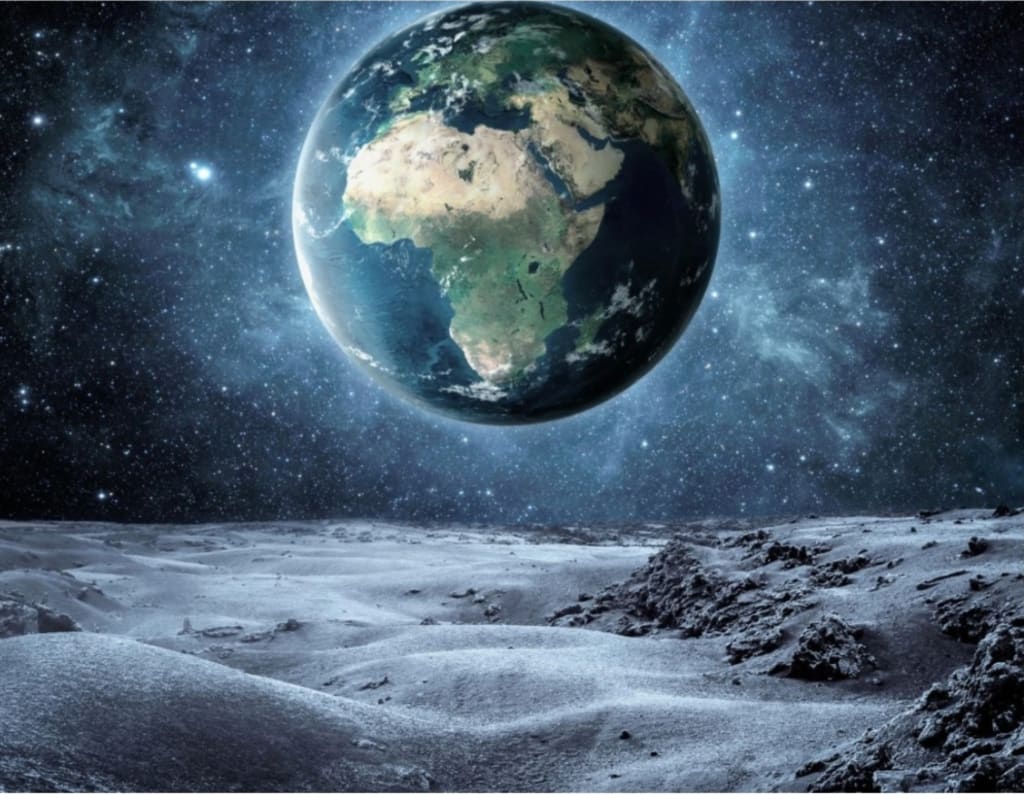
For centuries, the Moon has been viewed as a silent companion to Earth—airless, lifeless, and largely unchanged. But new scientific research is challenging that long-held perception. According to recent studies, the Moon may be quietly collecting small amounts of Earth’s escaping atmosphere, creating an unexpected chemical connection between the two worlds. This discovery is reshaping how scientists understand atmospheric loss, planetary evolution, and the long-term relationship between Earth and its closest neighbor in space.
---
How Earth’s Air Escapes Into Space
Earth’s atmosphere feels permanent, but it is not completely sealed. Every day, small quantities of gases—especially lighter elements like hydrogen and helium—escape Earth’s gravitational pull and drift into space. This process has been happening for billions of years.
Several forces drive atmospheric escape. Solar wind interactions, ultraviolet radiation, and geomagnetic storms can energize atmospheric particles enough for them to break free. While Earth’s strong magnetic field protects most of the atmosphere, it also creates pathways—particularly along the polar regions—through which particles can leak into space.
Until recently, scientists assumed these escaped particles simply dispersed into the vastness of space. New findings suggest otherwise.
---
The Moon’s Unexpected Role
The Moon orbits Earth at an average distance of about 384,000 kilometers, well within the extended reach of Earth’s magnetic field, known as the magnetotail. For several days each month, the Moon passes through this invisible structure as it travels around Earth.
Researchers now believe that during these periods, ions from Earth’s atmosphere—such as oxygen, nitrogen, and noble gases—can be transported along magnetic field lines and deposited on the Moon’s surface. Though the Moon lacks a thick atmosphere, its dusty surface, called regolith, is highly effective at trapping and preserving particles over long periods.
This means the Moon may be acting as a subtle archive of Earth’s atmospheric history.
---
Evidence From Lunar Samples and Space Missions
The idea that the Moon collects Earth’s escaping air is supported by data from lunar missions and sample analysis. Instruments aboard spacecraft have detected Earth-origin ions near the Moon, especially during times of heightened solar activity.
More compellingly, scientists examining lunar soil samples brought back by past missions have identified isotopic signatures that closely resemble Earth’s atmosphere rather than solar wind sources. These chemical fingerprints suggest that some of the gases embedded in lunar regolith likely originated on Earth.
Modern simulations and space weather models further support this conclusion, showing that Earth’s magnetosphere can funnel atmospheric particles toward the Moon under the right conditions.
---
Why This Discovery Matters
This finding has profound scientific implications. First, it changes how researchers understand atmospheric evolution. By studying how much air Earth has lost—and where it went—scientists can better model the planet’s long-term climate stability.
Second, it offers a new way to study Earth’s past. The Moon’s surface changes very slowly due to the lack of weather, plate tectonics, and erosion. Trapped atmospheric particles could preserve snapshots of Earth’s atmosphere from different geological eras, including periods when oxygen levels were rising or falling.
In essence, the Moon may hold a time capsule of Earth’s environmental history.
---
Clues for Future Human Exploration
The discovery could also influence future lunar exploration. If Earth-derived gases are present in the lunar regolith, they may be extractable in small quantities. While not a substitute for major resources, these gases could contribute to life-support systems or scientific experiments at future Moon bases.
Understanding the Moon’s interaction with Earth’s atmosphere also helps engineers design better equipment for long-term lunar missions, particularly in understanding space weather effects and surface chemistry.
---
A Broader Planetary Perspective
This Earth-Moon connection may not be unique. Scientists are now considering whether similar processes occur elsewhere in the solar system. For example, could Mars have lost part of its ancient atmosphere to its moons? Do exoplanets share atmospheric material with nearby celestial bodies?
If so, studying the Moon could provide a template for understanding how planets exchange material and evolve together over time.
---
Challenges and Ongoing Research
Despite the excitement, many questions remain. Researchers are still trying to determine how much of Earth’s atmosphere has been transferred to the Moon and over what time scales. It’s also unclear how deeply these particles are embedded in the lunar surface and how easily they can be detected or extracted.
Future missions, including advanced lunar landers and sample-return projects, are expected to provide clearer answers. Improved instruments will allow scientists to analyze lunar soil at unprecedented precision, revealing more about this hidden atmospheric exchange.
---
Final Thoughts
The idea that the Moon is quietly collecting Earth’s escaping air transforms our understanding of both worlds. Far from being an isolated, lifeless rock, the Moon appears to be a silent witness to Earth’s atmospheric journey through time.
As research continues, this discovery reminds us that space is not empty or disconnected. Even across hundreds of thousands of kilometers, Earth and the Moon remain linked by invisible streams of particles—proof that our planet’s story extends far beyond its skies and into the cosmos.
About the Creator
Keep reading
More stories from Salaar Jamali and writers in Beat and other communities.
To the Moon! Inside the Outer Space Hotels Prepping to Welcome Guests as Soon as 2032
To the Moon! Inside the Outer Space Hotels Prepping to Welcome Guests as Soon as 2032 For decades, space travel was reserved for astronauts, scientists, and the ultra-elite backed by government missions. But that era is rapidly changing. What once belonged purely to science fiction is now edging closer to reality. By as early as 2032, outer space hotels may begin welcoming their first civilian guests, offering an experience that blends cutting-edge technology, luxury hospitality, and humanity’s timeless fascination with the stars.
By Salaar Jamaliabout 4 hours ago in Beat
Griffin Snowden Drops Highly Anticipated Single “HEARTBEAT”
In a world of excess—excess content, excess opinions, excess noise—Griffin Snowden is taking the high road. His new single, HEARTBEAT, represents a conscious decision to prioritize meaning over momentum.
By Variety Pressabout 17 hours ago in Beat




Comments
There are no comments for this story
Be the first to respond and start the conversation.