
Albert Camus: The Rebel Against Meaninglessness
Albert Camus: The Rebel Against Meaninglessness

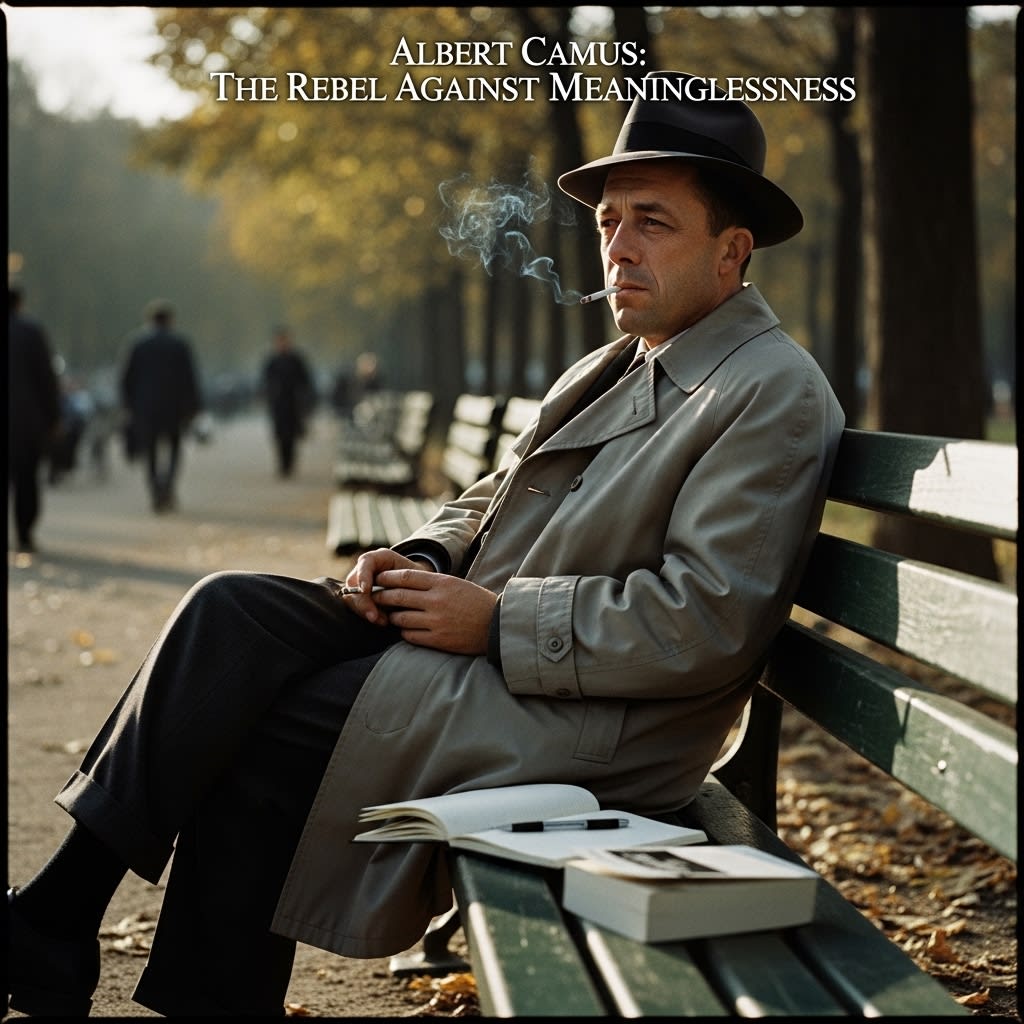
Albert Camus did not promise hope in the traditional sense. He did not offer comforting answers about destiny, faith, or cosmic purpose. Instead, he began with a stark observation: the universe is silent. Human beings search desperately for meaning, yet the world does not provide it. From this tension, Camus built one of the most powerful philosophical positions of the modern era—the philosophy of the absurd.
Born in 1913 in French Algeria, Camus grew up in poverty. His father died in World War I, leaving his family struggling for survival. This early experience shaped his outlook. Life, he understood, could be harsh, indifferent, and unfair without explanation. Yet instead of falling into despair, Camus developed a fierce appreciation for existence itself—sunlight, friendship, work, and resistance.
Camus is often grouped with existentialists like Jean-Paul Sartre, but he rejected the label. He believed existentialism still sought systems and justifications. Camus preferred honesty without illusion. His philosophy begins with a simple question: if life has no inherent meaning, why continue living?
His essay *The Myth of Sisyphus* provides his most famous answer. Drawing from Greek mythology, Camus describes Sisyphus, condemned to push a boulder up a hill forever, only for it to roll back down. The task is endless, pointless, and inescapable. Yet Camus concludes with a surprising statement: “One must imagine Sisyphus happy.”
For Camus, meaning is not discovered—it is created through conscious rebellion. The absurd cannot be defeated, but it can be confronted. By accepting life’s lack of ultimate purpose and choosing to live fully anyway, individuals assert their freedom. Happiness, in this view, is not the result of certainty but of defiance.
This philosophy is not passive. Camus believed that awareness of absurdity should lead to engagement with life, not withdrawal from it. To live without appeal—to refuse comforting illusions—requires courage. It means valuing experience itself rather than searching for final answers.
Camus explored these ideas through fiction as much as essays. In *The Stranger*, his most famous novel, the protagonist Meursault appears emotionally detached from society’s expectations. He does not perform grief in acceptable ways. He refuses to pretend feelings he does not have. As a result, society condemns him not just for his actions, but for his honesty.
The novel reveals how deeply social norms depend on shared narratives. Meursault’s “crime” is not only violence—it is his refusal to lie about meaning. His execution becomes a ritual of restoring order to a world threatened by authenticity.
During World War II, Camus moved from philosophical reflection to active resistance. Living in Nazi-occupied France, he joined the Resistance and worked as a journalist for an underground newspaper. For him, rebellion was not abstract—it was moral action in the face of injustice. His philosophy demanded engagement with real suffering.
This commitment shaped another major work, *The Plague*. On the surface, it tells the story of a town ravaged by disease. Beneath that, it functions as an allegory for fascism and collective struggle. The characters do not defeat the plague through heroic gestures alone, but through persistent effort, solidarity, and refusal to surrender.
Camus argued that rebellion must be guided by limits. Unlike revolutionary ideologies that justify violence in pursuit of utopia, he believed that no future ideal is worth sacrificing present human dignity. His later book *The Rebel* critiques systems that excuse cruelty in the name of progress.
This position made him controversial. He refused both authoritarian communism and complacent liberalism, insisting that moral responsibility exists even in chaotic times. He stood for resistance without fanaticism.
Albert Camus died in a car accident in 1960 at the age of forty-six, leaving behind a body of work that continues to resonate. In an age marked by uncertainty, conflict, and existential anxiety, his ideas feel less like abstract philosophy and more like survival guidance.
Camus did not promise that life would make sense. He insisted that meaning emerges through how we respond to its silence. To live fully, to act with integrity, and to resist injustice—even without guarantees—was, for him, the highest form of human dignity.
In a world that offers no final answers, Camus taught that the most radical act is simply to continue—and to do so consciously.
About the Creator
Fred Bradford
Philosophy, for me, is not just an intellectual pursuit but a way to continuously grow, question, and connect with others on a deeper level. By reflecting on ideas we challenge how we see the world and our place in it.
Keep reading
More stories from Fred Bradford and writers in BookClub and other communities.
Franz Kafka: The Architect of Quiet Nightmares
Franz Kafka never set out to become one of the most influential writers in modern history. He lived quietly, worked a bureaucratic job, doubted his own talent, and published little during his lifetime. Yet his stories—strange, unsettling, and hauntingly familiar—reshaped how we understand anxiety, power, and the individual’s place in a system too vast to comprehend. Today, the word *Kafkaesque* describes experiences that feel absurd, oppressive, and inescapable. That alone is a measure of his lasting impact.
By Fred Bradford4 days ago in BookClub
Rachel Reviews: Lunch Tales: Teagan by Lucille Guarino
Well, I did enjoy this! Sometimes, all you need is just great storytelling and this is what Lucille Guarino delivers here. There's no big message to this book; it's just about folks and families, living their lives and coping with everything that's being thrown at them and finding their way. But when it's done well, like it is here, then you have characters to whom you can relate, tension which leaves you rooting for a better outcome, attraction which has your heart racing and an urge, as a reader, to see the characters happy with the people with whom they belong.
By Rachel Deeming6 days ago in BookClub
7 Books Perfect For Reading Before Sleep
In our fast-paced, always-connected world, winding down at the end of the day has never been more essential. One of the most effective ways to relax, reduce stress, and improve sleep quality is through reading before bed. But not all books are created equal for this intimate evening ritual. Some ignite anxiety or stimulate overthinking, while others gently lull the mind into a peaceful state. Choosing the right book can transform your nightly routine, enhancing relaxation, mental clarity, and overall well-being.
By Diana Meresc7 days ago in BookClub
The Light Turns
It's Tuesday 7:13 a.m. A cold and clear November morning awaits Ray on his morning commute. Ray rubs his hands together in the front seat of his Subaru. He turns the air temperature up, but keeps the air on low until the air warms up. He looks at the backup camera screen and reverses the Subaru out of his driveway onto Trimble Road.
By John R. Godwin7 days ago in Fiction


Comments
There are no comments for this story
Be the first to respond and start the conversation.