
Maria de Naglowska
The Forbidden Architect of Erotic Mysticism

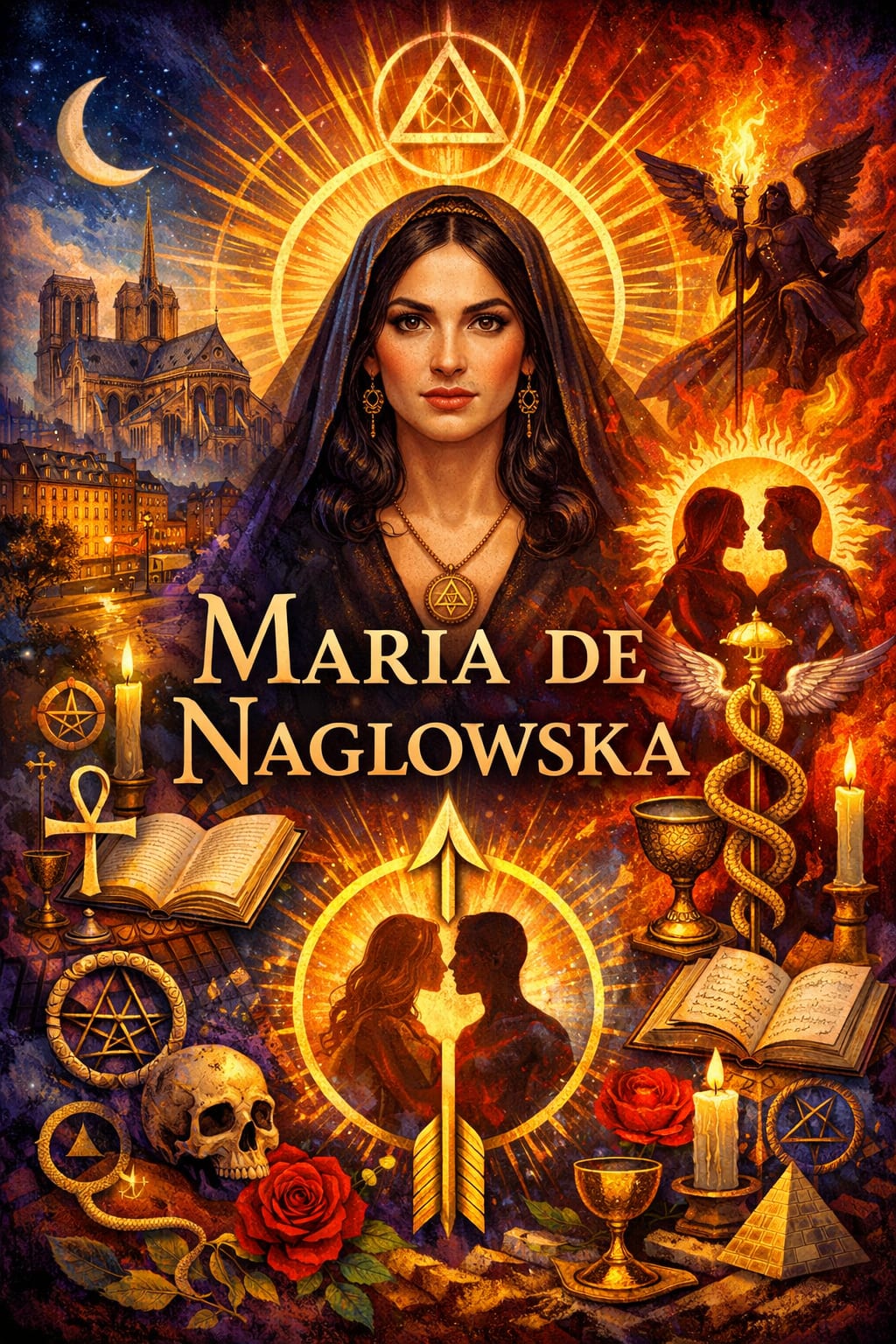
The Forbidden Mysticism of Maria de Naglowska
Maria de Naglowska occupies one of the most enigmatic positions in modern occult history. At the intersection of mysticism, sexuality, and ritual, her work confronted social and spiritual conventions with intensity and purpose. Within the early twentieth century, a period marked by cultural upheaval and experimentation, erotic experience became a medium for metaphysical insight and personal transformation, challenging entrenched notions of morality, divinity, and human potential.
Reputation carried both fascination and scandal. Accusations of Satanism and moral transgression circulated through Parisian salons, literary circles, and intellectual gatherings. Beneath public controversy, a coherent and deliberate philosophical system emerged, emphasizing the reconciliation of dualities often treated as opposites: spirit and matter, masculine and feminine, desire and consciousness. Ritual practice functioned as a structured method for engagement with these forces, blending discipline with transformative intensity.
Early experiences of displacement, aristocratic education, and navigation of complex social and cultural worlds shaped the philosophical and mystical vision. Orphanhood, exile, and personal loss fostered sensitivity to hidden currents of human experience. Life on the margins of convention informed both the writings and ceremonies, producing a mysticism grounded in authenticity, rigor, and deliberate transgression.
The allure of Maria de Naglowska resides in the fusion of intellectual precision, spiritual ambition, and daring confrontation with taboo. Ritual, eroticism, and the sacred intertwined in a system designed to expand perception and challenge complacency. Exploration of this work illuminates a vision that continues to resonate for those drawn to the edge of conventional understanding, where forbidden knowledge and transformative experience converge.
Foundations of Rebellion
Maria de Naglowska entered the world in Saint Petersburg in 1883, within a family deeply entwined with the Russian aristocracy and imperial administration. Childhood unfolded amidst privilege, rigorous discipline, and structured education. Enrollment at the Smolny Institute for Noble Maidens provided immersion in an environment defined by refinement, intellectual rigor, and strict moral instruction. Exposure to structured authority and Orthodox Christian doctrine laid the groundwork for both discipline and eventual tension, as early spiritual frameworks collided with emerging curiosity about hidden currents of human experience.
Orphanhood arrived in early adolescence, leaving profound voids and a need for self-reliance. The deaths of both parents created a landscape of emotional independence and early confrontation with impermanence. Loss instilled sensitivity to marginality and nurtured skepticism toward inherited social and spiritual hierarchies. Marriage to Moïse Hopenko, a man outside aristocratic expectations, produced children but created estrangement from family and established social circles. Economic strain and ideological differences ultimately dissolved the union, leaving survival dependent on adaptability, resourcefulness, and intellectual labor.
Income derived from teaching, journalism, translation, and literary pursuits, revealing both versatility and resilience. Political writing in Switzerland resulted in imprisonment and eventual expulsion, introducing exile as a recurring condition rather than a temporary disruption. Subsequent movement through Berlin, Geneva, Rome, and finally Paris brought exposure to revolutionary politics, European intellectual debates, esoteric traditions, Catholic symbolism, and avant-garde culture. Each city contributed threads to a complex tapestry of thought, experience, and observation, blending intellectual rigor with spiritual curiosity.
Early experiences created a fragmented yet fertile intellectual and emotional landscape. Encounters with loss, displacement, social marginality, and cross-cultural currents fostered a capacity to synthesize seemingly contradictory elements. Aristocratic discipline intersected with bohemian experimentation. Orthodox moral instruction met with clandestine engagement with forbidden knowledge. Personal adversity encouraged both resilience and radical imagination.
These formative conditions set the stage for the emergence of a unique synthesis of mysticism, sexuality, and ritual. The intellectual and spiritual foundation was neither linear nor conventional; instead, it resembled a constellation of disparate influences coalescing into the distinctive philosophical and ceremonial vision that would define Maria de Naglowska’s later work.
Parisian Crossroads: Mysticism, Art, and the Birth of the Golden Arrow
Paris in the late 1920s and early 1930s functioned as a crucible for radical thought, artistic experimentation, and spiritual exploration. Streets and salons resonated with the restless energy of writers, painters, and thinkers who sought to break from tradition. Surrealists pursued the logic of dreams and the liberation of desire, while psychoanalytic ideas challenged inherited moral codes and revealed the unconscious as a domain of profound influence. At the same time, occult revivalism found fertile ground, thriving in lodges, private salons, and clandestine circles where ritual and symbolism intersected with the avant-garde.
Within this vibrant milieu, Maria de Naglowska emerged not merely as observer but as an active participant and deliberate provocateur. Economic precarity necessitated inventive engagement, with sustenance drawn from lectures, written essays, and intimate gatherings. Public addresses confronted topics of mysticism, sexuality, theology, and the perceived spiritual crisis of modern Europe. Expression remained deliberate, direct, and unflinching; erotic experience functioned as both subject and method, not merely as metaphor or allegory. Ritualized sexuality appeared as a tangible conduit to consciousness and transformation, challenging audiences accustomed to intellectual abstraction or moral restraint.
A community gradually coalesced around these teachings. Artists, writers, seekers, and curious attendees formed a circle of study and practice. From this circle arose the Brotherhood of the Golden Arrow, an initiatory society embodying the principles articulated in lectures and essays. The arrow symbolized conscious intention, force, and direction, a point of focus for both spiritual practice and philosophical inquiry. The emphasis rested on transformation, integration, and balance rather than transcendence or escapism.
Influence extended beyond immediate gatherings through the publication of the journal La Flèche. Essays, ritual instructions, philosophical reflections, poetry, and commentary on contemporary culture circulated within Parisian intellectual networks, blending literary sophistication with esoteric instruction. The tone balanced severity with lyricism, intellectual ambition with deliberate provocation, inviting engagement from those drawn to challenge, risk, and reflection.
Paris offered both freedom and challenge. Exposure to revolutionary politics, artistic innovation, and esoteric traditions provided a context in which radical ideas could be tested, refined, and enacted. Interaction with thinkers exploring Catholic symbolism, Hermeticism, and avant-garde experimentation supplied frameworks for synthesis. Within this charged atmosphere, the Golden Arrow emerged as a living laboratory of mystical practice, bridging the worlds of art, sexuality, and spiritual philosophy with precision and audacity.
The Third Term: Reimagining the Sacred Through Desire
At the heart of Maria de Naglowska’s teachings lay the concept of the Third Term of the Trinity, a radical reinterpretation of Christian theology through an esoteric and experiential lens. Traditional Trinitarian structure, emphasizing Father, Son, and Holy Spirit, had long dominated Western thought, yet Naglowska perceived a fundamental misrepresentation of the third element. The Third Term was not merely the Holy Spirit as abstract presence; it embodied a dynamic, earthly, and feminine principle essential for the reconciliation of opposites within human consciousness and the natural world.
This force was neither passive nor theoretical. It moved through life, desire, and the body itself, affirming the sacred potential within embodied experience. Sexuality, in this framework, transformed from a moral obstacle into a living conduit for spiritual insight. Erotic engagement became ritual, reflection, and communion, a tangible expression of divine integration. Desire was no longer a secret to be suppressed, but a sacred energy capable of bridging spirit and matter, intellect and emotion, light and shadow.
Dualism formed the central challenge addressed by this philosophy. Western thought had long treated spirit as opposed to body, good as opposed to evil, and masculine authority as suppressor of feminine energy. The Third Term demanded recognition of these divisions as artificial constructs to be reconciled. Darkness required acknowledgment, not denial. Desire demanded conscious engagement, not repression. Integration, rather than moral purification, became the guiding principle for personal and spiritual evolution.
The philosophy maintained rigorous structure. Ritual, symbolic intention, and ethical responsibility governed practice, ensuring that the sacred use of desire remained disciplined rather than indulgent. Sexual union functioned simultaneously as sacrament, initiation, and metaphysical operation, producing transformation through balance, awareness, and deliberate practice rather than excess. Ceremonial acts fused intellect, emotion, and sensation, creating a bridge between ordinary consciousness and the hidden currents of life.
The Third Term represented more than theory; it offered a blueprint for navigating tension, embracing polarity, and awakening latent potential within the self. By reframing desire and sexuality as instruments of spiritual development, Naglowska challenged inherited assumptions, redefined the sacred, and opened a space where the body, the mind, and the spirit could converge in conscious harmony.
Sexual Magic as Sacred Technology
Within the system of Maria de Naglowska, sexual magic functioned as a precise and disciplined tool rather than mere indulgence or spectacle. Erotic ritual operated as a methodical technology designed to alter consciousness, reconcile internal polarities, and facilitate spiritual awakening. Preparation for ritual involved careful attention to symbolic gestures, meditative focus, and the creation of a controlled environment, transforming ordinary experience into a deliberate conduit for transformation.
Central to these practices was the concept of sexual polarity. Masculine and feminine energies required conscious alignment, each amplifying the other through intentional engagement. The union of these forces generated a dynamic current of spiritual energy capable of illuminating hidden layers of perception, fostering empowerment, and producing heightened awareness. Ritual climax functioned as a symbol of the temporary dissolution of egoic boundaries, granting access to deeper realms of consciousness and reinforcing the integration of body, mind, and spirit.
The origins of these practices drew upon a rich tapestry of esoteric traditions. Gnostic concepts of hidden knowledge and transformative gnosis informed the symbolic framework, while Hermetic alchemy provided a language of transmutation and synthesis. Elements of Tantric philosophy appeared in adapted form, emphasizing the sacred potential of sexual energy within structured ritual. Naglowska’s innovation lay not in inventing these elements but in synthesizing them into a coherent, publicly articulated system with theological depth and philosophical rigor.
The body occupied a central, sacred role within this framework. Flesh and spirit existed as complementary, interdependent dimensions of existence rather than as opposing forces to be subordinated or suppressed. Denial of bodily experience was considered a spiritual error, an obstacle to full awareness and the realization of integrated consciousness. Ritualized engagement with the body and with desire became a pathway to transcendence, transforming ordinary sensation into vehicles for sacred insight.
In this context, sexual magic functioned as both laboratory and sacrament, a deliberate technique for exploring consciousness while cultivating harmony between internal opposites. Each act, gesture, and moment of attention carried significance, reinforcing the broader philosophical vision of integration, balance, and transformative potential. The practice elevated the body to the status of temple, and desire to the role of spiritual catalyst, creating a system in which ritual, awareness, and lived experience merged into a coherent path of mystical development.
The Shadow as Teacher: Satanic Symbolism and Misinterpretation
Engagement with Satanic imagery remains one of the most misunderstood aspects of Maria de Naglowska’s work. Within her teachings, the figure of Satan did not signify worship of an external demonic being, nor did it embody literal evil. Instead, Satan functioned as a symbolic representation of rebellion, critical thought, and the necessary force of negation within the cosmos. This force served to challenge stagnation, provoke reflection, and catalyze transformation in both consciousness and experience.
Western Christian traditions often framed Satan as the absolute embodiment of moral and spiritual opposition, an entity to be feared, resisted, or expelled. Naglowska reinterpreted this figure as a principle of reason, autonomy, and confrontation. Suppression of this symbolic force produced imbalance, psychological repression, and spiritual limitation. Conscious engagement with this energy became a pathway to integration, self-awareness, and the reconciliation of opposites, allowing the individual to embrace both light and shadow without moral panic.
This approach resonated with certain Gnostic teachings and strands of Romantic philosophy, which emphasized the transformative potential of forces traditionally labeled as dark or forbidden. Symbolic use of Satan challenged passive moral assumptions, exposing hidden tensions within the psyche and broader cultural structures. Public misinterpretation often arose from superficial reading of lectures, writings, or ritual practice, with sensationalist reporting amplifying fears of literal devil worship. Provocative language functioned deliberately as pedagogy, designed to dismantle complacency and provoke direct engagement with taboo aspects of human experience.
Controversy naturally followed. Public lectures that explored sexuality, magic, and esoteric principles attracted accusations of immorality and indecency. Legal scrutiny, social censure, and gossip circulated widely, amplifying notoriety while simultaneously drawing attention to the philosophical depth of the work. Even when formal charges were overturned, the conflation of symbolic exploration with literal transgression remained persistent, obscuring nuance and philosophical intent.
Through this lens, the figure of Satan became a tool rather than a threat. By confronting the shadow directly, the practitioner could access hidden reserves of intellect, courage, and transformative energy. In Naglowska’s system, darkness was not the enemy of the sacred; it was an indispensable teacher, a reflection of suppressed potential, and a guide toward wholeness.
Convergence of the Unseen: Surrealism, Modern Thought, and Naglowska
The intellectual and artistic currents of early twentieth-century Paris formed a fertile environment for radical experimentation, and Maria de Naglowska’s work resonated deeply within this context. Surrealism, with its emphasis on liberating the imagination from rational constraints, cultivated an aesthetic of dream logic, symbolic transgression, and erotic imagery. Exploration of the unconscious mind, fascination with taboo, and deliberate destabilization of normative morality created a cultural space in which mystical and erotic experimentation could be understood as complementary rather than oppositional.
Naglowska’s teachings found natural synergy with these explorations. Concepts of sacred eroticism, polarity, and conscious engagement with desire mirrored the Surrealists’ interest in the hidden dimensions of human experience. While not formally affiliated with Surrealist collectives, Naglowska engaged with artists, writers, and thinkers who were pushing boundaries of perception and expression. These interactions produced mutual influence, where intellectual curiosity intersected with mystical experimentation, generating cross-pollination of ideas rather than hierarchical authority.
Philosophical engagement extended beyond Surrealism. Dialogue with contemporary thinkers interested in tradition, initiation, and the metaphysical structure of reality broadened conceptual horizons. Figures concerned with esoteric hierarchy, the role of symbolism, and the transformative potential of disciplined ritual provided additional frameworks for synthesizing mystical and cultural inquiry. Ideological differences did not prevent collaboration or influence; shared interest in hidden currents of human experience created a platform for experimentation, reflection, and refinement of esoteric philosophy.
Within this convergence of art, mysticism, and intellectual exploration, Naglowska’s work functioned as both influence and participant. The deliberate interplay of ritual, erotic symbolism, and philosophical reflection intersected with the avant-garde cultural milieu, reinforcing the perception of desire and imagination as transformative forces. Paris became a laboratory where ideas, aesthetics, and spiritual practice merged, allowing for the articulation of a system that combined rigorous structure with provocative experimentation.
This environment illuminated the interdependence of culture and occultism, demonstrating that radical mystical thought did not exist in isolation but flourished through dialogue with contemporary artistic and intellectual movements. The fusion of erotic mysticism with Surrealist imagination and philosophical inquiry created a framework in which symbolism, ritual, and consciousness could be explored with unprecedented depth and sophistication.
Controversies Surrounding Maria de Naglowska
Maria de Naglowska’s work provoked intense scrutiny and critique from multiple sectors of society. Religious authorities condemned public engagement with ritual and sexuality as blasphemous, framing her teachings as a threat to established moral and spiritual order. Moralists criticized open discussions of eroticism and its sacred applications, interpreting direct instruction and ritual practice as corruptive rather than transformative. Even within contemporary esoteric circles, discomfort arose in response to the explicit nature of her ceremonies, with some practitioners questioning the appropriateness of such integration of sexuality into mystical practice.
Speculation and rumor accompanied these critiques. Accusations of manipulation, sensationalism, and danger circulated widely, fueled by the secretive nature of the Brotherhood of the Golden Arrow and the small, intimate size of its membership. Gender dynamics amplified controversy. Authority over ritual sexuality, exercised by a woman in a patriarchal society, unsettled both traditional religious structures and male-dominated esoteric networks. Female leadership in matters of desire, ritual, and spiritual guidance challenged social and cultural expectations, heightening resistance and misinterpretation.
Concerns about health, psychological risk, and moral decay appeared prominently in critiques, reflecting broader societal anxieties about unconventional spirituality and erotic expression. Critics feared that deliberate engagement with desire and the subconscious could destabilize character or endanger wellbeing. Supporters countered these claims with evidence of disciplined practice, ethical structure, and a philosophical framework designed to harmonize body, mind, and spirit. Rituals operated with intention, consent, and precise structure, transforming potential risk into opportunity for growth and integration.
Rather than retreating from scrutiny, Naglowska embraced controversy as an instrument of instruction. Provocation was not a byproduct of practice but a deliberate pedagogical choice, intended to dismantle complacency, confront taboo, and awaken reflection. Comfort, social approval, or conformity rarely influenced design of ritual or philosophy. Instead, controversy became part of the mechanism by which hidden truths were revealed, challenging practitioners and observers alike to confront assumptions about morality, desire, and the sacred.
Through these tensions, the work of Maria de Naglowska persisted in the cultural imagination, resisting simplification or passive consumption. Engagement with her teachings demanded active thought, ethical reflection, and willingness to navigate discomfort, reinforcing the transformative intent at the heart of her mystical vision.
Twilight and Legacy
By the mid-1930s, the pressures of health decline and persistent legal scrutiny began to curtail the public and ceremonial activity of Maria de Naglowska. The Brotherhood of the Golden Arrow, once a vibrant circle of study and ritual, gradually dissolved under these strains. The publication of La Flèche, which had served as both journal and vehicle for philosophical and mystical dissemination, came to an end, marking the conclusion of formalized outreach and organized instruction.
Final years unfolded quietly in Zurich, in the company of family and close confidants. The intensity of earlier decades gave way to reflection, study, and private contemplation. Despite a retreat from public life, the philosophical and mystical contributions remained fully formed, preserved in written works, personal correspondence, and ritual manuals. Death arrived in 1936 at the age of fifty-two, closing a life characterized by intellectual daring, spiritual experimentation, and deliberate confrontation with social and cultural boundaries.
The absence of an institutional succession ensured that teachings survived primarily through texts rather than through formalized lineage or organizational structures. This lack of centralized authority permitted reinterpretation, allowing subsequent generations to engage with the work according to individual understanding and contemporary context. At the same time, it prevented dilution or oversimplification through mass popularity, preserving the integrity and philosophical rigor of the original vision.
The final chapter of Maria de Naglowska’s life underscores the resilience of ideas over personal presence. While public attention faded and the circles she led dissipated, the intellectual and mystical imprint endured. Texts and recorded teachings continued to provoke thought, inspire study, and challenge assumptions, allowing the philosophy of erotic mysticism, ritual integration, and symbolic exploration to reach beyond temporal and geographic constraints. The legacy reflects a life lived on the edges of convention, where innovation, discipline, and audacity shaped enduring contributions to modern esoteric thought.
Foundations of the Forbidden
The work of Maria de Naglowska revolves around a series of interrelated concepts that form the backbone of her philosophy and ritual practice. Understanding these ideas provides a framework for engaging with her teachings, revealing the depth and precision of a system that combines mysticism, sexuality, and conscious transformation.
Third Term of the Trinity
The Third Term represents a dynamic, feminine principle that completes the balance between spirit and matter. Unlike conventional interpretations of the Holy Spirit, this principle emphasizes embodiment, desire, and the creative energy necessary for integration. It functions as a bridge between dualities, allowing the practitioner to reconcile opposites such as intellect and emotion, light and shadow, masculine and feminine. The Third Term is not abstract but operative, expressed through ritual, intention, and lived experience.
Erotic Initiation
Erotic initiation transforms sexuality into a structured path for spiritual development. Ritualized practice harnesses erotic energy to awaken latent faculties of consciousness and facilitate personal transformation. Each stage of initiation involves preparation, meditative focus, and symbolic acts designed to align mind, body, and spirit. Erotic initiation is governed by discipline and ethical awareness, ensuring that desire becomes a tool for insight rather than indulgence.
Sacred Polarity
Sacred polarity embodies the dynamic balance between masculine and feminine energies. This balance is not fixed but fluid, requiring conscious recognition and harmonization. Ritual and daily practice reinforce the interplay of opposing forces, allowing energy to circulate and generate insight, empowerment, and creative potential. Sacred polarity emphasizes interaction, complementarity, and integration rather than conflict or domination.
Symbolic Satan
In Naglowska’s system, Satan functions as a principle rather than an entity. Symbolic Satan represents intellect, rebellion, and the necessary force of negation within the cosmos. Confronting this symbolic shadow allows the practitioner to engage with suppressed or denied aspects of self and society. Integration of the symbolic shadow restores balance, encourages self-knowledge, and transforms apparent opposition into a source of empowerment.
Golden Arrow
The Golden Arrow symbolizes directed will, focused intention, and initiatory movement. It represents both the aspirant’s trajectory toward transformation and the concentrated energy that animates ritual practice. The arrow points not to transcendence alone, but toward deliberate engagement with life, desire, and consciousness, guiding practitioners in the cultivation of balance, insight, and spiritual potency.
Together, these concepts form a coherent system in which body, mind, and spirit converge. They provide both vocabulary and methodology, offering practitioners a framework for navigating dualities, harnessing desire, and engaging with hidden dimensions of experience. Mastery of these ideas illuminates the structure underlying Naglowska’s provocative and transformative teachings, revealing a philosophy that combines intellectual rigor, spiritual ambition, and radical engagement with the human condition.
Influence and Modern Relevance
Interest in the work of Maria de Naglowska experienced a resurgence during the late twentieth century, as Western occult revival, feminist spirituality, and sex-positive mysticism reexamined ideas once dismissed as scandalous or dangerous. Philosophical and ritual frameworks that had previously been marginalized found new relevance in conversations about embodiment, conscious sexuality, and the reconciliation of inner dualities. Explorations of the sacred potential within desire, long central to Naglowska’s teachings, began to intersect with broader cultural and spiritual discourse, drawing attention from scholars, practitioners, and artists seeking alternative pathways to integration and self-realization.
The themes articulated by Naglowska—ritualized engagement with desire, recognition of shadow elements, and conscious cultivation of polarity—echo across contemporary practice and theory. Embodiment is increasingly understood not as limitation but as a medium for spiritual insight. Sexuality, once framed by moral anxiety, is reevaluated as a force for empowerment, creativity, and connection to deeper currents of consciousness. The symbolic reinterpretation of traditionally feared or suppressed forces, including what was termed Satan, finds reflection in modern approaches to shadow work, psycho-spiritual development, and integrative ritual.
Influence operates less through formal structures and more through intellectual and spiritual inheritance. The absence of institutional continuity allowed Naglowska’s work to avoid dilution through popularity or dogmatism. Contemporary practitioners and thinkers encounter her texts and rituals as open systems, capable of adaptation while retaining philosophical coherence. The deliberate intensity, discipline, and audacity of the original practice continue to challenge, provoke, and inspire, offering a model of esoteric engagement that privileges personal responsibility, conscious attention, and rigorous experimentation.
The legacy of Maria de Naglowska resists simplification or reduction to sensationalism. Contributions to modern occult thought, feminist spirituality, and the study of Western esotericism highlight a thinker whose radical integration of mysticism, sexuality, and symbolic philosophy remains both provocative and instructive. Engagement with her work encourages reflection on the boundaries of morality, the potential of desire, and the transformative power of disciplined ritual. Despite the passage of decades, Naglowska’s vision continues to resonate, revealing that exploration of the forbidden can yield insight, awareness, and integration far beyond its original historical context.
Recommended Reading: #commissionearned
Magia Sexualis: Sexual Practices for Magical Power by Paschal Beverly Randolph, Maria de Naglowska
Magia Sexualis explores the transformation of erotic energy into spiritual power, tracing a lineage of ritualized sexual practices across Western occultism. The text presents polarity, initiation, and discipline as essential components for awakening latent faculties of consciousness. Rituals are described with attention to preparation, ethical responsibility, and symbolic intention, illustrating how desire can become a structured medium for mystical insight. Exploration of masculine and feminine energies demonstrates the balance required for integration of body, mind, and spirit. The work situates sexual magic within philosophical and metaphysical frameworks, providing historical grounding for understanding Naglowska’s innovations. Themes of transformation through conscious erotic engagement resonate strongly with the Third Term and the principles of sacred polarity. Magia Sexualis offers a foundation for appreciating how desire and ritual intersect as tools for inner development.
Advanced Sex Magic: The Hanging Mystery Initiation by Maria de Naglowska
Advanced Sex Magic presents the most advanced practices within Naglowska’s system, detailing techniques designed to harness sexual energy for spiritual transformation. Ritual exercises emphasize consciousness, discipline, and symbolic alignment with cosmic forces. The text elaborates on the Third Term, the dynamic interplay of masculine and feminine energies, and the integration of shadow elements. Ethical and psychological dimensions of practice receive careful attention, reinforcing the importance of preparation and responsibility. Ceremonial instructions translate abstract philosophical principles into embodied, experiential processes. By detailing initiation stages and ritual focus, the text demonstrates the coherence and deliberate intensity of Naglowska’s teachings. It stands as a primary resource for understanding sexual magic as both sacred practice and structured technology for transformation.
The Great Work of the Flesh: Sexual Magic East and West by Sarane Alexandrian
Alexandrian’s study situates sexual magic within both Eastern Tantra and Western esoteric traditions, offering historical and comparative analysis. The text highlights the universal recognition of erotic energy as a transformative force, tracing philosophical, ritualistic, and symbolic elements across cultures. Examination of polarity, ritualized sexuality, and embodied practice provides context for Naglowska’s adaptations of Western esoteric frameworks. Ethical concerns, symbolic interpretation, and psychological impact are discussed in depth, illustrating the functional and spiritual dimensions of erotic ritual. By comparing Eastern and Western methodologies, the work clarifies Naglowska’s contribution as both innovative and historically informed. Integration of body, mind, and spirit demonstrates continuity of mystical principles across geographic and temporal boundaries. The book illuminates the intellectual context that allowed sacred sexuality to emerge as a disciplined practice in Europe.
West chronicles key figures in the development of sexual magic, situating Naglowska’s work within a lineage of experimentation and mystical innovation. Biographical accounts highlight the interplay between social taboo, personal risk, and the ethical dimensions of ritualized sexuality. The text emphasizes the role of initiation, polarity, and conscious transformation in diverse practices. Historical context clarifies why public fascination and moral panic accompanied figures engaging openly with erotic ritual. Interpersonal and intellectual networks reveal how ideas circulated and influenced practitioners across Europe and North America. The work demonstrates thematic continuity between Naglowska and contemporaries who explored the integration of erotic energy and mystical insight. Reflection on these legacies underscores the philosophical depth and transformative ambition of Naglowska’s contribution.
The Brotherhood of the Golden Arrow by Maria de Naglowska
This text offers direct insight into the structure, philosophy, and ceremonial practices of the Brotherhood of the Golden Arrow. Ritual instructions, symbolic interpretation, and guidance on ethical preparation illustrate the precision and intentionality of Naglowska’s society. The Third Term, sacred polarity, and initiation processes are presented as operative principles, highlighting the practical embodiment of abstract philosophy. Emphasis on discipline, awareness, and consent demonstrates the deliberate management of energy for transformation. Accounts of ritual and instruction reveal how philosophy, experience, and symbolism merged in living practice. By preserving organizational and mystical frameworks, the book functions as a primary reference for study of Naglowska’s methodology. The text clarifies the integration of erotic energy with metaphysical exploration, providing a foundation for modern engagement with her work.
The Art of Sexual Magic: Cultivating Sexual Energy to Transform Your Life by Margo Anand
Anand’s text explores methods for harnessing sexual energy in contemporary practice, reflecting themes central to Naglowska’s philosophy. Exercises in awareness, meditation, and polarity demonstrate how desire can serve as a vehicle for consciousness expansion and personal empowerment. Emphasis on ethical engagement, preparation, and integration parallels Naglowska’s insistence on discipline and responsibility within erotic ritual. The book connects historical frameworks to practical application, illustrating how sacred sexuality can function in both spiritual and personal development. Symbolic interpretation and reflective techniques reinforce awareness of shadow, energy flow, and transformative potential. The work demonstrates ongoing relevance of principles pioneered by Naglowska, bridging historical innovation with modern approaches to erotic mysticism. Practical guidance is paired with philosophical insight, maintaining rigor while remaining accessible to contemporary readers.
Pathways to Understanding and Independent Inquiry
Maria de Naglowska remains a figure whose work demands careful attention, critical thought, and direct engagement with primary sources. Sensational labels, rumors, and oversimplified narratives obscure the philosophical rigor and spiritual ambition embedded in her teachings. Dismissal of her work prevents meaningful insight, while romanticization risks misrepresentation of deliberate methods and intention. The careful study of ritual, symbolism, and historical context reveals the subtlety and coherence of a system designed to explore the intersection of desire, consciousness, and spiritual integration.
Exploration of her writings highlights enduring tensions within Western spirituality regarding embodiment, erotic energy, gender dynamics, and the reconciliation of opposites. Answers do not present themselves neatly; inquiry generates more questions than it resolves. The texts emphasize integration over repression, awareness over blind adherence, and active engagement over passive consumption. Patterns of polarity, shadow work, and sacred eroticism emerge as tools for reflection and self-transformation rather than prescriptions for universal truth.
For those drawn to the study of occult history, sacred sexuality, or radical spiritual philosophy, engagement with original texts offers the most reliable path to understanding. Public and university libraries provide access to many historical and contemporary works, ensuring accuracy and preservation of context. Free online resources may be useful for initial exploration, but caution is essential, as errors, omissions, and misinterpretations are common in unverified digital material. Readers are encouraged to cross-reference sources, read with attention to historical and cultural nuance, and develop independent interpretations rather than relying on popular summaries or sensationalized accounts.
Approaching Naglowska’s work with patience, curiosity, and respect for complexity allows the philosophical and ritual insights to emerge fully. Engagement itself becomes a form of initiation, cultivating discernment, critical awareness, and the willingness to navigate intellectual and spiritual edges. Curiosity, careful study, and reflective inquiry remain the most fitting means to honor the spirit of discovery that defined both the life and the work of Maria de Naglowska.
About the Creator
Marcus Hedare
Hello, I am Marcus Hedare, host of The Metaphysical Emporium, a YouTube channel that talks about metaphysical, occult and esoteric topics.
https://linktr.ee/metaphysicalemporium
Keep reading
More stories from Marcus Hedare and writers in BookClub and other communities.
Austin Osman Spare:
A Maverick of Vision and Magic Few figures in the history of art and mysticism stand as distinctly as Austin Osman Spare. Born in London in 1886, at the close of the Victorian era, Spare entered a world caught between rigid social order and a fascination with the unseen. From a young age, his drawings displayed extraordinary skill and imagination, revealing an ability to render internal visions with a precision and intensity rarely seen in an artist so young. These early works conveyed both beauty and unease, hinting at an innate understanding of the subconscious mind and its symbolic potential.
By Marcus Hedare2 days ago in BookClub
Self Help: Grifters' Gospel
On Self-Help, Snake Oil, and the Illusion of Change Psychology professionals and students can be imagined on two opposite sides of a line called self-help books: likely a larger group opposes pop-science and step-by-step manuals filled with talk of success, journaling, and not giving a f**k; others love them, but they aren’t many.
By Avocado Nunzella BSc (Psych) -- M.A.P 4 days ago in BookClub
7 Books That Contain Life Lessons Too Good to Ignore
Life doesn’t come with a manual—but it does come with books that feel remarkably close. Across decades, cultures, and disciplines, certain books rise above entertainment or information. They change how we think, decide, love, work, and endure. They meet us where we are and quietly guide us toward who we could become.
By Diana Meresc6 days ago in BookClub


Comments
There are no comments for this story
Be the first to respond and start the conversation.