
Neoplatonism: Ancient Ideas Shaping Modern Minds
Explore the Philosophy That Connects Yesterday and Today

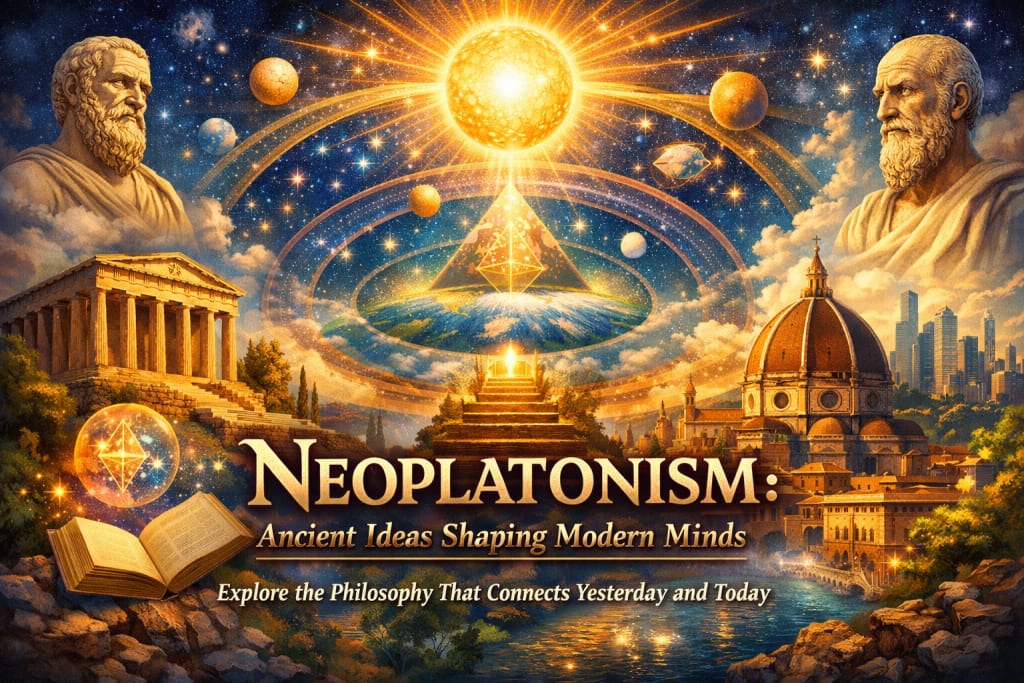
Neoplatonism and the Architecture of Reality
Neoplatonism emerged in the third century CE as a sophisticated philosophical tradition dedicated to understanding the deepest foundations of existence. Rooted in the dialogues of Plato and shaped by centuries of interpretation, Neoplatonic thought sought to explain reality not merely as a physical or material phenomenon, but as a structured hierarchy of being, intellect, and transcendence. Central to the tradition lay the conviction that all existence originates from a single, ultimate principle often described as the Good or the One, a source beyond form, division, and limitation.
Within Neoplatonic philosophy, reality unfolds through ordered levels of emanation rather than mechanical creation. Intellect, soul, and the material cosmos arise as successive expressions of an underlying unity, each level reflecting the perfection of its source while possessing distinct characteristics. Such a worldview provided a metaphysical explanation for diversity, order, and intelligibility within the cosmos, while preserving the idea of an absolute and unchanging origin. The human mind occupied a meaningful position within this structure, capable of recognizing higher realities through reason, contemplation, and ethical refinement.
Neoplatonism also stands apart for its integration of philosophical rigor with spiritual aspiration. Logical analysis, metaphysical speculation, and disciplined contemplation functioned together as paths toward intellectual clarity and inner transformation. Philosophical inquiry served not only as an academic exercise but as a means of aligning consciousness with the deeper order of existence. This synthesis influenced intellectual life across late antiquity, shaping theological reflection, mystical traditions, and metaphysical systems within multiple cultural contexts.
As a philosophical tradition, Neoplatonism offered a vision of reality marked by coherence, purpose, and intelligibility. The emphasis on unity, moral elevation, and intellectual ascent continues to inform discussions of metaphysics, consciousness, and spirituality. Through its enduring concepts and carefully constructed worldview, Neoplatonism remains a vital source of insight into the relationship between being, thought, and transcendence.
Alexandria, Plotinus, and the Birth of a Metaphysical Tradition
Neoplatonism took shape within the intellectually charged environment of the third century CE, drawing early momentum from the cosmopolitan city of Alexandria. Renowned as a crossroads of scholarship, commerce, and religious exchange, Alexandria fostered dialogue among Greek philosophy, Egyptian theology, Jewish intellectual traditions, and emerging Christian thought. Libraries, academies, and informal scholarly circles cultivated an atmosphere where metaphysical speculation and spiritual inquiry flourished side by side. Within such a setting, philosophical synthesis became not only possible but inevitable.
Plotinus of Lycopolis stands at the center of Neoplatonism’s formative period. Born in Roman Egypt during the early third century, Plotinus pursued philosophical training in Alexandria before later establishing a teaching circle in Rome around 244 CE. Surviving biographical accounts, preserved by students, describe a thinker deeply committed to contemplative practice and metaphysical investigation. Intellectual development unfolded amid a landscape shaped by earlier Platonism, Aristotelian analytical methods, Stoic ethical frameworks, and religious cosmologies circulating throughout the eastern Mediterranean. Rather than reproducing earlier doctrines, Plotinus refined and reinterpreted Platonic philosophy into a comprehensive vision of reality structured by transcendence and unity.
A defining feature of Plotinian philosophy involved the articulation of hypostases, a term denoting fundamental levels of reality. The concept described existence as an ordered procession from absolute simplicity toward increasing multiplicity. At the summit stands the One, an ineffable source beyond being and intellect. From the One proceeds Intellect, the realm of perfect forms and unified knowledge. From Intellect emerges Soul, the dynamic principle responsible for life, motion, and the organization of the material cosmos. Each hypostasis maintains dependence upon its source while expressing diminished unity through differentiation.
The principal record of Plotinus’ teachings survives in the Enneads, a structured collection of treatises compiled and edited by the student Porphyry in the late third century. Arranged into six groups of nine texts, the compilation preserves systematic explorations of metaphysics, epistemology, ethics, and spiritual ascent. Within those writings appear the foundational formulations of the One, Intellect, and Soul that shaped subsequent Neoplatonic development. Through careful argumentation and contemplative insight, the Enneads established a durable philosophical architecture that guided later thinkers across late antiquity and beyond.
The Ladder of Being and Consciousness
Neoplatonic philosophy rests upon a tightly interwoven set of metaphysical principles designed to explain how unity gives rise to diversity, how consciousness relates to ultimate reality, and how existence maintains coherence across visible and invisible domains. Careful study reveals a system structured not as disconnected doctrines but as an organic architecture of being. Each level of reality expresses dependence upon a higher principle while contributing to the intelligibility of the cosmos as a whole.
The One
At the summit of Neoplatonic metaphysics stands the One, the absolute foundation of all reality. The One exists beyond being, beyond intellect, and beyond every category used to describe finite existence. Language, bound to distinction and limitation, fails to grasp such a principle. For this reason, Neoplatonic writers frequently relied upon negative theology, describing the One through what cannot be attributed rather than through positive definition.
Simplicity forms the defining characteristic of the One. No division, multiplicity, or composition can exist within such absolute unity. All attributes associated with created existence, including motion, form, quantity, and thought, remain absent at this highest level. Despite such transcendence, the One serves as the inexhaustible source of all that exists. Every level of reality depends upon this principle for existence, intelligibility, and order.
Emanation provides the framework through which reality flows from the One. Unlike material production, emanation implies no division, loss, or transformation within the source. Light radiating from the sun often served as a classical analogy. Illumination spreads outward while the source remains undiminished. Through this model, Neoplatonic metaphysics preserved both divine transcendence and cosmic continuity.
The Intellect (Nous)
Immediately proceeding from the One stands the Intellect, known in Greek as Nous. This level represents the first domain in which multiplicity appears, though still unified within perfect coherence. The Intellect contains the totality of intelligible forms, the eternal archetypes originally articulated in Platonic philosophy. Justice, beauty, equality, number, life, and being itself exist within this realm as fully actualized realities rather than abstractions derived from sensory experience.
Knowledge within the Intellect differs fundamentally from discursive human reasoning. No separation exists between knower and known. Thought occurs as direct, unified apprehension. Each form exists in mutual transparency with every other form, producing a state of total intelligibility. Truth within this realm remains timeless, unchanging, and complete.
Self-reflection characterizes the activity of the Intellect. Contemplation of the One generates the Intellect’s existence, while contemplation of its own contents sustains the intelligible cosmos. Through this perpetual act of knowing, the Intellect becomes the structural blueprint for all lower realities. Every pattern expressed within nature, mathematics, ethics, and beauty reflects participation in intelligible forms rooted in this level.
The Soul
From the Intellect proceeds the hypostasis of Soul, the dynamic principle responsible for life, motion, and psychic awareness. The Soul functions as an intermediary reality, linking intelligible perfection with the realm of generation and change. Dual orientation defines its nature. One aspect remains turned upward toward the Intellect, preserving access to eternal forms. Another aspect extends downward, organizing and animating the material universe.
Within Neoplatonic cosmology, the World Soul governs the order of the cosmos. Celestial motion, natural law, biological life, and temporal processes unfold through this animating principle. Individual souls emerge within this broader psychic continuum. Rational capacity, moral awareness, imagination, and perception all belong to the soul’s faculties as expressed within embodied existence.
Embodiment introduces fragmentation and distraction. Sensory immersion can obscure awareness of intelligible origins. Neoplatonic ethics therefore emphasized purification, philosophical discipline, and contemplative ascent. Intellectual clarification and moral refinement restore alignment with higher realities. Through such ascent, the soul reorients toward unity rather than dispersion.
Emanation and the Structure of Reality
Emanation forms the governing principle that binds the entire Neoplatonic system. Reality unfolds not through temporal manufacture but through ontological procession. Each level arises necessarily from the superabundance of its source. Perfection generates expression without intention, effort, or division.
The sequence follows a precise metaphysical order. The One stands as absolute unity. From unity emerges the Intellect, containing the fullness of intelligible being. From the Intellect proceeds Soul, extending intelligibility into motion and life. Beyond Soul unfolds the material cosmos, the realm of change, multiplicity, and spatial extension.
Matter occupies the lowest position within this hierarchy. Neoplatonic writers often described matter as indeterminate potentiality, lacking form until shaped by soul and intellect. Distance from the One corresponds to diminished unity and increased multiplicity. Such gradation explains the coexistence of order and imperfection within the visible world.
Philosophical practice within this framework carried existential significance. Intellectual contemplation, ethical cultivation, and aesthetic sensitivity functioned as modes of ascent. Movement toward unity represented not spatial travel but ontological reorientation, a return from fragmentation toward foundational simplicity. Through this vertical vision of reality, Neoplatonism articulated one of antiquity’s most intricate syntheses of metaphysics, psychology, and cosmology.
Ascent Through Silence and Illumination
Neoplatonism developed not only as a metaphysical system but also as a disciplined path of interior transformation. Philosophical reflection, within this tradition, extended beyond abstract reasoning into the domain of direct spiritual apprehension. Mystical experience occupied a central role, understood as an immediate awareness of ultimate reality surpassing intellectual analysis. Such experience did not reject philosophy but fulfilled philosophical inquiry through lived realization.
Accounts preserved within Neoplatonic writings describe union with the One as the highest fulfillment of conscious existence. This union involved no spatial movement and no sensory perception. Instead, mystical vision unfolded as an awakening to foundational unity underlying all multiplicity. Conceptual thought, dependent upon distinction and comparison, could not operate within such awareness. Silence, simplicity, and inward stillness therefore formed essential conditions for encounter.
Descriptions attributed to Plotinian contemplation portray moments in which the soul rises beyond discursive reasoning into direct presence. No image, form, or symbol mediates this encounter. Awareness becomes unified, stripped of fragmentation. Light served as a frequent metaphor, not as physical luminosity but as intelligible radiance conveying immediacy, clarity, and indivisibility. Vision language conveyed insight without sensory mechanism, suggesting perception rooted in intellect rather than bodily sight.
Preparation for such realization required sustained ethical and psychological refinement. Neoplatonic texts emphasized purification as a gradual disentanglement from excess attachment to sensory life. Material preoccupation, emotional turbulence, and moral disorder were viewed as forces dispersing attention outward. Philosophical discipline functioned as a reorientation, drawing consciousness back toward intelligible origins.
Intellectual contemplation formed one stage within this ascent. Study of eternal forms, meditation upon unity, and reflection upon metaphysical order clarified the inner faculties. Yet contemplation alone did not complete the process. A further movement beyond thought became necessary, a surrender of multiplicity within awareness itself. Through this inward concentration, the soul approached likeness to the simplicity of the One.
Interiorization marked a defining feature of Neoplatonic mysticism. Rather than seeking transcendence through external ritual alone, the tradition located the pathway within the depths of consciousness. Layers of identity associated with social role, bodily sensation, and temporal concern were gradually quieted. What remained, in advanced states of contemplation, was a purified awareness capable of recognizing participation in absolute unity.
Mystical union, within this philosophical framework, did not imply permanent absorption or loss of individual existence. Descriptions suggest episodic encounters, transformative yet fleeting, leaving lasting intellectual and ethical impact. After such vision, renewed engagement with philosophical life carried deeper coherence, guided by memory of unity.
Through this integration of metaphysics and contemplative practice, Neoplatonism articulated one of antiquity’s most refined accounts of mystical ascent. The tradition preserved a vision in which knowledge, virtue, and spiritual illumination converged, presenting human consciousness as capable of awakening to the deepest ground of reality.
Architects of the Neoplatonic Legacy
Neoplatonism did not remain confined to the teachings of a single founder. Successive generations of philosophers expanded, systematized, and reinterpreted its metaphysical vision across nearly three centuries. Intellectual continuity combined with creative development, producing a lineage of thinkers who preserved core doctrines while adapting them to new religious, cultural, and philosophical environments. Through commentary, theological speculation, ritual theory, and metaphysical system building, these figures ensured the endurance and transformation of the tradition.
Porphyry and the Preservation of Doctrine
Among the earliest inheritors of Plotinian philosophy stood Porphyry, a Syrian born intellectual whose scholarship proved decisive for the survival of Neoplatonism. Active during the third century CE, Porphyry combined rigorous philosophical training with editorial discipline. The most enduring contribution lay in the compilation and arrangement of the Enneads, the collected treatises of Plotinus. Organization into six groups of nine treatises established the textual structure through which later centuries encountered Plotinian metaphysics.
Philosophical activity extended beyond editorial work. Porphyry composed commentaries on both Plato and Aristotle, pursuing harmony between Platonic metaphysics and Aristotelian logic. This conciliatory effort shaped late antique education, where logical analysis functioned as preparation for higher metaphysical inquiry. The Isagoge, an introductory text to Aristotle’s Categories, became foundational within medieval scholastic curricula. Latin translations circulated widely, influencing logical classification, predication theory, and debates concerning universals.
Porphyry also defended traditional Hellenic religion against Christian theological expansion. Polemical writings critiqued scriptural interpretation and doctrinal claims, though many of these works survive only through later refutations. Despite religious controversy, philosophical influence endured through pedagogical and textual transmission.
Iamblichus and the Sacralization of Philosophy
A significant transformation within Neoplatonism emerged through the work of Iamblichus in the late third and early fourth centuries CE. Educated within the Porphyrian intellectual lineage, Iamblichus diverged from earlier emphases on purely intellectual ascent. Philosophical contemplation, while essential, was judged insufficient for achieving union with transcendent principles.
Theurgical practice became central within this revised framework. Theurgy referred to ritual actions employing sacred symbols, invocations, and material correspondences believed to attract divine presence. Unlike magic oriented toward worldly manipulation, theurgy aimed at spiritual elevation and purification. Ritual functioned as a participatory bridge between material existence and divine intelligibility.
Iamblichus articulated a theology populated by hierarchies of gods, daimons, and intermediary intelligences. These beings mediated between human souls and transcendent unity. Symbol, number, geometry, and liturgical gesture all possessed metaphysical significance. Through ritual alignment with cosmic order, the soul could ascend beyond limitations imposed by embodiment.
This sacralization of philosophy reshaped later Neoplatonism, particularly within Syrian and Athenian schools. Integration of metaphysics, liturgy, and cosmology influenced Byzantine spirituality, Hermetic traditions, and later esoteric systems.
Proclus and Systematic Metaphysical Architecture
The fifth century CE witnessed the intellectual maturity of Neoplatonism in the work of Proclus, head of the revived Platonic Academy in Athens. Proclus developed one of antiquity’s most intricate metaphysical systems, combining rigorous logic with expansive theological speculation. Philosophical writing displayed extraordinary structural precision, reflecting an effort to map every level of reality within a unified explanatory framework.
The Elements of Theology presented metaphysical propositions in axiomatic form, each followed by deductive demonstration. This geometrical method mirrored mathematical reasoning, reinforcing the claim that metaphysical truths possessed demonstrable coherence. Proclus elaborated complex hierarchies extending beyond the triad of One, Intellect, and Soul. Divine henads, intelligible gods, intellectual gods, and psychic orders populated the cosmos, forming an unbroken chain of procession and return.
Extensive commentaries on Plato’s Timaeus, Parmenides, and Republic preserved invaluable interpretations of classical dialogues. Through these works, Proclus transmitted Platonic cosmology, epistemology, and theology to later Byzantine, Islamic, and Latin intellectual traditions. Medieval thinkers encountered Platonic philosophy largely through Proclean mediation, often without direct access to original Greek sources.
Damascius and the Final Flowering
The late Neoplatonic period culminated in the work of Damascius, active during the late fifth and early sixth centuries CE. As head of the Athenian philosophical school, Damascius advanced metaphysical inquiry into increasingly apophatic territory. Philosophical analysis probed the limits of language, knowledge, and conceptualization concerning the First Principle.
Writings such as Problems and Solutions Concerning First Principles intensified the doctrine of ineffability. The ultimate source of reality, within this framework, exceeded not only description but also intelligibility. Even the term One risked imposing conceptual limitation upon absolute transcendence. Such philosophical rigor represented both culmination and transformation of earlier Neoplatonic theology.
Imperial intervention brought institutional disruption. In 529 CE, the Byzantine emperor Justinian I ordered the closure of pagan philosophical schools in Athens. This decree symbolized the end of public Neoplatonic academies within the classical Mediterranean world. Yet intellectual extinction did not follow. Scholars migrated eastward, carrying manuscripts and doctrines into Syriac, Persian, and later Arabic intellectual centers.
Transmission through translation movements ensured continuity. Neoplatonic metaphysics entered Islamic philosophy, influenced Christian theological speculation, and resurfaced in medieval and Renaissance Platonism. Through the labors of these major thinkers, Neoplatonism evolved from a third century philosophical movement into a transhistorical current shaping metaphysical thought across civilizations.
Sacred Philosophies in Dialogue
Neoplatonism entered the religious landscape of late antiquity and the medieval world not as a rival creed but as a philosophical language capable of articulating transcendence, creation, and spiritual transformation. Metaphysical vocabulary developed within Platonic and Neoplatonic schools offered theologians conceptual instruments for expressing doctrines concerning divine unity, cosmological order, and the destiny of the soul. Through translation movements, commentarial traditions, and interreligious scholarship, Neoplatonic thought flowed into Christian, Jewish, and Islamic intellectual life, shaping theological reflection across centuries.
Christian Theology and Contemplative Ascent
Engagement between Neoplatonism and Christian theology began during the formative centuries of doctrinal development. Educated converts and theologians encountered Greek philosophical texts while seeking language capable of expressing the transcendence of God beyond material limitation. Among the most influential figures stood Augustine of Hippo, whose intellectual formation included exposure to Latin translations of Neoplatonic writings prior to baptism.
Philosophical influence appears throughout theological and autobiographical works. Descriptions of divine immateriality, interior illumination, and the ascent of the mind toward eternal truth reflect Neoplatonic conceptual frameworks. The inward turn of consciousness, central to Augustinian spirituality, parallels earlier philosophical emphasis on interior contemplation as a pathway to ultimate reality.
Christian theologians adopted certain metaphysical structures while modifying others. Divine transcendence, hierarchical cosmology, and intellectual participation in eternal truth found theological expression. Yet Christian doctrine rejected emanation as the mechanism of cosmic origin. Creation ex nihilo affirmed divine freedom and intentionality rather than necessary ontological overflow. Despite doctrinal divergence, Neoplatonic contemplative ideals profoundly influenced monastic spirituality, mystical theology, and negative theology within Eastern and Western Christianity.
Jewish Philosophy and Mystical Cosmology
Neoplatonic currents entered Jewish intellectual culture primarily through Arabic philosophical transmission during the medieval period. Philosophers writing in Arabic engaged Greek metaphysics within Islamic intellectual centers, and Hebrew translations later carried these ideas into Jewish scholastic discourse. Among the earliest Jewish thinkers shaped by Neoplatonic cosmology stood Solomon ibn Gabirol, whose philosophical poetry and prose articulated a universe structured through divine will, universal matter, and hierarchical emanation.
Metaphysical speculation concerning divine unity and multiplicity also appears in the writings of Maimonides. Although more deeply aligned with Aristotelian rationalism, Maimonidean negative theology resonates with Neoplatonic apophatic traditions that emphasized the ineffability of the divine essence. Language about God required negation of limiting attributes rather than positive description.
Parallel developments emerged within Jewish mysticism. Kabbalistic cosmology, particularly doctrines concerning sefirotic emanation and layered divine manifestation, exhibits structural resemblance to Neoplatonic hierarchies. Distinct scriptural foundations and symbolic systems differentiate the traditions, yet shared metaphysical concerns reveal convergent efforts to articulate the relationship between infinite divinity and finite creation.
Islamic Philosophy and the Intellective Cosmos
Islamic intellectual civilization provided one of the most fertile environments for the reception and transformation of Neoplatonic philosophy. Translation movements centered in Abbasid Baghdad rendered Greek philosophical works into Arabic, often through Syriac intermediaries. Within this scholarly milieu, Neoplatonic metaphysics interwove with Aristotelian logic and Qur’anic theology, generating sophisticated philosophical syntheses.
Among the leading figures stood Al-Farabi, whose cosmology described emanative intellects governing celestial spheres and mediating divine knowledge to humanity. Philosophical prophecy, political order, and metaphysical hierarchy formed interconnected elements within this system.
Further development appeared in the writings of Avicenna, also known as Ibn Sina. Avicennian metaphysics articulated a Necessary Existent from whom proceeded successive intellects culminating in the Active Intellect responsible for human cognition. Integration of Neoplatonic emanation with Aristotelian substance theory produced one of medieval philosophy’s most influential cosmologies.
Illuminationist philosophy, associated with Suhrawardi, introduced symbolic and visionary dimensions into Islamic metaphysics. Light metaphysics, angelology, and gradations of luminous being echoed Neoplatonic hierarchies while grounding speculation in Islamic revelatory symbolism.
A significant textual conduit for these developments appeared in the Arabic work known as the Theology of Aristotle. Despite attribution to Aristotle, the text derived largely from Neoplatonic sources, particularly paraphrased materials from Plotinian treatises. Circulation of this work shaped philosophical theology, psychology, and cosmology throughout the Islamic world.
Through these theological engagements, Neoplatonism extended far beyond its late antique philosophical origins. Conceptual frameworks concerning divine transcendence, hierarchical reality, and contemplative ascent entered scriptural traditions, reshaping metaphysical reflection while adapting to doctrinal commitments unique to each faith. The resulting dialogue produced some of the most enduring syntheses of philosophy and religion in intellectual history.
Echoes of Unity in Modern Philosophy and Culture
Neoplatonic thought did not conclude with the closure of ancient philosophical schools. Intellectual afterlives unfolded across Renaissance revival, early modern metaphysics, German idealism, Romantic symbolism, and contemporary philosophy of consciousness. Through translation, commentary, and artistic interpretation, Neoplatonic metaphysics reentered cultural discourse, shaping reflections on beauty, unity, imagination, and the structure of reality.
Renaissance Recovery and Humanist Transformation
Renewed engagement with Platonic and Neoplatonic philosophy emerged in fifteenth century Italy, where manuscript discoveries and scholarly patronage encouraged systematic translation of Greek texts into Latin. A central figure in this revival was Marsilio Ficino, a Florentine priest, physician, and philosopher supported by the Medici intellectual circle.
Ficino translated the complete works of Plato along with writings attributed to late antique Neoplatonists. These translations rendered previously inaccessible metaphysical systems available to Western European scholars. Ficinian philosophy fused Christian theology with Platonic cosmology, presenting the universe as a harmonious hierarchy animated by divine love.
Particular emphasis fell upon the dignity and mediating role of the human soul. Positioned between material and intelligible realms, the soul possessed the capacity for intellectual ascent through contemplation, virtue, and aesthetic experience. Ficino’s writings on spiritual love, cosmic sympathy, and astral influence shaped Renaissance literature, visual art, and courtly philosophy. Harmonic proportion, sacred geometry, and symbolic light imagery within Renaissance painting and architecture reflected this revived metaphysical vision.
German Idealism and Metaphysical Unity
Neoplatonic structures resurfaced in modern philosophical systems seeking to reconcile multiplicity with absolute unity. German idealist thinkers, working in the late eighteenth and early nineteenth centuries, developed metaphysical frameworks echoing ancient emanationist hierarchies while grounding speculation in epistemology and self consciousness.
Philosophy associated with Friedrich Wilhelm Joseph Schelling explored nature as a dynamic expression of absolute spirit. Nature and mind formed complementary manifestations of a single underlying reality, recalling Neoplatonic procession from unity into differentiated existence. Artistic intuition, within Schelling’s philosophy, provided privileged access to this unity, paralleling earlier doctrines of contemplative vision.
Systematic metaphysics advanced further in the work of Georg Wilhelm Friedrich Hegel. Dialectical development, unfolding through stages of self realization, bears structural resemblance to Neoplatonic return to source. Absolute Spirit, achieving full self knowledge through historical and conceptual evolution, reflects a modern reinterpretation of intelligible unity expressing itself through multiplicity.
Romanticism, Symbol, and the Interior Cosmos
Romantic intellectual culture extended Neoplatonic sensibilities into literature, aesthetics, and philosophy of imagination. Reaction against mechanistic materialism encouraged renewed attention to interior experience, symbolic perception, and organic unity within nature.
Poetic and philosophical works associated with Samuel Taylor Coleridge articulated imagination as a mediating faculty capable of perceiving unity within diversity. Nature appeared not as inert matter but as a living expression of spiritual principle. Symbol functioned as a bridge between visible form and invisible meaning, echoing Neoplatonic participation between material image and intelligible archetype.
Romantic art and literature frequently portrayed ascent, illumination, and visionary encounter. Mountains, stars, light, and vast landscapes became metaphors for transcendence and inward awakening. Through such symbolism, Neoplatonic metaphysics entered cultural imagination beyond formal philosophical treatise.
Contemporary Philosophy and Consciousness Studies
Modern scholarly engagement with Neoplatonism spans philosophy of mind, metaphysics, religious studies, and comparative mysticism. Renewed interest in consciousness as a fundamental dimension of reality has prompted reconsideration of hierarchical models of mind and being.
Process philosophy, phenomenology, and transpersonal psychology explore themes resonant with Neoplatonic ascent, participation, and unity. Questions concerning the relationship between subject and object, intellect and intuition, multiplicity and ground of being continue to draw upon conceptual resources refined within late antique metaphysics.
Academic study also investigates Neoplatonism’s influence on symbolic systems, sacred art, cosmological imagination, and theories of beauty. Intellectual history reveals continuity rather than rupture, with ancient metaphysical structures reinterpreted through modern philosophical vocabulary.
Across Renaissance revival, idealist system building, Romantic symbolism, and contemporary inquiry, Neoplatonism persists as a living philosophical inheritance. The vision of reality as an ordered expression of unity continues to inspire reflection on consciousness, creativity, and the intelligible depth of existence.
An Enduring Vision of Unity and Meaning
Neoplatonism occupies a distinctive position within the history of ideas, functioning both as an inherited philosophical system and as an interpretive lens through which later cultures have examined existence, consciousness, and transcendence. Rather than fading with the decline of ancient academies, Neoplatonic metaphysics persisted through manuscript transmission, theological adaptation, artistic symbolism, and philosophical reinterpretation. Intellectual continuity allowed its central doctrines to remain active within scholarly and spiritual discourse across centuries.
At the heart of this legacy stands a comprehensive vision of reality structured through unity, intelligibility, and hierarchical participation. Existence, within this framework, unfolds as an ordered continuum linking material multiplicity to transcendent simplicity. Such a model offers explanatory coherence for questions concerning causality, form, consciousness, and ethical aspiration. Philosophical reflection shaped by this structure often emphasizes interconnection rather than fragmentation, purposiveness rather than randomness, and intelligible order rather than metaphysical isolation.
Academic engagement with Neoplatonism spans multiple disciplines. Historians of philosophy analyze late antique metaphysical architecture alongside its transmission into medieval and Renaissance thought. Scholars of religion examine contemplative ascent, negative theology, and symbolic cosmology within comparative frameworks. Literary studies investigate Neoplatonic imagery embedded in poetic and allegorical traditions. Psychological and phenomenological inquiry explores parallels between hierarchical models of soul and layered theories of consciousness.
Interpretive diversity characterizes modern evaluation of the tradition. Some scholars emphasize mystical dimensions, highlighting experiential union, contemplative illumination, and metaphors of inward ascent. Others foreground logical rigor, systematic metaphysics, and ontological analysis rivaling later philosophical systems in complexity. This plurality of readings reflects the breadth of Neoplatonism itself, a tradition equally at home within rational dialectic and spiritual introspection.
Contemporary debates concerning mind, reality, and meaning continue to find conceptual resonance within Neoplatonic structures. Discussions surrounding the relationship between consciousness and cosmos, unity and plurality, transcendence and immanence often revisit problems articulated with remarkable precision in late antiquity. Hierarchical models of awareness, participatory metaphysics, and the notion of reality grounded in intelligible principles remain philosophically generative.
Neoplatonism endures, therefore, not as a relic confined to intellectual history but as a living reservoir of metaphysical insight. Systematic depth, symbolic richness, and existential scope sustain ongoing engagement. Through its architecture of unity and ascent, the tradition continues to offer a profound framework for contemplating the nature of being and the place of consciousness within the totality of existence.
Recommended Reading: #commissionearned
Neoplatonism (Hackett Classics) 2nd Edition by R. T. Wallis
Clear orientation within the intellectual world of late antiquity defines the strength of this volume. Historical framing introduces the social and philosophical environment in which Neoplatonism took shape, allowing metaphysical doctrines to emerge from lived intellectual conditions rather than abstraction alone. Careful exposition follows the development of the tradition from Plotinus through later system builders, clarifying how successive thinkers expanded the original philosophical architecture. Central teachings such as the One, Intellect, Soul, and emanation receive precise treatment supported by textual interpretation. Wallis also addresses interactions between Neoplatonism and rising Christian theology, illuminating both philosophical borrowing and doctrinal tension. Analytical clarity allows complex hierarchies of being to remain intelligible without oversimplification. The work functions as a reliable conceptual gateway into the metaphysical vision that shaped late antique spirituality and philosophy.
The Essential Plotinus (Hackett Classics) 2nd Edition by Plotinus
Encounter with primary philosophical writing carries a distinct intellectual immediacy, and this collection provides that experience through carefully selected treatises from the Enneads. Passages reveal metaphysics in active formation, shaped through argument, analogy, and contemplative reflection. Discussions of beauty, intellect, evil, and transcendence unfold with a combination of logical precision and inward intensity. The structure of reality appears not merely as doctrine but as realization grounded in philosophical practice. Editorial framing supports comprehension while preserving the density of the original Greek thought world. Readers gain insight into how mystical ascent, metaphysical unity, and ethical purification interlock within Plotinian philosophy. Engagement with these texts deepens understanding of the experiential and intellectual foundations underlying later Neoplatonic development.
Scholarly breadth defines this handbook, assembling specialist research across the full chronological and thematic range of Neoplatonic studies. Essays investigate figures from Plotinus to Damascius while also examining lesser studied philosophers whose contributions shaped doctrinal transmission. Thematic studies explore metaphysics, epistemology, psychology, cosmology, and ritual practice, revealing the multidimensional character of the tradition. Reception history receives sustained attention, tracing philosophical migration into Byzantine, Islamic, and Latin medieval contexts. Philological rigor combines with philosophical analysis, offering both textual scholarship and conceptual interpretation. Diversity of academic voices produces a layered portrait of Neoplatonism as evolving intellectual culture rather than static doctrine. The volume supports advanced study of hierarchical ontology, contemplative ascent, and interreligious philosophical exchange.
The Gang of Three: Socrates, Plato, Aristotle (Ancient Wisdom) by Neel Burton
Philosophical lineage forms the organizing thread of this work, presenting Socrates, Plato, and Aristotle as an interconnected triad whose ideas shaped subsequent metaphysical traditions. Narrative biography intertwines with philosophical exposition, grounding abstract doctrines in personal intellectual journeys. Platonic metaphysics receives particular focus, especially the theory of forms and the structure of intelligible reality that later informed Neoplatonic hierarchy. Aristotelian logic and psychology appear as complementary developments, clarifying analytical tools later synthesized within late antique philosophy. Ethical inquiry, dialectical method, and contemplative reflection emerge as shared pursuits across the three thinkers. Accessible yet thoughtful prose invites sustained engagement with foundational Greek philosophy. Familiarity with this triadic inheritance strengthens comprehension of how Neoplatonism extended classical metaphysical speculation into a more explicitly transcendental system.
Ritual practice and metaphysical ascent converge within this exploration of theurgy in later Neoplatonic spirituality. Attention centers on ceremonial techniques believed to align the soul with divine hierarchies through symbolic action. Sacred objects, invocations, and cosmological correspondences receive detailed interpretation, illustrating how material forms functioned as conduits of intelligible power. Development from Plotinian contemplation toward the ritual emphasis associated with Iamblichean traditions appears as a major thematic movement. Angelology and intermediary beings occupy an important role, mediating between transcendent unity and embodied consciousness. Discussions of death and post corporeal ascent extend Neoplatonic metaphysics into eschatological speculation. The study illuminates experiential dimensions of the tradition often overshadowed by purely philosophical analysis.
Neoplatonism and Gnosticism (Neoplatonism Vol 6) edited by Richard T. Wallis
Comparative inquiry guides this collection, examining philosophical intersections between Neoplatonic metaphysics and diverse Gnostic cosmologies. Contributors analyze shared structural themes including emanation, hierarchical being, and the soul’s estrangement from material immersion. Careful distinction accompanies comparison. Neoplatonic affirmation of cosmic intelligibility contrasts with Gnostic depictions of materiality as rupture or fall. Textual studies investigate late antique intellectual environments where philosophical and revelatory traditions coexisted and interacted. Polemical exchanges receive attention, revealing how each system defined identity through critique as well as adaptation. Reception history traces how later interpreters blurred or clarified boundaries between the two traditions. The volume deepens understanding of Neoplatonism’s distinct metaphysical optimism while situating it within a wider landscape of ancient spiritual philosophy.
Returning to the Wellsprings of Wisdom
Engagement with Neoplatonism reveals far more than an isolated philosophical system preserved in late antique manuscripts. Intellectual exploration uncovers a vast contemplative tradition concerned with the structure of reality, the capacities of consciousness, and the metaphysical ground from which existence unfolds. From the scholarly environment of Alexandria to the manuscript circles of Renaissance Florence, transmission of Neoplatonic thought shaped theological reflection, philosophical speculation, artistic symbolism, and mystical practice across civilizations.
Sustained study rewards patience. Primary texts demand careful reading, often requiring repeated engagement to grasp layered metaphysical arguments and symbolic language. Treatises attributed to Plotinus, Porphyry, Iamblichus, and Proclus invite slow contemplation rather than rapid consumption. Intellectual ascent within this tradition mirrors philosophical method itself, progressing through stages of clarification, reflection, and interior insight.
Independent research strengthens comprehension. Public libraries provide invaluable access to scholarly translations, academic commentaries, and historical studies without financial barrier. Many library systems maintain interlibrary loan programs, granting readers access to specialized philosophical works held in distant collections. University affiliated libraries frequently extend guest privileges, opening additional avenues for study within quiet research environments conducive to sustained concentration.
Digital resources offer convenience yet require discernment. Open access archives, digitized manuscripts, and academic databases expand availability of rare texts and modern scholarship. At the same time, unverified online material can circulate mistranslations, decontextualized excerpts, or speculative interpretations presented without scholarly grounding. Cross referencing digital findings with established academic publications preserves intellectual accuracy and protects against distortion of complex doctrines.
Personal inquiry forms an essential component of philosophical engagement. Annotation, comparative reading, and reflective writing cultivate deeper understanding than passive absorption alone. Study groups, lecture series, and public philosophy forums provide opportunities for dialogue that sharpens interpretation through collective examination.
Neoplatonism endures not solely through preservation of ancient writings but through the continued effort of readers willing to wrestle with its questions. Investigation into unity, multiplicity, intellect, and transcendence remains as vital now as in late antiquity. Through disciplined reading and careful research, the philosophical vision first articulated within Neoplatonic schools continues to illuminate pathways of thought concerned with the deepest structures of being.
About the Creator
Marcus Hedare
Hello, I am Marcus Hedare, host of The Metaphysical Emporium, a YouTube channel that talks about metaphysical, occult and esoteric topics.
https://linktr.ee/metaphysicalemporium
Keep reading
More stories from Marcus Hedare and writers in BookClub and other communities.
The Martinist Order
The Hidden Current of Martinism Beneath the visible progression of Western intellectual, religious, and philosophical development exists a disciplined initiatory current dedicated to the restoration of humanity’s original spiritual condition. The Martinist Order represents one of the most enduring expressions of that current. Martinism does not function as a religion, church, or political fraternity. Martinism operates as an initiatory tradition centered upon the doctrine of reintegration, a spiritual philosophy asserting that humanity originated within divine unity and retains the capacity to consciously return to that state through interior transformation, moral purification, and contemplative knowledge.
By Marcus Hedareabout 8 hours ago in BookClub
Self Help: Grifters' Gospel
On Self-Help, Snake Oil, and the Illusion of Change Psychology professionals and students can be imagined on two opposite sides of a line called self-help books: likely a larger group opposes pop-science and step-by-step manuals filled with talk of success, journaling, and not giving a f**k; others love them, but they aren’t many.
By Avocado Nunzella BSc (Psych) -- M.A.P 13 days ago in BookClub



Comments
There are no comments for this story
Be the first to respond and start the conversation.