
The Boy Who Waited at the Empty Station
Some promises arrive… even if the person never does.

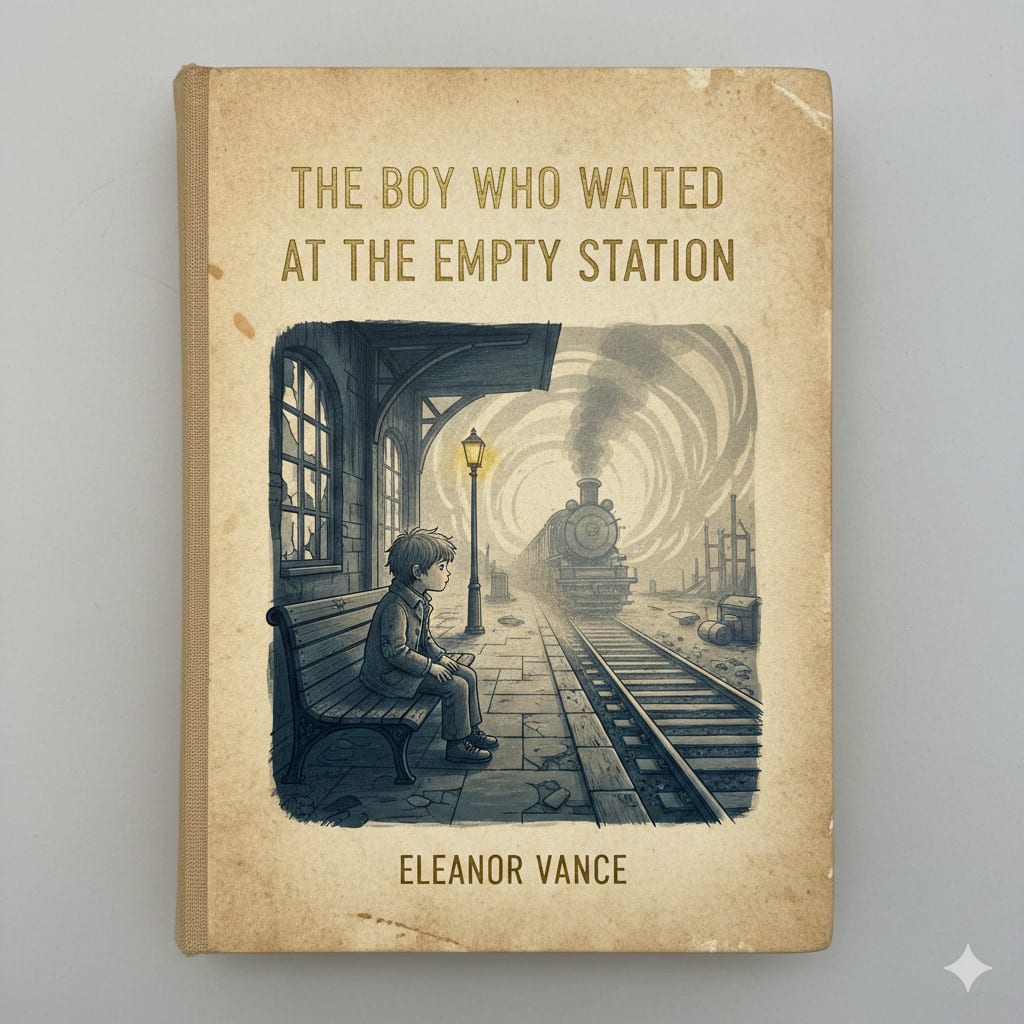
The Boy Who Waited at the Empty Station
The station had not seen a train in twelve years.
Weeds grew between the rusted rails like quiet rebellions. The old ticket booth windows were cracked, their paint peeling in long, tired sighs. A wooden bench sat beneath a crooked sign that once proudly read Rivermouth Station. Now, only a few faded letters remained.
Yet every evening at precisely 6:15 PM, a boy came and sat on that bench.
His name was Ilyas.
He was seventeen, thin as a shadow, with eyes that carried more yesterdays than tomorrows. The villagers called him foolish. Some called him stubborn. A few called him broken.
But Ilyas called it hope.
Twelve years earlier, when he was only five, his father had stood on that very platform with a small brown suitcase and a promise too heavy for such a fragile place.
“I’ll be back on the evening train,” his father had said, kneeling to meet Ilyas’s eyes. “Wait for me if I’m late.”
The train had come.
It had taken his father away.
And it had never returned.
A week later, the railway line shut down due to landslides in the northern hills. Repairs were promised. Repairs never came. Gradually, trains stopped passing through Rivermouth. The station died quietly, like an old man forgotten in his sleep.
But Ilyas remembered the promise.
And so, every evening at 6:15 PM—the time the train used to arrive—he waited.
At first, his mother waited too.
She would stand beside him, holding his small hand as they scanned the distant curve of the tracks. But years have a way of exhausting belief. After three winters and three summers of empty rails, she stopped coming.
“Ilyas,” she would say gently, “sometimes people don’t come back.”
But he would shake his head.
“He said to wait.”
As the seasons passed, the station aged with him. The roof sagged slightly more each year. The metal rails dulled. The wind grew louder in the hollow waiting room.
Still, Ilyas came.
Rain or shine.
Exams or illness.
He would sit on the bench and watch the horizon as if the very act of looking could pull a train into existence.
People whispered about him.
“That boy is trapped in the past.”
“He needs to let go.”
But they did not understand.
Waiting was not weakness to Ilyas.
It was loyalty.
One autumn evening, when the air smelled of burning leaves and distant rain, someone new appeared at the station.
An old man with a cane and a coat too large for his frame shuffled slowly along the platform.
Ilyas noticed him but said nothing.
Few people came here, and those who did usually left quickly, uncomfortable with the heavy silence.
The old man, however, sat at the opposite end of the bench.
“You’re waiting,” he said after a moment.
It was not a question.
“Yes,” Ilyas replied.
“For a train that doesn’t run.”
“For someone who might.”
The old man studied him carefully. “How long?”
“Twelve years.”
The wind moved softly through the broken windows.
“That’s a long time to hold onto a maybe,” the old man murmured.
Ilyas looked at the rails, their rust glowing faintly in the fading light.
“Maybe is better than never.”
The old man smiled faintly, but there was sadness in it.
“I used to work these tracks,” he said. “Back when trains sang through here every day. I was the signal operator.”
Ilyas turned toward him for the first time.
“You were?”
“Yes. I remember the last train that passed before the landslide.”
A strange tension tightened in Ilyas’s chest.
“My father left on the last evening train before the line closed.”
The old man’s gaze sharpened.
“What was his name?”
“Karim Hassan.”
The name hung in the air like a fragile bridge between past and present.
The old man’s eyes darkened slightly, as though a door had opened inside his memory.
“I remember him,” he said slowly.
Ilyas’s heart pounded.
“You do?”
“Yes. Tall man. Nervous smile. Kept checking his watch.”
Ilyas leaned forward.
“That’s him.”
The old man nodded thoughtfully. “There was talk that night. About unstable ground beyond the northern pass. But no one expected what happened.”
“What happened?” Ilyas whispered.
The wind seemed to hold still.
“The landslide didn’t just damage the tracks,” the old man said quietly. “It derailed the final train beyond the hills.”
The words fell heavy.
Ilyas blinked.
“No… They said the train made it to the next city.”
“That’s what they told the town,” the old man replied. “To prevent panic. But I saw the emergency signal flare. I heard the radio transmission before it went silent.”
Ilyas felt the world tilt slightly.
“Was there… were there survivors?”
“A few,” the old man admitted. “But many names were never officially recorded. The railway company closed the file quietly when the line shut down.”
The station felt smaller.
Quieter.
As if even the wind feared what had been spoken.
For twelve years, Ilyas had imagined delay.
A missed connection.
A lost letter.
He had never imagined disaster.
“Why didn’t anyone tell us?” he asked, his voice trembling.
The old man’s eyes filled with something that looked like regret.
“Because sometimes truth feels crueler than hope.”
Silence wrapped around them like a shroud.
Ilyas stared at the tracks.
If the train had never made it…
If his father had never reached the city…
Then what had he been waiting for?
The old man placed a gentle hand on his shoulder.
“You were a child,” he said softly. “Waiting kept your father alive in your heart.”
Tears welled in Ilyas’s eyes, though he had not cried in years.
“I thought if I stopped coming,” he whispered, “it would mean I gave up on him.”
The old man shook his head.
“Letting go of the station doesn’t mean letting go of the love.”
The sky darkened fully now, the evening swallowing the platform.
For the first time, 6:15 PM passed without Ilyas counting the seconds.
He realized something profound: he had not only been waiting for his father.
He had been waiting for permission to move forward.
The old man stood slowly, leaning on his cane.
“I don’t know what happened beyond those hills,” he said gently. “But I know this—you’ve honored him long enough.”
Ilyas looked down the empty track one last time.
The curve where trains once appeared now seemed less like a doorway and more like a memory.
He stood.
The bench creaked softly, as if surprised.
“Will you come tomorrow?” the old man asked.
Ilyas looked at the station—the cracked walls, the silent rails, the echo of a promise made long ago.
He shook his head.
“No.”
The word felt strange.
Heavy.
Freeing.
As they walked away together, the wind moved through Rivermouth Station one final time that evening.
The empty platform remained.
The rusted tracks stretched endlessly into the hills.
But for the first time in twelve years, the boy who waited was no longer there.
And somehow, the station felt quieter than ever.
Not because hope had died.
But because it had finally been laid to rest.
About the Creator
Samaan Ahmad
I'm Samaan Ahmad born on October 28, 2001, in Rabat, a town in the Dir. He pursued his passion for technology a degree in Computer Science. Beyond his academic achievements dedicating much of his time to crafting stories and novels.
Keep reading
More stories from Samaan Ahmad and writers in BookClub and other communities.
The Last Message Before Midnight
At 11:47 PM, the city was unusually quiet. Rain tapped softly against the window of Daniel’s apartment, tracing restless patterns down the glass like anxious fingers. The world outside seemed to be holding its breath, suspended between yesterday and tomorrow. Daniel sat alone at his desk, staring at the dim glow of his phone screen.
By Samaan Ahmadabout 6 hours ago in BookClub
Rachel Reviews: The Spiral Archive by Pieter Hendrik
It's difficult for me to know where to start with a review of this book as it was, for me, an entirely unique experience and one that I'll probably never have again. I don't want that to be interpreted as unenjoyable but it has left me scratching my head a little and ruminating on its content, its themes and its characters.
By Rachel Deemingabout a month ago in BookClub
8 Thought-Provoking Books About Life and Self-Discovery
At some point, we all pause and ask the same quiet but powerful questions: Who am I, really? What gives my life meaning? Am I living authentically—or merely surviving? Books about life and self-discovery exist precisely for these moments. They act as mirrors, mentors, and sometimes gentle provocateurs, inviting us to reflect more deeply on our values, fears, desires, and purpose.
By Diana Meresc6 days ago in BookClub


Comments
There are no comments for this story
Be the first to respond and start the conversation.