
Your Phone is a Leash. You put it on yourself!
You feel it when its not there. The small panic. Pocket check. Nothing!

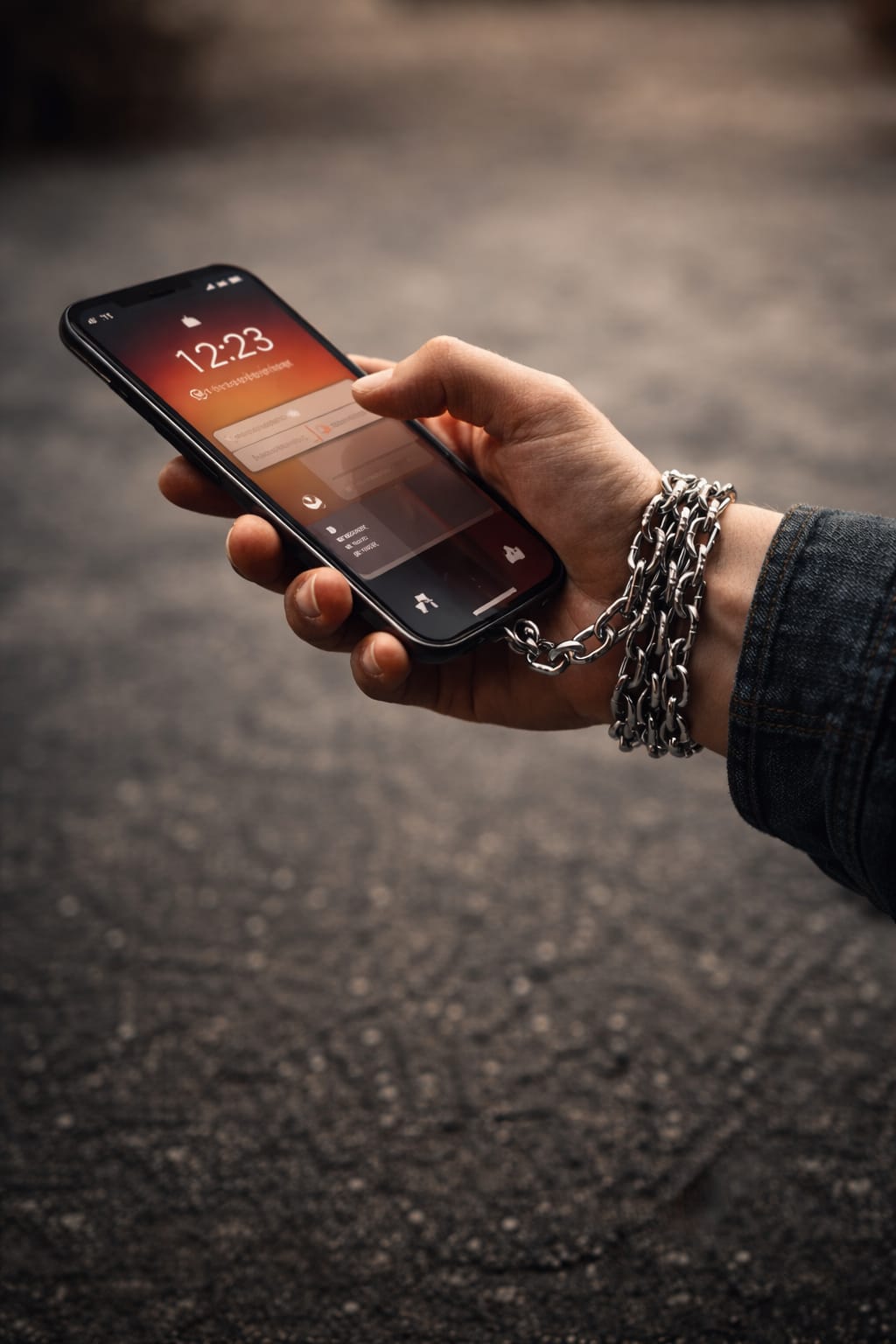
By Jonas Vale.
You Feel It When It’s Not There
The small panic. Pocket check. Nothing. Another pocket. Still nothing.
For a split second, your body reacts as if something essential is missing. Keys? Wallet? No. Worse.
Your phone. That reflex tells you everything. You don’t just carry your phone. You are tethered to it.
And here’s the uncomfortable part:
No one forced it onto you.
You put it on yourself.
The Soft Collar
There was no dramatic moment. No corporate villain locking it around your wrist.
It happened gradually. You enabled notifications. You allowed background refresh. You connected your bank. Your maps. Your health data. Your conversations. Your memories.
Each step felt practical. Each step made life smoother.
Until smooth turned into constant.
Now your phone is not a tool you use.
It is a system you orbit.
The Illusion of Freedom
We tell ourselves the phone represents autonomy.
Work from anywhere. Navigate anywhere. Learn anything. Talk to anyone.
And all of that is true.
But, autonomy without boundaries becomes surveillance.
Not just corporate surveillance.
Self-surveillance. You track your steps. You track your sleep. You track your productivity. You track your mood.
You respond instantly because you can.
Availability becomes expectation. Expectation becomes obligation.
You are reachable at all times.
And reachable slowly becomes required.
The Economics of Attention
The leash is not made of metal.
It is made of incentives.
Every notification competes for your focus. Every app is optimized to reduce friction. Every scroll is engineered to remove stopping points.
The phone is not evil.
It is efficient.
And, efficiency without limits becomes extraction. Your attention is the raw material. Your behavior is the product.
The device in your hand is simply the most elegant interface ever built for harvesting both.
You Chose Convenience
Here is the hard truth.
You were not coerced. You accepted the terms. Because the trade felt fair. Instant answers. Seamless payments. Effortless communication. Endless entertainment.
The leash is padded.
It vibrates gently. It plays music. It delivers affirmation.
But it still tugs.
You check it before you think. You reach for it in silence. You scroll in moments that used to belong to boredom. Boredom used to belong to thought.
Now it belongs to the feed.
The Psychological Hook
The phone compresses time.
Waiting disappears. Gaps disappear. Silence disappears.
But, those gaps were not empty.
They were cognitive rest. They were imagination. They were processing time.
When every idle second is filled, your nervous system never fully settles.
You are always slightly alert. Always slightly anticipating. Always slightly interrupted.
You call it productivity.
Your body calls it stress....
The Social Contract Has Changed
There was a time when not responding immediately was normal.
Now silence signals something. Disinterest. Anger. Avoidance.
Read receipts changed etiquette. Online status changed expectations. Typing indicators changed patience. We redesigned social rules around devices built to eliminate delay. The leash is social as much as technological.
We pull on each other.
The Myth of Disconnection
People talk about digital detox.
Delete the apps. Turn off notifications. Buy a minimalist phone. All of that candon't help.
The deeper question is not about apps.
It is about identity.
Who are you when you are not reachable? Who are you when you are not consuming? Who are you when you are not broadcasting?
If that question feels uncomfortable, the leash is tight.
The Quiet Reclaiming
You do not need to smash your phone.
You need to renegotiate the relationship.
Turn off non-essential notifications. Set response windows. Remove apps that harvest more than they serve. Leave the device in another room when you sleep.
These are not productivity hacks.
They are autonomy practices.
The goal is not rejection of technology.
It is reestablishing hierarchy.
You above device. Device below intention.
Not the other way around.
You Snapped It On
This is not a moral lecture. The phone is extraordinary. It enables work, connection, creativity, safety.
But it is not neutral.
Pretending it is keeps the leash invisible.
The most powerful systems are the ones we consent to without noticing.
You allowed it to follow you everywhere. You allowed it to interrupt you anytime. You allowed it to mediate nearly every interaction.
That is not shame.
That is awareness.
Awareness is where autonomy begins.
Remove the Slack
You may never remove the leash entirely.
Modern life runs through that glass rectangle.
But, you can loosen it. You can create slack.
Moments where nothing buzzes. Conversations without glances downward. Walks without headphones. Meals without screens.
Not because the phone is evil.
But, because attention is finite.
And whatever holds it holds you.
You put the leash on yourself.
Which means you can loosen it..
About the Creator
Jonas Vale
Writing about systems, autonomy, and modern life. Interested in how tools, incentives, and structures influence human freedom. Often in subtle, overlooked ways.
Keep reading
More stories from Jonas Vale and writers in BookClub and other communities.
Rachel Reviews: The Spiral Archive by Pieter Hendrik
It's difficult for me to know where to start with a review of this book as it was, for me, an entirely unique experience and one that I'll probably never have again. I don't want that to be interpreted as unenjoyable but it has left me scratching my head a little and ruminating on its content, its themes and its characters.
By Rachel Deeming30 days ago in BookClub
7 Amazing Books You'll Want to Tell Everyone About
In a world overflowing with stories, it’s rare to encounter books that stay with us long after we turn the final page. Books have the power to transform perspectives, spark creativity, and ignite meaningful conversations. Whether you’re a lifelong reader or just seeking your next great read, discovering a book that resonates deeply can feel like uncovering a hidden gem. Below is a list of 7 amazing books you'll want to tell everyone about.
By Diana Meresc6 days ago in BookClub


Comments (1)
Great points! I do keep my phone in another room while I sleep. 💜