
China’s C919 Aircraft: A New Competitor in the Asia-Pacific Aviation Market
Opportunity for New Aircraft Manufacturers
This scene is from the Singapore Airshow, where exhibition halls are filled with aircraft models, mock cockpit structures, and interactive displays. Everything from modern commercial airplanes to the latest aviation technology is on display.
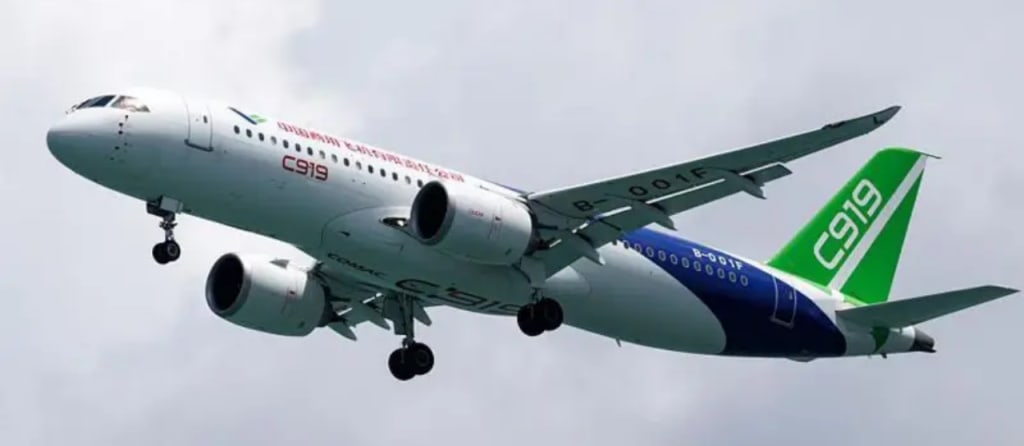
At the Singapore Airshow, one booth in particular has captured everyone’s attention—that of COMAC, China’s state-owned passenger aircraft manufacturer.
The company’s passenger aircraft, the C919, made its first flight to Singapore two years ago.
This aircraft has been developed to compete with the Airbus A320neo and the Boeing 737 Max, and it is also targeting markets outside China.
The Asia-Pacific region is a rapidly growing aviation market. At a time when airlines are facing delivery delays and supply chain pressures, this airshow provides COMAC with an opportunity to prove itself as a potential rival to Airbus and Boeing in the Asia-Pacific.
Willie Walsh, Director General of the International Air Transport Association (IATA), said: “I believe that at some point COMAC will compete globally, but it will take time.
“Ten to fifteen years from now, we will be talking about Boeing, Airbus, and COMAC. Without a doubt, they will be major players in the future.”
Walsh added that Asia-Pacific airlines can only achieve double-digit growth in 2026 if aircraft are available. According to him, “It is extremely frustrating for airlines that there is nearly a seven-year gap between ordering an aircraft and receiving it.”
This is why COMAC is emerging as another option for Asia-Pacific airlines.
At present, more than 150 COMAC aircraft are in operation within China. COMAC planes are also flying in Laos, Indonesia, and Vietnam. Brunei’s GallopAir has placed a large order for COMAC aircraft, and Cambodia is also planning to purchase around 20 planes.
Subhas Menon, Director General of the Association of Asia Pacific Airlines, said: “There is a need for more suppliers so that the supply chain does not face disruptions. The problem with this industry is that the supply chain is dominated by a few companies, and sometimes just two.”
He added: “We have been waiting for this for a long time. COMAC is a welcome addition. We need more suppliers, especially in the Asia-Pacific.”
The company is in a strong position. The government support available to COMAC in emerging markets, along with comparatively cheaper aircraft, makes it attractive for airlines with limited capital.
Mike Szucs, Chief Executive of the Philippine low-cost carrier Cebu Pacific, told the BBC: “We welcome new companies entering the market in the future. We strongly want a competitive environment in this sector.
“COMAC still has to go through its certification process, and we expect that sometime in the 2030s it will become an attractive option for us and other airlines.”
Along with expanding in the Asia-Pacific, COMAC is also trying to obtain European certification. Regulators are conducting test flights of the C919 aircraft. If the aircraft is approved, it will be allowed to be sold to European airlines.
However, the road ahead is quite long.
Regulators say that European certification could take until 2028, or even 2031. Adapting Chinese components, flight controls, and software to Western standards is also a technical challenge for securing international orders.
Aircraft maintenance and repair systems are another hurdle for COMAC, as is pilot training. These are areas in which companies like Boeing and Airbus established structured systems decades ago.
In the Asia-Pacific, COMAC faces competition not only from Boeing and Airbus but also from another manufacturer.
This is Brazil’s aircraft maker Embraer, which has already established its presence in the region. Singapore’s low-cost airline Scoot, Virgin Australia, and Japan’s All Nippon Airways (ANA) are placing orders for Embraer aircraft.
Nevertheless, Boeing and Airbus still maintain a strong foothold at the Singapore Airshow and across the region. Airlines that have long been frustrated by aircraft delivery delays are now receiving assurances from Boeing and Airbus that delivery schedules are set to improve.
Mike Szucs of Cebu Pacific said: “It is good to feel that perhaps we can see light at the end of the tunnel.”
Questions are also being raised about the number of aircraft COMAC can actually deliver. The company previously said that Chinese airlines had placed orders for 1,000 C919 passenger planes. However, only around a dozen aircraft have been delivered so far.
Verifying these figures is also difficult because, unlike Boeing and Airbus, COMAC is a Chinese state-owned company. This means it is not required to publicly disclose its production, costs, and revenue.
Until COMAC resolves some or all of these issues, it is highly likely that Boeing and Airbus will continue to dominate the skies of the Asia-Pacific.
About the Creator
Keep reading
More stories from Pets and animals and writers in Chapters and other communities.
Valentine's Dates Over the Years
Colin grinned as Brooklyn slipped into the living room. “Is it all set?” he asked. The twenty-one year old grinned. She was in her last year of college and Colin knew that Lincoln was proud of her. Although she had been away at college, she’d eagerly helped Colin plan his surprise for Lincoln. “I’m so glad you’re finally doing this,” she said.
By Reb Kreyling6 days ago in Chapters




Comments
There are no comments for this story
Be the first to respond and start the conversation.