
How Black Pepper and Olive Oil Boost Vitamin Absorption Naturally
How to Increase Vitamin Absorption from Food Naturally

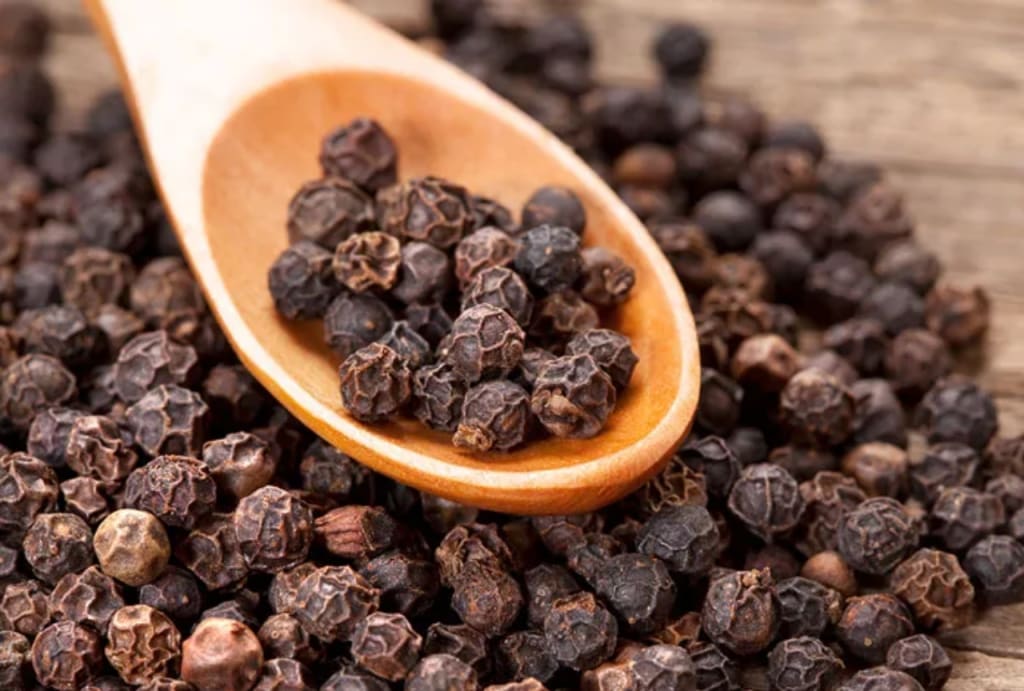
Adding black pepper or dressings (such as oil and vinegar) to your food may help you absorb more vitamins and minerals. Scientists believe this can increase the nutritional value of food.
Black pepper has been a valuable spice for thousands of years because it gives food a distinctive flavor.
The black pepper plant originally came from India, where it has been cultivated for more than 3,500 years. It became one of the most valuable commodities of the ancient world.
Today, most of us sprinkle it over our meals for flavor without thinking much about it.
However, adding black pepper to your food can do much more than enhance taste. It can increase the amount of nutrients you get from your meals.
Black pepper contains a chemical that helps vitamins and other nutrients be more easily absorbed into the bloodstream. It has also been observed that tiny fat droplets found in milk and olive oil can improve the body’s access to nutrients.
Scientists are now trying to use these effects to develop new types of fortified foods and to help people who struggle to absorb the nutrients they need to stay healthy.
Despite the availability of highly nutritious foods, we still face a problem: our bodies can lose vitamins and minerals as they pass through the digestive system.
Take sweet corn, for example. Corn kernels are undoubtedly rich in nutrients—they are full of fiber, protein, vitamins, and micronutrients such as potassium.
However, the outer layer of the kernels is difficult for our bodies to break down, especially if we do not chew them thoroughly.
David Julian McClements, a professor of food sciences at the University of Massachusetts in the United States, says: “When you eat corn, it often passes through your body undigested, with all the nutrients still trapped inside.”
However, chewing corn properly releases the nutrient-rich pulp inside so it can be digested.
Food structure
This example highlights a simple truth about food. For nutrients to be digested and used by the body, they must first be released from the complex structure of proteins, carbohydrates, fats, and other components that give food its shape and texture.
There are other barriers that can prevent vitamins from being digested. After being released from the food structure, vitamins must dissolve in digestive juices. Then they need to reach the small intestine, where specialized cells called enterocytes carry them into the bloodstream.
Many vitamins including A, D, and E, which are classified as fat-soluble vitamins need help dissolving into the blood.
Professor McClements explains: “Fat-soluble vitamins do not dissolve in water. So if you eat them and your meal contains no fat, they won’t dissolve and will simply pass through your digestive system and end up in your stool.
“If you eat vitamins with some fat, the fat breaks down and forms tiny nano-sized particles called micelles in your digestive system.
“They trap the vitamins inside them. Then they carry them through the watery digestive fluids to epithelial cells, where they can be absorbed.”
However, some people have additional difficulty absorbing vitamins from their food.
In simple terms, “malabsorption syndrome” means that no matter how healthy your diet is, your body cannot benefit from it and the nutrients are excreted in the stool.
This can happen for several reasons, including inflammatory bowel disease (IBD), celiac disease, radiotherapy, and chemotherapy. Chronic pancreatitis is a long-term condition.
Over time, this inflammation permanently damages the pancreas, causing it to stop functioning properly.
Liver disease can also block the flow of bile into the small intestine. Bile helps digest fat, and without dietary fat, the body cannot absorb fat-soluble vitamins.
In such cases, vitamin supplements are often recommended.
The problem with supplements
JoAnn Manson, a professor of medicine at Harvard Medical School who has extensively studied vitamins and supplements, says: “Vitamin and mineral supplements are not for everyone, and most people do not need them.”
Instead, she says a healthy and balanced diet should be sufficient.
“However, people with Crohn’s disease, ulcerative colitis, and celiac disease—where there is an allergy to gluten—often cannot absorb fat properly. This can lead to deficiencies in fat-soluble vitamins such as vitamins E, D, A, and K. So taking a multivitamin can be quite appropriate in such cases.”
But vitamins in supplement form are not always easily absorbed. To overcome this, scientists are developing new ways to enhance vitamin absorption. The key appears to be “nanoparticles” that form around the vitamins themselves.
McClements says: “They are trying to mimic what the body already does, but using different types of molecules that are not normally found in food.”
Nanoparticles are extremely small, ranging from one to 100 nanometers (nm) in size. For comparison, a human hair is about 80,000 to 100,000 nanometers thick.
Scientists at the University of Alberta in Canada found that wrapping vitamin D inside nanoparticles made from pea protein can increase its absorption.
Meanwhile, McClements’ own research found that taking beta-carotenoids—the precursor to vitamin A—with nano-sized fat droplets called liposomes can increase the supplement’s “bioavailability,” meaning the amount of vitamin absorbed into the bloodstream, by up to 20%.
Carotenoids can be obtained from brightly colored fruits and vegetables such as carrots, broccoli, leafy greens, and tomatoes.
In one study, McClements asked people to eat salad either with or without nanoparticles.
The salad included 50 grams of baby spinach, 50 grams of romaine lettuce, 70 grams of grated carrots, and 90 grams of cherry tomatoes.
“If you just give them salad,” McClements says, “very few carotenoids enter the bloodstream because without fat, the vitamins do not dissolve in digestive fluids.
“But if we give them a salad dressing containing very small fat droplets, the amount of carotenoids absorbed into the blood increases significantly.
The power of black pepper
When McClements and his team added black pepper to the salad and dressing, it further increased the body’s ability to absorb nutrients.
Cells in the intestinal lining often contain “transporters” that can take absorbed nutrients and send them back into the digestive tract.
However, a chemical in black pepper blocks these transporters, allowing more vitamins or carotenoids to enter the bloodstream.
At that moment, McClements had a realization: this method had existed thousands of years ago.
He says, “We spent years trying to improve the bioavailability of curcumin (a compound found in turmeric).
“We compared all these different delivery systems made from proteins, fats, or carbohydrates and found that the best was small fat droplets that looked just like milk, into which you add curcumin.
“I was walking around my town and saw an advertisement for ‘golden milk.’ It’s a very traditional, ancient Indian drink. And it was actually the same formula we had developed—but they made it 1,000 years ago.”
In ancient Indian drinks, turmeric was mixed with dairy products and included black pepper.
McClements and his colleagues have shown that high amounts of curcumin can be added to cow’s milk and remain stable for at least two weeks if refrigerated. More recently, they have also been experimenting with adding the compound to plant-based milk.
The importance of salad
So what can we do to increase our ability to absorb vitamins?
According to McClements, if you are going to take vitamin supplements, it may be a good idea to take them with food that contains fat.
“For example, you might want something with small fat particles, such as milk or yogurt.”
It is also important to note that while plants are rich in healthy vitamins, they often contain “anti-nutrients”—molecules that can interfere with the body’s ability to absorb certain nutrients.
For example, broccoli and Brussels sprouts contain glucosinolates, which can interfere with iodine absorption. Similarly, leafy green vegetables are rich in substances called oxalates, which bind to calcium and prevent it from being absorbed.
Finally, if you are going to enjoy that juicy salad, your choice of dressing or oil can make a big difference.
Recent research by McClements and his colleagues at the University of Missouri found that eating a highly nutritious vegetable rich in carotenoids, vitamin C, and vitamin E with an olive oil dressing can help your body absorb more of its nutrients.
This finding may be one reason why consuming plenty of olive oil with fresh fruits and vegetables is often considered healthy.
McClements says: “We found that nanoparticles made from olive oil actually increased the bioavailability of carotenoids, whereas particles made from coconut oil did not.
“That’s because coconut oil forms very small micelles, and carotene is too large to fit inside them. It’s like trying to fit an elephant into a Mini Cooper. Sometimes you need a bigger vehicle.”
About the Creator
Keep reading
More stories from Real content and writers in Chapters and other communities.
India to Buy 114 Rafale Jets in $40 Billion Defense Boost Ahead of French President’s Visit
India on Thursday granted initial approval for the purchase of $40 billion (3.6 trillion Indian rupees) worth of defense equipment, including additional French Rafale fighter jets for the Indian Air Force.
By Real contenta day ago in Chapters
AI, Surveillance, and the Fragile Line Between Deterrence and Disaster
AI, Surveillance, and the Fragile Line Between Deterrence and Disaster The next great danger in global conflict is not only missiles or soldiers, but machines that think faster than humans. As artificial intelligence (AI) becomes deeply embedded in military planning, surveillance, and nuclear command systems, the risk of accidental war is growing quietly but dangerously. What once depended on human judgment is now increasingly shaped by algorithms, sensors, and automated decision-making. In this new environment, a single error, misreading, or cyber manipulation could push the world toward catastrophe.
By Wings of Time 2 days ago in Chapters
The Pride Flag and the Diversion
For nearly a decade, the LGBTQIA Pride Flag rippled in the wind at Christopher Park, a kaleidoscope of color staked into the soil of America’s first national monument to LGBTQIA+ liberation. That flag came down this week. Federal officials, citing new guidance from the Trump Administration, silently lowered the rainbow flag from its pole across the street from the Stonewall Inn. The birthplace of the modern gay rights movement now flies only the United States flag.
By Tim Carmichael4 days ago in Pride



Comments
There are no comments for this story
Be the first to respond and start the conversation.