
I Was Never Supposed to Make It
Part One: The Girl Who Survived Chapter Three: The House That Wasn’t Safe


From the outside, the house looked ordinary.
The grass was cut. The porch was swept. Curtains hung neatly in the windows. If you drove past it, you would not slow down. You would not suspect anything unusual lived inside those walls.
But safety is not determined by appearances.
Safety is determined by how your body reacts to footsteps in the hallway.
I learned early that the sound of a door closing could mean several things. It could mean nothing. Or it could mean I needed to prepare.
I became fluent in tone before I understood vocabulary.
The way Carla set her coffee cup down told me what kind of evening it would be. The rhythm of dishes in the sink told me whether I should speak or disappear. Silence at the dinner table was not peaceful — it was predictive.
Home was not where I rested.
It was where I calculated.
Emotional abuse rarely announces itself. It disguises itself as a correction. As discipline. As “what’s best for you.”
“You’re too sensitive.”
“Stop acting like that.”
“What’s wrong with you?”
“You’re going to end up just like your mother.”
The words weren’t always shouted.
That’s what made them more dangerous.
They were repeated calmly. Casually. Often enough that they began to sound factual.
Repetition becomes identity.
Physical pain came differently.
It came faster.
My sister Tiffany’s anger did not build slowly. It arrived sharp and sudden. I learned to watch her the way you watch a storm cloud forming in the distance. If her mood shifted, I adjusted mine. If her voice tightened, I retreated.
Stay small.
Stay quiet.
Stay out of reach.
Children are not meant to be strategic.
But I became strategic.
I memorized which floorboards creaked. I learned which rooms felt safer. I understood that retreat was often smarter than defense. I learned that silence could be armor.
Living like that changes your body before it changes your thoughts.
Your heart races before you understand why. Your shoulders tighten without instruction. Your stomach knots at raised voices, even if they aren’t directed at you.
I did not have language for trauma.
I only had adaptation.
At home, I shrank.
At school, I did not.
At school, I was often in trouble.
Not for failing.
My grades were excellent — A’s and high B’s. I understood the material. I completed assignments. I performed well on tests.
Intelligence was never absent.
Stability was.
I talked back sometimes. I reacted quickly. I carried an anger I didn’t know how to name. Small corrections felt like accusations. Authority felt unsafe. I challenged tone more than I challenged content.
Teachers saw defiance.
They did not see fear.
They saw attitude.
They did not see a nervous system that never rested.
It confused adults.
How can a child be smart and still act like this?
The answer was simple, though no one asked it.
Because I was surviving in two different ways.
At home, I disappeared.
At school, the pressure leaked out.
If someone raised their voice in class, my body reacted before my mind could catch up. If I felt cornered, I pushed back. If I felt misunderstood, I escalated.
I was not trying to be difficult.
I was trying to stay in control of something.
Control felt safer than vulnerability.
So I became the “problem” student with strong grades.
Behavior is louder than report cards.
Adults remember disruption more than achievement.
And slowly, a new layer formed over the old one.
Not just not smart enough.
Now—
Too emotional.
Too reactive.
Too much.
Too hard to handle.
At home, I was too small.
At school, I was too loud.
In both places, I was wrong.
What no one understood — what I didn’t understand — was that hypervigilance doesn’t turn off when you walk into a classroom. It follows you. It interprets tone. It anticipates threat. It responds quickly.
My body had learned to survive a house.
It did not know how to behave in safety.
But instead of someone asking why I reacted the way I did, the narrative hardened.
She’s difficult.
She’s disrespectful.
She’s a problem.
And somewhere between shrinking and reacting, between silence and defiance, I began to feel something more dangerous than fear.
I began to feel misunderstood.
And when a child feels misunderstood long enough, she starts to believe she is the misunderstanding.
From the outside, the house looked ordinary.
At school, I looked intelligent but disruptive.
Inside, I was still just a girl trying to survive rooms that never felt safe.
And even when my behavior was questioned, even when my name was written on the board for talking back, even when I was sent to the hallway—-
I was still surviving.
About the Creator
Jeannie Dawn Coffman
Short fiction and prose shaped by real lives, memory, and the depths of human consciousness. Stories rooted in observation and lived experience.
Keep reading
More stories from Jeannie Dawn Coffman and writers in Chapters and other communities.
I Was Never Supposed to Make It
The kitchen table was round and scratched, the kind of table that had absorbed years of elbows, spilled drinks, and unfinished conversations. A yellow light hung low above it, humming faintly. That hum is what I remember most. Not the math problem in front of me. Not the numbers I kept erasing.
By Jeannie Dawn Coffmanabout 13 hours ago in Chapters
Valentine's Dates Over the Years
Colin grinned as Brooklyn slipped into the living room. “Is it all set?” he asked. The twenty-one year old grinned. She was in her last year of college and Colin knew that Lincoln was proud of her. Although she had been away at college, she’d eagerly helped Colin plan his surprise for Lincoln. “I’m so glad you’re finally doing this,” she said.
By Reb Kreyling6 days ago in Chapters
The Story of the Surgeon Who Operated on Himself
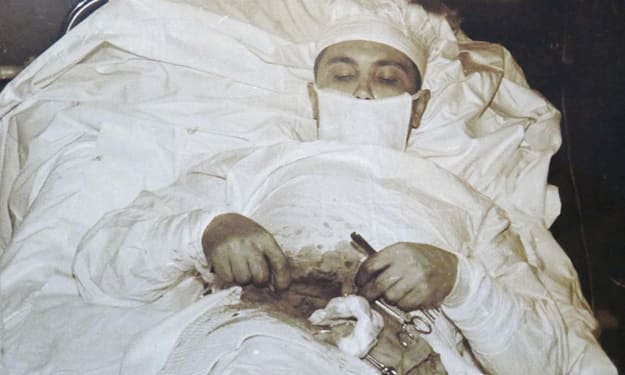
The Story of the Surgeon Who Operated on Himself Normally, whenever a person feels unwell and suffers from a disease ,they immediately go to a doctor for treatment because he knows that doctor will treat me well. But if the doctor himself becomes ill and suffer from such a painful disease and disorder that without surgery can not be recovered and there is no other doctor available to treat him, then he may have no choice but to treat himself,because life is very beautiful and beauty of life based on good and sound health .Treating oneself is understandable to some extent—but a doctor performing surgery on himself might sound unbelievable and a miracle even like an exaggeration. However, in reality, such an extraordinary and marvelous event did take place in the past when a surgeon operated on himself to save his own life.
By Ibrahim Shah 6 days ago in Chapters



Comments (1)
This is very emotionally deep. Thank you for writing it, I learned through reading it. :)