
Russia-Ukraine War Enters Fourth Year: Can Flamingo, Oreshnik Missiles, F-16 Jets and AI Drones Change the Balance?
Four Years of Russia-Ukraine War: Why Peace Talks in Abu Dhabi Failed Again U.S.-mediated negotiations show no breakthrough Is diplomacy losing ground to military technology?

On the 24th of this month, four years will be completed since Russia’s invasion of Ukraine. This war has continued without pause for four years, and there are still no visible signs that it will end.
Negotiations between Russia and Ukraine are being held in Abu Dhabi under U.S. mediation. On Thursday, another round of these talks ended without any progress.
If diplomacy is failing to deliver results, do the two countries possess such advanced weapons that could potentially tilt the balance of war in favor of either side?
New Missiles: Flamingo vs. Oreshnik
The armies of Russia and Ukraine are using cruise and ballistic missiles, some of which are new and are being deployed on an experimental basis.
Ballistic missiles are accurate but can be detected by radar, whereas cruise missiles fly at low altitude close to the ground, making them harder to track.
Ukraine relies largely on missiles supplied by its Western allies. It has fired U.S-made ATACMS (Army Tactical Missile Systems) as well as the Storm Shadow/SCALP missiles jointly developed by Britain and France at targets inside Russia.
However, Ukraine is rapidly expanding its domestic arms industry.
Striking deep inside an enemy’s territory is considered a key part of warfare, and for this purpose Ukraine mostly uses long-range drones.
According to our correspondent, Ukraine has so far been pushed back by Russia on a front more than a thousand kilometers long. Ukraine is therefore increasing attacks on Russia’s war economy to slow its advance.
The Flamingo cruise missile, produced locally in Ukraine by the defense company Fire Point, is being viewed as a major breakthrough. It is a long-range weapon that Western countries had been hesitant to supply to Ukraine.
This missile can hit targets up to 3,000 kilometers away. It travels at a speed of 900 kilometers per hour and can carry a warhead weighing 1,150 kilograms. This means it can strike strategic Russian targets that are beyond the reach of drones or shorter-range weapons like the Neptune missile.
Its range is comparable to the American Tomahawk missile – a sophisticated and expensive weapon that U.S. President Donald Trump refused to provide to Ukraine.
Since Ukraine manufactures the Flamingo itself, it can use it against any target. Western allies support Ukraine in fighting Russian forces but have also imposed certain restrictions. The Flamingo missile, however, is free from any such limitations.
Ukrainian President Volodymyr Zelensky has described the Flamingo as one of his country’s most successful missiles, although few details about its battlefield use have been made public.
Meanwhile, Russia has developed a new missile called Oreshnik with a range of 5,500 kilometers.
Because of its speed, it is different from other ballistic missiles. In 2024 President Vladimir Putin said the missile could travel 2.5 to 3 kilometers per second, making it extremely difficult for Ukraine to intercept.
Russia has used this missile twice during the war: first in November 2024 in the central city of Dnipro, and again in January 2026 in the western city of Lviv.
It is believed that the Oreshnik warhead splits into several parts as it nears the target, with each part heading toward a separate point. This results in a series of explosions within moments.
Fighter Jets: F-16 vs. Sukhoi
It is estimated that about half of the 90 F-16 aircraft promised by NATO countries—including Belgium, Denmark, the Netherlands and Norway—have already been delivered to Ukraine.
These aircraft are considered versatile, easy to maintain and capable of carrying almost all types of weapons built to U.S. and NATO standards.
The F-16 entered service with the U.S. Air Force in 1978. Many Western militaries are now gradually retiring these older jets and replacing them with U.S.-made F-35 aircraft introduced in 2015.
Even so, the F-16 is highly significant for a small air force like Ukraine’s, which previously relied on Soviet-era aircraft from the 1970s.
When the F-16s were introduced, a Ukrainian pilot described them on national television:
“Compared to the planes we used to fly, the F-16 is like a smartphone next to an old push-button phone.”
The F-16 is mainly used to strengthen air defense and to strike ground targets with precision.
Ukrainian pilots testify that the F-16 has been very successful. The Ukrainian Air Force cited an example from December 2024 when a Ukrainian pilot shot down six Russian cruise missiles in a single battle.
Even today, the F-16 plays the central role in Ukraine’s air-defense missions.
The core strength of Russia’s modern air force lies in Sukhoi aircraft, including the Su-30, Su-34 and Su-35, as well as the fifth-generation Su-57.
Russian Sukhoi jets are equipped with advanced radar and long-range air-to-air missiles. For example, the claimed range of the R-37 missile is more than 200 kilometers. These aircraft can fly much farther than the MiG-29 or the F-16.
According to the World Directory of Modern Military Aircraft, Russia has the second most powerful air force in the world after the United States, and in terms of total fighter aircraft Russia holds a clear advantage over Ukraine.
Russian aircraft rarely venture deep into Ukrainian territory for fear of being shot down by Western-supplied surface-to-air systems such as the Patriot.
Both sides therefore attack ground targets from a distance using missiles fired from aircraft without entering each other’s airspace.
Drones
Whether it is surveillance, striking targets, launching missiles or exploding on impact, drones have been widely used during the war.
Ukraine is now ahead of many countries in developing systems such as robots and drones. Bloomberg reported in November 2025 that Ukraine produces nearly four million drones a year.
Last year’s “Operation Spider Web” proved Ukraine’s successful drone strategy. In that operation, 110 Ukrainian drones were smuggled into Russia and more than 40 bomber aircraft were targeted.
Ukraine also uses combat drones on the battlefield and naval drones at sea, which have helped sink several Russian warships.
Ukrainian-made drones like FP-1 and FP-2 are cheap and can be produced quickly. The FP-1 is even capable of reaching Moscow.
At the start of the war, Ukraine used Turkish Bayraktar TB2 drones, U.S. Switchblade kamikaze drones, and commercially available drones such as the Chinese DJI Mavic 3 for surveillance.
Russia, according to reports, is trying to increase production to manufacture tens of thousands of cheap attack drones every year.
In November, Russia announced the creation of a robotic systems force to manage its drone program.
Russian media reports in 2025 mentioned drones named Artemis-10, Tuvek, Sirius and others, claiming they were advanced and ready for mass production.
However, there has been no confirmed report of their use in the war.
During 2025 Russia continued to modernize existing drones, such as the tactical Molniya-2 used as a kamikaze drone.
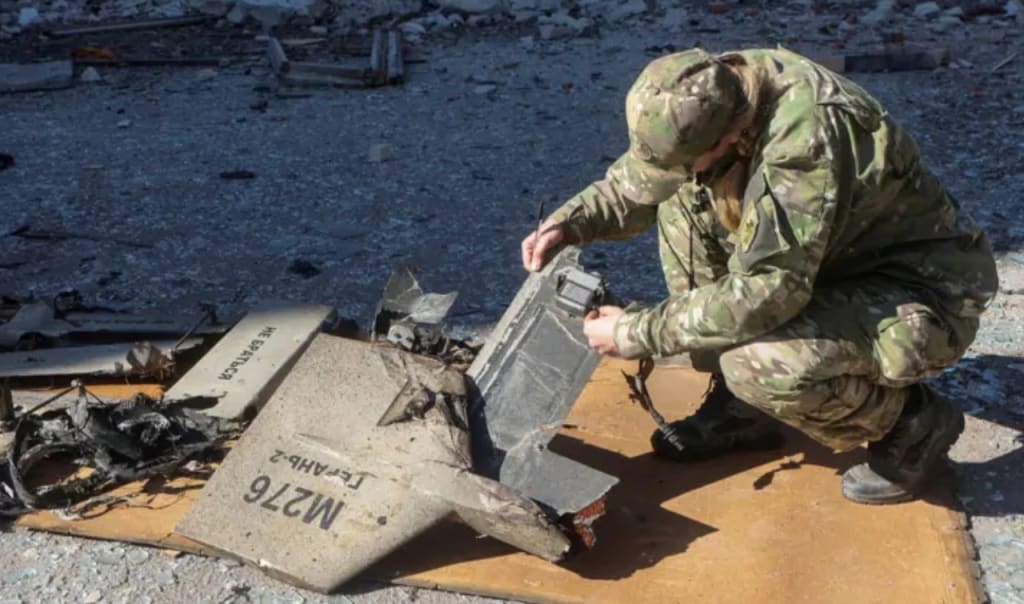
Earlier Russia imported Shahed drones from Iran, but it now uses a domestically produced version called Geran-2. Like the Shahed, these are winged drones often used for suicide attacks.
Geran drones are commonly used for long-range strikes on Ukrainian cities, transport networks and civilian and military infrastructure.
Russia is still producing about 3,000 such drones every month. According to analysis by the Institute for Science and International Security in Washington, during the summer and autumn of 2025 Russia launched an average of 175 Shahed-type drones every day.
Communication between drones and their operators is a challenge for both sides. Some drones rely on satellite links for navigation.
Elon Musk has recently tried to prevent Russia from using his Starlink satellites for drone attacks. Ukrainian officials say this step has produced “real results.”
Russia’s own satellite system, Gazprom Space Systems, is far more limited than Starlink, meaning its availability in wartime is not always guaranteed.
Ilya Abishev explains that other alternatives—such as drones connected via fiber-optic cables or using radio transmission—work only over short distances and are not as effective, reliable or cheap.
What other future weapons could be decisive?
Artificial intelligence has become a new front in the technological war between Ukraine and Russia. Weapons using AI could change battlefield conditions.
Ukraine’s Defense Minister Mykhailo Fedorov says work on such technology is already underway, but no fully ready weapon using AI effectively is yet available.
The Kremlin is also developing drones capable of autonomously identifying and striking targets using artificial intelligence.
About the Creator
Keep reading
More stories from Real content and writers in Chapters and other communities.
Bangladesh Student Revolution 2024: Rahat Hossain Story and the Future of Bangladesh Politics
Rahat Hossain was close to being killed himself while trying to save his friend, as the rebellion of many young people like him turned into one of the bloodiest episodes in Bangladesh’s history. In a video that went viral during the recent revolution in the country, he is seen trying to carry Imam Hasan Taim Bhuiyan to safety after he had been shot by police. On 20 July 2024, during the crackdown on protests, 24-year-old Rahat Hossain and 19-year-old Imam Hasan Bhuiyan took refuge at a tea stall in Dhaka. Police dragged them out, beat them and ordered them to run. Bhuiyan was shot. Seeing him fall to the ground, Rahat Hossain began dragging him away, but the police continued firing. Rahat realized that a bullet had struck his own leg. “I had to leave him behind,” Rahat says. Later, Imam Hasan Bhuiyan was declared dead at the hospital. Such violence transformed the student-led demonstrations into large-scale nationwide protests centered on the capital, Dhaka. Within two weeks, the government was removed from power and Prime Minister Sheikh Hasina fled the country. According to the United Nations, nearly 1,400 people were killed during the protests, most of them in the security crackdown ordered by Sheikh Hasina. Hasina’s fall appeared to promise a new era. The uprising was regarded around the world as the first and most successful Gen-Z protest movement. Some Bangladeshi student leaders assumed important positions in the interim government and tried to shape the country for which they had taken to the streets. After decades of rule by Sheikh Hasina’s Awami League and the rival Bangladesh Nationalist Party (BNP), they were expected to play a role in the country’s future administration. But as Thursday’s general elections approach, the newly formed student political party appears deeply divided. The Awami League is banned, and decades-old parties seem to be filling the vacuum. Rahat Hossain had taken part in the student-led protests of 2024. Those demonstrations brought together the younger generation—men and women, secular and religious people alike. Initially the protests were against new quotas in civil service jobs, but gradually they developed a “single common goal”: the end of authoritarian rule. “The interim government has failed to build the beautiful Bangladesh based on peace, equality and justice that was expected from it.” He is not alone in feeling that the student-led National Citizens Party (NCP) is inexperienced. Instead, many believe it is influenced by another older party, Jamaat-e-Islami. This Islamist party has historically played the role of a small ally in Bangladeshi politics, but its popularity has grown ahead of the 12 February elections, in which the Awami League is barred. Founded in 1941, the party has always been questioned over its stance during the 1971 war of independence from Pakistan, in which millions were killed and more than ten million displaced. Some of its politicians were accused of siding with West Pakistan at the time. But this history does not trouble Rahat Hossain. He believes the party has changed. He explains, “Jamaat supported the July uprising and the students in many ways.” Party leader Shafiqur Rahman said Jamaat promises to eradicate corruption and restore the independence of the judiciary. Although such claims are difficult in a country with historically high levels of corruption, they are resonating with many people. Professor Towfique Haque of North South University in Dhaka says most young voters born after 1971 can separate Jamaat from its past and do not see it as a “red line.” He says, “It is a generational issue,” arguing that the new generation does not want to be entangled in that debate. Haque adds that young voters see Jamaat as a party like themselves—one that suffered under Sheikh Hasina’s repression, was banned from politics, and whose leaders were jailed. Rahat Hossain is not alone in leaning toward Jamaat-e-Islami. Last September, candidates backed by Jamaat’s student wing won major victories in elections at Bangladesh’s top universities, seen as a sign of a national trend. Notably, for the first time since independence, an Islamist group gained control of the student union at Dhaka University. This was a major signal for student leaders, especially in a country where nearly four out of ten voters are under 37. A controversial compromise The lack of confidence in the NCP has been a major setback for student leaders. Twenty-seven-year-old Asif Mahmud, former adviser in the interim government and now chairman of the NCP election committee, admits, “We hoped to do far better.” But he argues the challenges were enormous. “For the last 50 years only two parties have ruled Bangladesh… we are trying to prove ourselves.” So the NCP made a decision. In December it announced a multi-party alliance with Jamaat-e-Islami. Like Jamaat, the NCP also promises to eliminate corruption. Its manifesto includes other pledges for young voters: justice for families of those killed in the uprising, lowering the voting age to 16, and creating jobs through tax and economic reforms. Asif Mahmud says, “We may disagree on some issues, but Jamaat has grassroots reach and the NCP needs that.” “We have always said we are not an Islamist party. This is not an ideological alliance.” However, Jamaat allowed the NCP to field only 30 candidates—just two of them women—while Jamaat itself has more than 200 candidates, all men. This compromise has been called an “ethical red line” by senior NCP women like Tasnim Zara, who along with others resigned from the party. Twenty-five-year-old student Shima Akhter, who played a key role in the protests, says, “They wanted to push us out.” Although women were central to the uprising, Shima says the interim government under Muhammad Yunus remains largely male-dominated. After the revolution, Shima and other female activists were targeted in social-media posts. “Some meme videos were very violent and depressing. We were defamed and mocked,” she recalls. Videos circulated calling them unintelligent, claiming their marriage prospects were ruined, and even mocking Shima’s complexion. Both parties deny ignoring women and claim the number of female candidates reflects Bangladesh’s “social structure.” Jamaat leader Shafiqur Rahman said he hopes the situation will change. Shima dismisses this as “just a patriarchal excuse.” She leans toward the BNP, which has fielded 10 women among more than 250 candidates. “At least it’s better than the worst,” she says. Will dynastic politics continue? The lack of support for the NCP and the ban on the Awami League are also benefiting the BNP, which now presents itself as a liberal democratic force. After seeing thousands of supporters and senior members jailed under Awami rule, the BNP is now the largest party contesting the elections, further pressuring the student party. Just as the Awami League was led by Sheikh Hasina, daughter of the country’s founding leader Sheikh Mujibur Rahman, the BNP is also tied to a political dynasty. Its new leader Tarique Rahman is the son of Khaleda Zia, Bangladesh’s first female prime minister. Khaleda herself came to power after her husband, a former president, was assassinated in a military coup. Former BNP commerce minister Amir Khasru Mahmud Chowdhury said, “Whether you belong to a family or not is irrelevant.” Ironically, this family legacy revived because of the student-led uprising, which allowed Rahman to return after 17 years of self-exile. After Hasina’s departure, both he and his mother were cleared of corruption charges they called politically motivated. He has criticized Jamaat for exploiting religious sentiment for votes and promises economic and democratic reforms and a “rainbow nation,” with a new national reconciliation commission to heal divisions. Sheikh Hasina ruled Bangladesh for 15 years, overseeing economic growth but continually silencing opposition through politically motivated arrests, disappearances and extrajudicial killings. Last year the Bangladesh war crimes tribunal sentenced her to death for the 2024 crackdown. A hidden district leader of the Awami League said, “Free and fair elections are impossible without including the Awami League. If Sheikh Hasina orders it, the party and its supporters will resist the elections.” He warned, “If she says people should not go to polling stations, we will not go. If she says disrupt the elections, we will do so.” He called allegations by independent human-rights groups of political arrests and extrajudicial killings “false and fabricated.” After the 12 February elections, students will know whether their revolution and bloodshed achieved anything. Rahat Hossain sits near the Jatrabari flyover in Dhaka—the place where he lost his friend. He is still waiting for the trial of the police officers accused in his friend’s death to be completed. Imam Hasan Bhuiyan’s father is himself a police officer. When he identified his son’s body, he called a senior officer and asked, “Sir, how many bullets does it take to kill a boy?” Rahat says he still feels fear from the day his friend was shot. He watched the video eight days later when the internet was restored. “My screams can be heard… I kept crying.” A year later, on 5 August, he marked the first anniversary of Hasina’s ouster with his “fellow rebels. But Rahat admits that his “new Bangladesh” has not yet been realized. He believes this will not be possible until an elected government carries out reforms. “You cannot expect mangoes from a tamarind tree,” he says.
By Real content7 days ago in Chapters
The Cave Part 6
If you have ever heard a tale about yourself that you cannot remember and doubtless think is made up, you will know how I felt when Tharkin related all that the eagle had seen of me before my memories were scattered. Of far distances and traveling companions that I did not recall, camping out under the stars and making our way to the mountains with deliberate purpose. The great bird had lost contact with my party once we entered the forests, and the seven other members were not seen again by him or his brethren since.
By Jamye Sharp3 days ago in Chapters
Brass Ring Interlude 4: When The Cherry Blossom Finds The Wind
Onna-Bugeisha exited a simple tunnel and entered her basement. She was fully armored, but her paired katana were sheathed. While she hated sneaking into her home, she and Kaneda had decided it was necessary if she were to remain with CAPES, providing her with a haven none of her enemies would know of. She smiled as she remembered him pulling out a shovel to help dig the tunnel even as the Steel Amazon had appeared to help her dig it. She had had to broker a compromise, suggesting that if he could make them tea with a light snack that would be sufficient for his share of the project. He had acquiesced, and the two women finished the tunnel, including supports, within a couple of hours. The strawberry teacakes he served that day were still her favorite. He sat back and let the two women enjoy being who they were while he cheered them on.
By Jamais Jochimabout 7 hours ago in Chapters




Comments
There are no comments for this story
Be the first to respond and start the conversation.