
The Expanding Universe
Understanding the Cosmic Journey

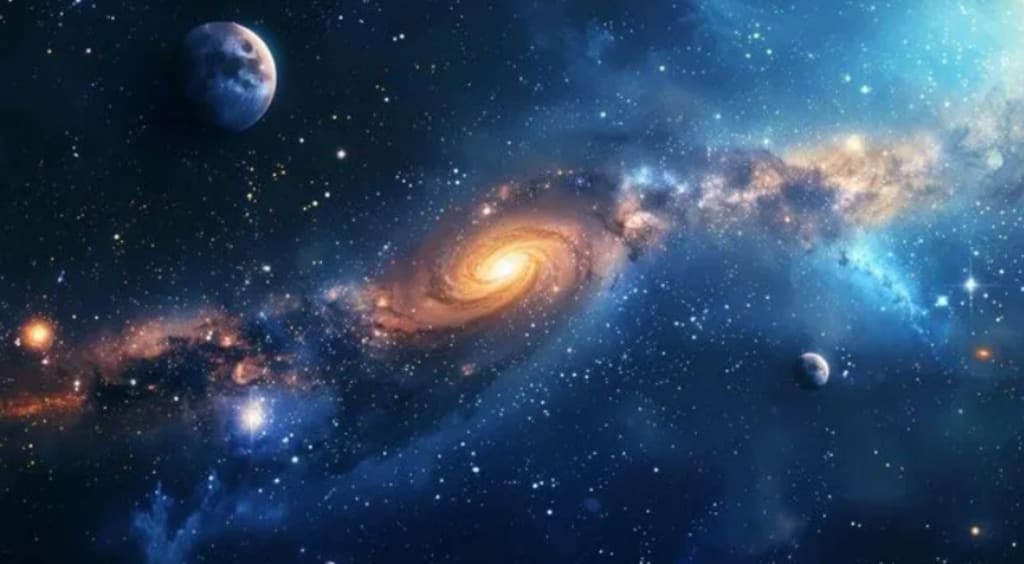
The universe’s expansion is one of the most astonishing and foundational concepts in modern astrophysics. Ever since the groundbreaking discovery in the 20th century, the idea that the universe is expanding has captivated scientists, sparking questions about the nature of the cosmos, its origins, and its ultimate fate. This article explores the history, mechanics, and implications of cosmic expansion.
1. The Discovery of Expansion
The concept of an expanding universe began gaining traction in the early 20th century. Astronomer Edwin Hubble, through observations at the Mount Wilson Observatory in California, noted a phenomenon in 1929 that changed our understanding of the cosmos: distant galaxies appeared to be moving away from us. More remarkably, the farther away these galaxies were, the faster they were receding. This observation gave rise to what is known as Hubble’s Law, establishing a relationship between the distance of a galaxy and its velocity, and led to the inescapable conclusion that the universe itself is expanding.
2. The Role of Redshift and the Doppler Effect
Hubble’s findings were based on a concept called redshift, a term derived from the Doppler Effect. Just as sound waves compress or elongate based on the motion of the source relative to the observer, light waves shift in wavelength as objects move closer or farther away. When galaxies recede, the light they emit shifts toward the red end of the spectrum. By measuring this redshift, scientists can estimate the speed at which a galaxy is moving away from us.
3. The Big Bang and the Beginning of Expansion
Hubble’s observations aligned with theories developed by physicists like Georges Lemaître, who suggested that the universe began from a single, dense point — a theory now known as the Big Bang Theory. According to this model, approximately 13.8 billion years ago, the universe started from an incredibly hot, dense state and began to expand. Over time, this expansion allowed the universe to cool, forming galaxies, stars, and planets. The Big Bang Theory is the prevailing model explaining the origin and subsequent expansion of the universe.
4. The Accelerating Universe and Dark Energy
In the late 1990s, two independent research teams made a surprising discovery: the universe’s expansion is not slowing down as previously thought, but is instead accelerating. This unexpected acceleration implies the presence of a mysterious force driving the expansion, known as dark energy. Dark energy is hypothesized to make up around 68% of the universe, yet its nature remains one of the biggest puzzles in cosmology.
5. How We Measure Expansion: The Hubble Constant
The rate at which the universe is expanding is quantified by the Hubble Constant (H₀). Over the years, astronomers have attempted to refine this value using various methods, including measurements of the cosmic microwave background radiation (CMB) and the observations of supernovae. However, two primary methods yield slightly differing values for H₀, leading to what is known as the Hubble tension. Resolving this discrepancy is a central goal in cosmology, as it could shed light on unknown aspects of the universe’s expansion.
6. Implications of an Expanding Universe
The fact that the universe is expanding has profound implications for its future. Cosmologists consider several scenarios:
A. The Big Freeze: As the universe expands, it cools. If expansion continues indefinitely, galaxies will drift further apart, and star formation will slow down, leading to a cold, dark universe.
B. The Big Rip: If dark energy increases in intensity, it could eventually overcome all gravitational forces, causing galaxies, stars, and even atoms to be torn apart.
C. The Big Crunch: In this scenario, gravity would eventually halt the expansion and reverse it, pulling everything back into a single point. While current observations suggest this is unlikely, it remains a theoretical possibility.
7. The Horizon of Knowledge: Questions Remain
While we have made significant strides in understanding the expanding universe, many questions remain. For instance:
A. What is dark energy? Its nature is unknown, and its discovery poses more questions than answers.
B. Is expansion uniform? There are theories suggesting that expansion may not be uniform in all regions of the universe, raising questions about cosmic structures.
C. Are there multiple universes? Some theories, including inflationary cosmology and the multiverse hypothesis, suggest the possibility of other universes beyond our own, each potentially with different expansion properties.
The expanding universe concept has revolutionized our understanding of the cosmos, leading us to questions that continue to push the boundaries of human knowledge. With advancing technology and innovative theories, future generations of astronomers and physicists may unlock more secrets of the universe’s expansion and uncover its ultimate destiny. For now, the expansion remains a cosmic journey, an ongoing process that holds the key to understanding our origins, our present, and perhaps our future in the vastness of space.
About the Creator
Keep reading
More stories from Gus Woltmann and writers in Chapters and other communities.
WW2 - Torture
World War II saw immense human suffering, and torture was widely used by some regimes to extract information, suppress dissent, and intimidate populations. These methods were employed in various places, including prisoner-of-war camps, concentration camps, interrogation facilities, and occupied territories. Here, we’ll explore the most commonly reported methods, used particularly by the Nazi regime in Europe, Japanese forces in East Asia, and some Allied forces as well.
By Gus Woltmann4 months ago in Chapters
Fair Exchange, No Robberies
Dark Memoirs - Index There are at least two kinds of people in the world: those who write this half-arsed kind of intro to a story that looks to separate the rare and the norm, and those who realise it's an overused framing device and don't.
By Paul Stewart29 days ago in Chapters



Comments