
The History of the American Civil War
The American Civil War

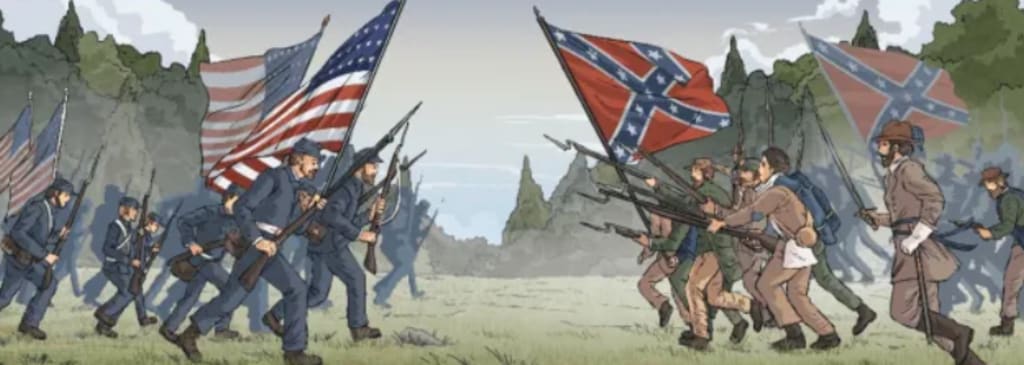
Causes of the Civil War
The Civil War’s origins can be traced to tensions between the Northern and Southern states, which had developed over decades. The primary issue was slavery, particularly its expansion into newly acquired territories. The Northern states, driven by an industrial economy, largely opposed slavery, while the agrarian South depended on enslaved labor for its economy.
Key events that heightened tensions included:
1. The Missouri Compromise (1820): Temporarily balanced the power between free and slave states.
2. The Compromise of 1850: Allowed California to enter as a free state while strengthening the Fugitive Slave Act.
3. The Kansas-Nebraska Act (1854): Allowed states to decide on slavery through popular sovereignty, leading to violent conflicts known as “Bleeding Kansas.”
4. The Dred Scott Decision (1857): Declared that African Americans could not be citizens and that Congress had no power to regulate slavery in the territories.
5. The Election of Abraham Lincoln (1860): Lincoln’s opposition to the spread of slavery led Southern states to secede, fearing their way of life was threatened.
The Outbreak of War
The Civil War officially began on April 12, 1861, when Confederate forces attacked Fort Sumter in South Carolina. Following this, more Southern states seceded, forming the Confederate States of America, led by President Jefferson Davis. The Union, under President Abraham Lincoln, vowed to preserve the United States.
Major Battles and Campaigns
1. The war saw numerous battles across the country, with some of the most significant including:
2. The First Battle of Bull Run (1861): The first major battle, signaling a long and bloody conflict ahead.
3. The Battle of Antietam (1862): The bloodiest single-day battle in American history, leading Lincoln to issue the Emancipation Proclamation.
4. The Battle of Gettysburg (1863): A turning point in the war, where Union forces halted Robert E. Lee’s invasion of the North.
5. The Siege of Vicksburg (1863): Gave the Union control over the Mississippi River, splitting the Confederacy in two.
6. Sherman’s March to the Sea (1864): A devastating campaign that crippled the South’s ability to continue fighting.
7. The Appomattox Campaign (1865): Led to Confederate General Robert E. Lee’s surrender to Union General Ulysses S. Grant on April 9, effectively ending the war.
The Emancipation Proclamation and the End of Slavery
One of the most profound outcomes of the Civil War was the abolition of slavery. On January 1, 1863, Lincoln issued the Emancipation Proclamation, declaring enslaved people in Confederate-held territories free. While it did not immediately free all enslaved individuals, it fundamentally shifted the war’s purpose, making the abolition of slavery a Union war goal.
With the war’s conclusion, the 13th Amendment to the U.S. Constitution was ratified in December 1865, officially outlawing slavery in the United States.
The War’s Aftermath and Reconstruction
The war left the South in ruins and the nation deeply divided. The Reconstruction Era (1865–1877) aimed to rebuild the South and integrate formerly enslaved individuals into American society. However, this period was marked by political strife, economic hardship, and racial tensions, as Southern states enacted discriminatory laws known as Black Codes and later Jim Crow laws to restrict African Americans’ rights.
Despite these challenges, the Civil War fundamentally reshaped the United States, strengthening the federal government’s power and setting the stage for future civil rights movements.
The American Civil War was a defining moment in U.S. history, fought over fundamental issues of freedom, unity, and governance. Its legacy continues to influence the nation, serving as a reminder of the cost of division and the enduring fight for equality and justice. The war not only preserved the Union but also laid the foundation for a more inclusive and democratic society.
About the Creator
Keep reading
More stories from Gustavo Woltmann and writers in Chapters and other communities.
The History of Coca-Cola
Coca-Cola, one of the most recognized and consumed beverages in the world, has a rich and fascinating history that dates back to the late 19th century. From its humble beginnings as a medicinal tonic to its current status as a global brand, Coca-Cola’s journey is a testament to innovation, marketing prowess, and adaptability.
By Gustavo Woltmann8 days ago in Chapters
The Cave Part 6
If you have ever heard a tale about yourself that you cannot remember and doubtless think is made up, you will know how I felt when Tharkin related all that the eagle had seen of me before my memories were scattered. Of far distances and traveling companions that I did not recall, camping out under the stars and making our way to the mountains with deliberate purpose. The great bird had lost contact with my party once we entered the forests, and the seven other members were not seen again by him or his brethren since.
By Jamye Sharpabout 21 hours ago in Chapters



Comments