

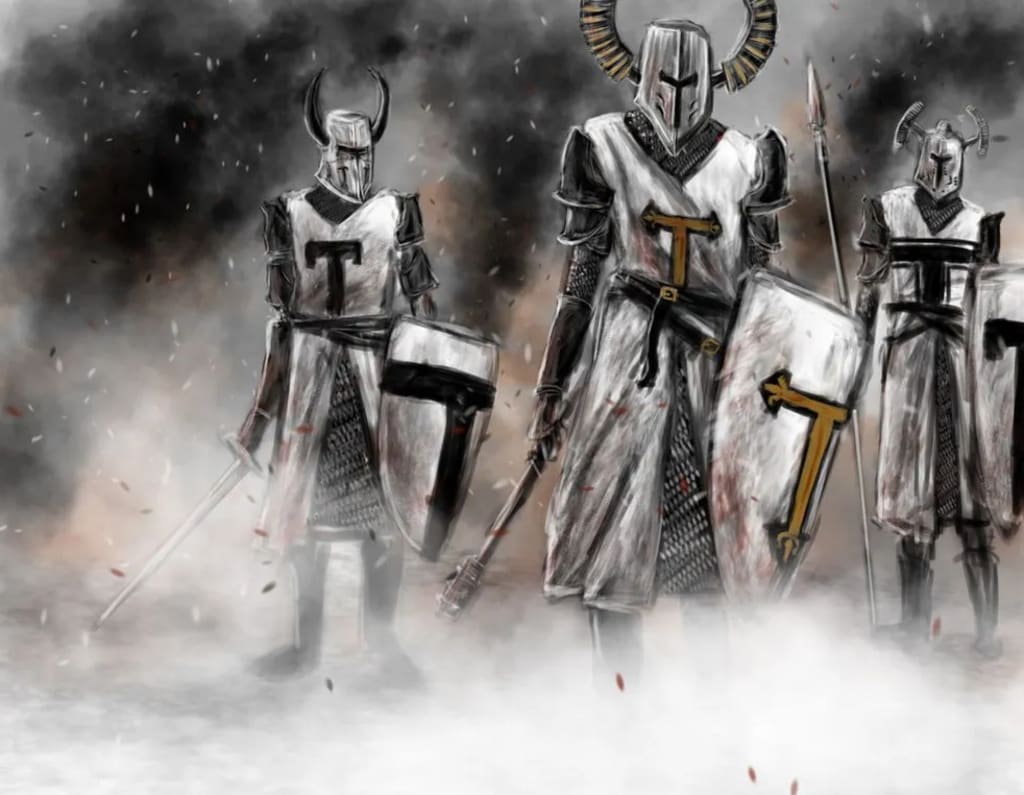
The history of the Teutonic Knights is a tale of military conquest, religious zeal, and political power. Founded during the tumultuous times of the Crusades, the Teutonic Order grew to become a formidable military and political force in medieval Europe, particularly in the Baltic region. Their legacy, marked by both glory and controversy, remains a significant chapter in the history of the Middle Ages.
The Origins: A Crusader Foundation
The Order of the Teutonic Knights of St. Mary’s Hospital in Jerusalem, more commonly known as the Teutonic Knights, was founded in 1190 during the Third Crusade. Initially established as a hospital brotherhood to care for sick and wounded pilgrims in Acre, it was modeled after the Hospitallers and the Templars. The order was formally recognized by Pope Innocent III in 1199, who granted them the same privileges as the other military orders.
The knights wore distinctive white mantles with a black cross, symbolizing their commitment to both martial and spiritual duties. Their motto, “Helfen, Wehren, Heilen” (Help, Defend, Heal), encapsulated their mission.
Expansion in the Baltic: The Northern Crusades
The Teutonic Knights found their true calling not in the Holy Land, but in Northern Europe. In 1226, Duke Conrad of Masovia invited the order to aid in his battles against the pagan Prussians. This invitation marked the beginning of the Teutonic Knights’ significant role in the Northern Crusades, aimed at Christianizing the Baltic region.
The knights embarked on a campaign to conquer and convert the pagan tribes of Prussia, Livonia, and Lithuania. Over several decades, they established a powerful state, building formidable castles and fortresses to consolidate their rule. The city of Königsberg (modern-day Kaliningrad) became a prominent center of their power.
The Teutonic State: A Military Monastic Order
By the mid-13th century, the Teutonic Order had established a monastic state that spanned large parts of modern-day Poland, Lithuania, Latvia, and Estonia. The Grand Master, the order’s supreme leader, ruled over this territory, combining religious authority with temporal power.
The order’s governance was highly militarized and disciplined. They constructed an extensive network of castles, the most famous being Malbork Castle (Marienburg), which served as the headquarters of the Grand Master and symbolized the order’s might and architectural ingenuity.
Conflict and Decline
The expansion of the Teutonic Knights inevitably led to conflicts with neighboring states. The order’s aggressive policies and territorial ambitions brought them into direct conflict with the Kingdom of Poland and the Grand Duchy of Lithuania. The most significant of these clashes was the Battle of Grunwald (Tannenberg) in 1410, where the combined forces of Poland and Lithuania dealt a devastating defeat to the Teutonic Knights. This battle marked the beginning of the order’s decline.
Despite the loss, the Teutonic Order continued to wield considerable influence. However, internal strife, financial difficulties, and the rise of powerful neighboring states eroded their power. The Prussian Confederation, a coalition of local nobles and cities, rebelled against the order, leading to the Thirteen Years’ War (1454–1466). The war ended with the Second Peace of Thorn, which forced the order to cede substantial territories to Poland and recognize Polish suzerainty over the remaining Teutonic lands.
Transformation and Legacy
The final blow to the Teutonic Order’s sovereignty came in the early 16th century. In 1525, Grand Master Albert of Brandenburg-Ansbach converted to Lutheranism, secularized the order’s remaining territories, and established the Duchy of Prussia as a vassal state of Poland. This act marked the end of the Teutonic Knights as a sovereign military power.
However, the order survived in a diminished form, relocating its headquarters to Vienna and continuing its charitable and religious activities. Today, the Teutonic Order exists as a Catholic religious order, focused on humanitarian work and preserving its historical heritage.
The Dual Legacy of the Teutonic Knights
The history of the Teutonic Knights is one of contrasts. They were both feared conquerors and dedicated crusaders, responsible for the Christianization and colonization of the Baltic region. Their military achievements and architectural legacies, such as the impressive castles they built, stand as testaments to their once-great power.
At the same time, their aggressive expansion and harsh rule left a complex legacy, marked by conflicts and cultural disruptions. The Teutonic Knights remain a subject of fascination and debate, embodying the dual nature of medieval chivalric orders as both warriors and servants of the faith.
About the Creator
Keep reading
More stories from Gustavo Woltmann and writers in Chapters and other communities.
The Order of the Holy Sepulchre
In the rich tapestry of medieval Christian chivalric orders, the Equestrian Order of the Holy Sepulchre of Jerusalem holds a unique place. With its roots deeply intertwined with the history of the Crusades, this venerable order has evolved over centuries, preserving its spiritual mission and dedication to the Holy Land.
By Gustavo Woltmann7 months ago in Chapters
Fair Exchange, No Robberies
Dark Memoirs - Index There are at least two kinds of people in the world: those who write this half-arsed kind of intro to a story that looks to separate the rare and the norm, and those who realise it's an overused framing device and don't.
By Paul Stewart30 days ago in Chapters
The Gates - Chapter One
The crevice widened into a vast chamber, its silence broken only by the faint hum of a glowing mark etched across an ancient skull. A brilliant blue light pulsed from the bones, shifting like reflections across a subterranean pool.
By Madison "Maddy" Newton4 days ago in Chapters


Comments