
The Untold Stories of Women in History
Power, Courage, and Leadership Beyond the Textbooks
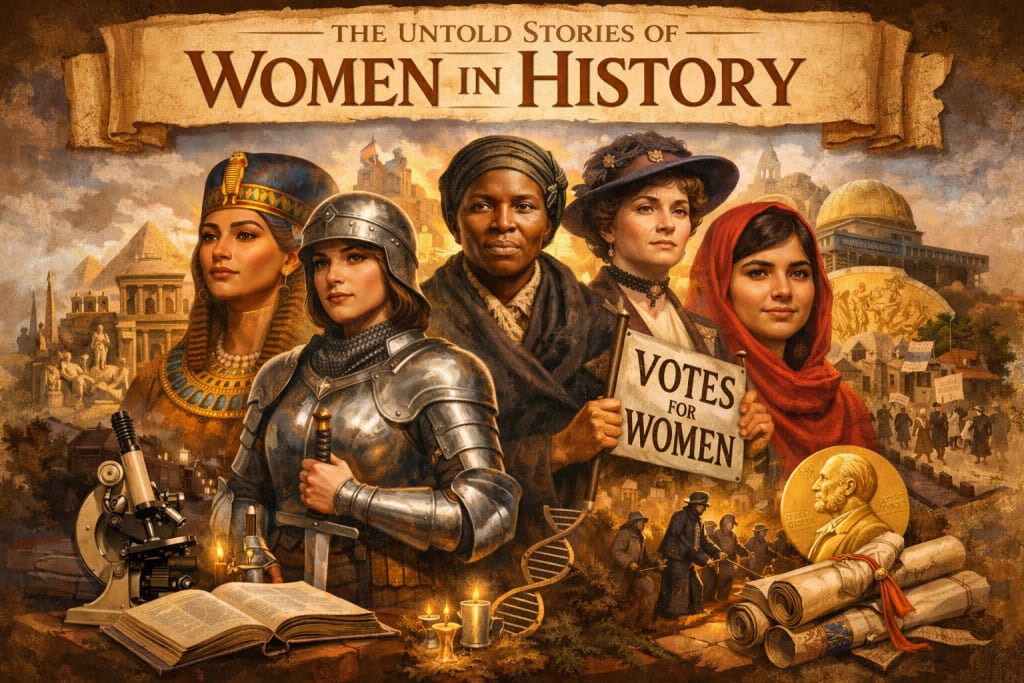
History, as it is often taught, feels like a gallery of kings, generals, inventors, and revolutionaries — most of them men. Yet behind every empire, every revolution, every scientific breakthrough, and every social transformation, women were present. They ruled nations, commanded armies, shaped intellectual movements, led resistance efforts, and redefined what leadership meant.
Their stories were not absent because they lacked impact. They were absent because history was recorded through narrow lenses. This is a journey through some of the untold — or under-told — stories of women who shaped the world in profound ways.
Queens Who Ruled Like Kings
Hatshepsut
Long before modern conversations about women in leadership, Hatshepsut ruled Egypt as Pharaoh in the 15th century BCE. Rather than acting as a placeholder ruler, she consolidated power, expanded trade routes, and oversaw ambitious architectural projects, including her magnificent mortuary temple at Deir el-Bahari.
To legitimize her rule in a male-dominated tradition, she often depicted herself with the traditional false beard worn by pharaohs. After her death, many of her statues and inscriptions were destroyed — likely an attempt to erase her legacy. Yet archaeology has restored her place as one of Egypt’s most successful rulers.
Wu Zetian
In 7th-century China, Wu Zetian rose from concubine to become the only woman in Chinese history to rule as Emperor in her own right. Her reign during the Tang Dynasty strengthened the imperial examination system, promoted capable officials regardless of background, and expanded the empire’s territory.
Though later historians painted her as ruthless, modern scholarship suggests that much of this portrayal stemmed from Confucian discomfort with female authority. Wu Zetian’s story challenges the idea that women were always confined to the background in ancient civilizations.
Warriors Who Defied Empires
Joan of Arc
A teenage peasant girl who claimed divine visions, Joan of Arc helped lead French forces during the Hundred Years’ War. Her leadership lifted the siege of Orléans and revived French morale at a critical time.
Captured and tried for heresy, she was burned at the stake in 1431. Decades later, she was declared innocent. Centuries later, she became a saint. Joan’s story is not just one of faith — it is about courage, conviction, and the cost of challenging power structures.
Harriet Tubman
Born into slavery in the United States, Harriet Tubman escaped — and then returned repeatedly to rescue others via the Underground Railroad. She conducted around 13 missions and freed dozens of enslaved people, risking her life every time.
During the American Civil War, she also served as a scout and spy for the Union Army. Tubman was not just a symbol of freedom; she was a strategist, organizer, and leader in a system designed to silence her.
Scientists the World Nearly Forgot
Rosalind Franklin
When the structure of DNA was discovered, the Nobel Prize went to three men. Yet one of the most crucial pieces of evidence — Photo 51 — came from Rosalind Franklin’s meticulous X-ray diffraction work.
Her contribution was not widely acknowledged during her lifetime. Today, historians of science recognize that without her data, understanding DNA’s double helix structure would have been delayed or impossible. Franklin’s story highlights how systemic bias can overshadow brilliance.
Chien-Shiung Wu
Known as the “First Lady of Physics,” Chien-Shiung Wu conducted the groundbreaking Wu Experiment in 1956, which disproved a fundamental law of physics known as parity conservation. The Nobel Prize for this discovery went to her male colleagues.
Wu’s contributions reshaped particle physics, yet her name remains less familiar outside scientific circles. Her experience reflects a broader pattern of women doing transformative work while receiving limited recognition.
Voices of Resistance and Reform
Emmeline Pankhurst
In early 20th-century Britain, Emmeline Pankhurst founded the Women’s Social and Political Union. Frustrated with slow progress, she and her supporters adopted militant tactics — protests, hunger strikes, and civil disobedience — to demand voting rights for women.
Her activism was controversial, but it forced the issue of women’s suffrage into the national spotlight. Today, voting is often taken for granted. Yet it came through relentless struggle led by women who refused to remain silent.
Malala Yousafzai
In the 21st century, Malala Yousafzai became a global symbol of the fight for girls’ education after surviving an assassination attempt by extremists. Rather than retreat, she amplified her advocacy on a global stage and became the youngest Nobel Prize laureate.
Her story reminds us that history is still being written — and women continue to shape it in real time.
Why Their Stories Matter
The untold stories of women in history are not just about fairness in storytelling. They reshape how we understand power, innovation, and leadership.
When we include women’s contributions:
Leadership stops looking exclusively masculine.
Innovation becomes collaborative rather than individual.
Revolutions appear as collective movements rather than singular hero narratives.
Young girls gain historical role models.
Young boys learn that strength includes empathy, resilience, and cooperation.
History is not a fixed script. It evolves as new evidence emerges and as societies choose which voices to amplify.
Rewriting the Narrative
For centuries, historical documentation depended on those with access to education, political influence, and publishing power — spaces often restricted to men. Women’s contributions were minimized, attributed to male counterparts, or ignored entirely.
But modern historians are digging deeper. Letters, diaries, court records, and archaeological discoveries are restoring women to their rightful places in the narrative.
We are learning that:
Women financed revolutions.
Women led trade networks.
Women authored philosophical works under pseudonyms.
Women organized resistance movements from kitchens, courtrooms, and battlefields.
The silence was never proof of absence. It was proof of exclusion.
The Future of History
As education systems evolve and scholarship broadens, the historical canon is slowly expanding. Museums, documentaries, and digital archives now spotlight women who were once sidelined.
But true change happens not only in institutions — it happens in storytelling. Every article written, every classroom lesson updated, every documentary produced contributes to a more complete understanding of our shared past.
The untold stories of women in history remind us of one powerful truth:
Women were never merely supporting characters. They were rulers, strategists, scientists, revolutionaries, and visionaries.
History did not overlook them because they were unimportant.
It overlooked them because the lens was narrow.
Now, that lens is widening — and with it, our understanding of humanity itself.
About the Creator
Keep reading
More stories from Aiman Shahid and writers in Confessions and other communities.
The Life I Almost Chose
There are moments in life that don’t look important while they’re happening. They don’t arrive with dramatic music or flashing lights. They come quietly — disguised as ordinary choices. A job offer. A relationship. A city. A “yes” or a “no.”
By Aiman Shahida day ago in Confessions
Blessed 33
So I woke up on the morning of February 5, 2026 and guess what and you know what I realized? It’s my 33rd birthday. Do you know what that means? Yes, technically I’m getting old, but what I couldn’t have guessed was this would be one of the best days of my life.
By Joe Patterson14 days ago in Confessions
Eyal Mehaber Discusses Foreclosure Realities and Commercial Property Strategy
When a person’s name appears next to a financial term online, it often sparks curiosity before it brings clarity. Searches related to Eyal Mehaber foreclosure reflect how easily complex commercial processes can be reduced to a single phrase. In large-scale real estate, however, financial terminology rarely tells the full story without context.
By Muhammad Bilal3 days ago in Confessions




Comments
There are no comments for this story
Be the first to respond and start the conversation.