
Crime Chronicles: The Werewolf of Wysteria
This is just...gross


A Quick Warning:
Guys and Gals, this is an important piece of info so please read carefully. This article is going to delve into some really dark, messed up stuff including graphic descriptions of violence committed against children. There are also excerpts and notes written by our villain of the story with some profanity and other potentially upsetting stuff. These have been included because they are part of the story, they're there for the sake of completion and nothing more.
I have covered some nasty people in this series so far, but I think this guy is the absolute worst. If you're squeamish and would prefer to skip this one, please do so. For those who decide to risk it, don't eat ANYTHING while reading - trust me on this, you really don't want to lose your meal.
Thanks - Greg.
Okay, so, you've seen my disclaimer and I think it's fair to say that the Crime Chronicles series isn't exactly family friendly. There are many monstrous people in the world, and we've discussed a few of them. Still, I think this is going to be different - and not in a nice way.
This time around, we're discussing a fellow who's very, very well-known to history; Albert Fish, the Werewolf of Wysteria.
Who is Albert Fish?

Hamilton Howard Fish was born in Washington D.C. on May 19, 1870 to Randall Fish and Ellen Howell. He was the youngest child and had three living siblings - note, I said 'living' siblings. Randall and Ellen had also had a child named Albert - who had died some time before Hamilton's birth.
The Fish family had a history of mental illness, including mania and schizophrenia.
On October 16, 1875, Randall Fish dropped dead of a fatal heart attack at the Baltimore and Potomac Railroad Station. Now, this might not make sense, but it's important to note that the patriarch of the Fish family was already 75 at the time of his marriage to Ellen Howell. A short while later, Ellen dropped Hamilton off at the St. John's Orphanage.
The other boys at the orphanage gave him the nickname 'ham and eggs' - much to his disgust. He later changed his name to Albert. While at the orphanage, he was constantly abused. The abuse included severe beatings which he grew to enjoy - this is going to come into play later.
He stayed at the orphanage until 1880 when his mom finally got him out after getting a stable job.
Albert moved to New York in 1890 at the age of 20 and, in 1898, married 19 year old Anna Mary Hoffman. The couple had six kids and stayed together until she left him in 1917, forcing Albert to be a single dad.
Albert Fish, Sexual Sadist

Albert Fish's criminal history is...twisted. While living in New York, engaged in male prostitution and molested and raped boys - many as young as six years old.
His first arrest was, as far as I can find, in 1889 - for forgery, he was arrested again in 1903 for grand larceny. After his release, he became obsessed with sexual mutilation...oh, no.
Okay, now, this is where things are going to get really, really, really NASTY!
In 1910, while working in Delaware, Albert began a sadomasochistic relationship with a man named Thomas Bedden. The relationship lasted around 10 days. Fish took him to an old farm house and spent two weeks torturing the man. In the end, he tied Bedden down, and cut off half of his penis...excuse me for a moment.
*Horrified internal screaming*
Instead of killing him, Fish poured peroxide over the wound and wrapped it in a vaseline-covered handkerchief…one moment.
*More screaming*
If that’s not bad enough, Albert’s later statement about Bedden was worse.
"Took first train I could get back home. Never heard what become of him, or tried to find out." - Albert Fish
What a psycho!

Things got worse in 1917, Albert's wife left him - as previously mentioned - and his mental health began to suffer. He began to engage in self-harm which included:
- Spanking himself with a nail-studded paddle.
- Sticking wool soaked in lighter fluid in his...back door and set it on fire.
- Embedding needles into his pelvic area.
Now, this abuse apparently didn’t extend to his kids, although, he did encourage them to use that same nail-studded paddle on him in a sort of game with obvious sexual overtones - that’s just wrong.
Between 1919 and 1924, Fish continued to tortured, murdered and mutilated young boys. His victims of choice were often (as previously stated) six years old and younger. They were also mentally disabled, African American or both, these were people that nobody would miss - because, you know, racism.
June 11, 1924, Albert found an 8 year old girl, Beatrice Kiel playing on her family’s farm and tried to get her to go into the woods with him to find rhubarb. Her parents promptly chased him off, he returned that night and tried to sleep in the barn - that didn’t work very well because Beatrice’s dad chased him off again (well done, dad).
The Bogeyman
On July 14, 1924, Francis McDonnell was reported missing. He’d been playing catch with his friends in Staten Island, but never came home. A search was arranged, and it wasn’t long before the poor boy’s body was found hanging from a tree in a wooded area near his home. He’d been sexually assaulted and strangled with his suspenders. An autopsy later revealed that McDonnell had extensive laceration on his legs and abdomen, and his hamstring was almost completely stripped of flesh.
McDonell’s friends reported later that he’d been seen wandering off with an elderly man with a grey mustache. That same description was given by Anna McDonnell, Francis’ mother. She’d seen Fish earlier that day, telling reporters:
“He came shuffling down the street mumbling to himself and making queer motions with his hands ... I saw his thick grey hair and his drooping grey moustache. Everything about him seemed faded and grey." - Anna McDonell
This was where the ‘Grey Man’ moniker came from, it also meant that things were going to get really, really bad.
February 11, 1927 saw Fish claiming his next victim. 3 year old Billy Beaton and his 12 year old brother were playing with a friend - 4 year old Billy Gaffney. When Beaton’s older brother left briefly to return to his apartment, he came back to find that both boys had disappeared. Of course, this set off a panicked search; Billy Beaton was found later on the roof of their apartment building. When asked about Gaffney, he said quote:
“The bogeyman took him.” - Billy Beaton
Billy Gaffney’s body was never recovered and, initially, his murder was attributed to another killer - Peter Kudzinowski That changed when Joseph Meehan, a tramcar worker who later recalled seeing Fish trying to calm a crying boy on the tram.
Little Gracie Budd
"Young man, 18, wishes position in country. Edward Budd, 406 West 15th Street." - May 25, 1925, Edition of the New York World.
This was the ad that set off a chain of events which would put Albert Fish in the history books...and not in a good way.
The ad was placed by one Edward Budd and, on May 28, 1928, Albert Fish came calling. He introduced himself as Frank Howard, a farmer from Farmingdale, New York, and agreed to hire both Edward and a friend of his to work on his farm. Before leaving, he said he'd come for the boys in a few days.

The date of his return to collect the two came and went with no sign of 'Frank Howard'. Instead, a telegram arrived to arrange a later date and apologizing for not being there. It was during his second visit to the Budd family, that Fish turned his attention to Edward's little sister - Grace.
It wasn't rocket science. Edward Budd was eighteen, muscular, and would certainly put up a fight when Fish tried to kill him. He'd probably overpower Fish. On the other hand, Grace Budd was only 10 years old. She was smaller, weaker, a much easier target for Fish who, at the time, was already 58 years old.
Getting Grace was remarkably easy, Albert cooked up a story about a niece’s birthday party. He persuaded Grace’s parents, Albert and Delia Budd, to allow her to accompany him to the party - giving them a fake address. Now, common logic says the parents would say:
“Absolutely not!”
Stranger danger is a common thing nowadays, but I guess with Albert being Edward’s soon-to-be employer, the Budds agreed…this decision would haunt them. Fish took little Grace to Wisteria Cottage at 359 Mountain Road in the East Irvington neighborhood of Irvington, New York. What happened there is nasty, but the actual details wouldn’t come out until later - which we’ll get to in a bit, but I need to steel myself for that first.
The Capture of the Grey Man
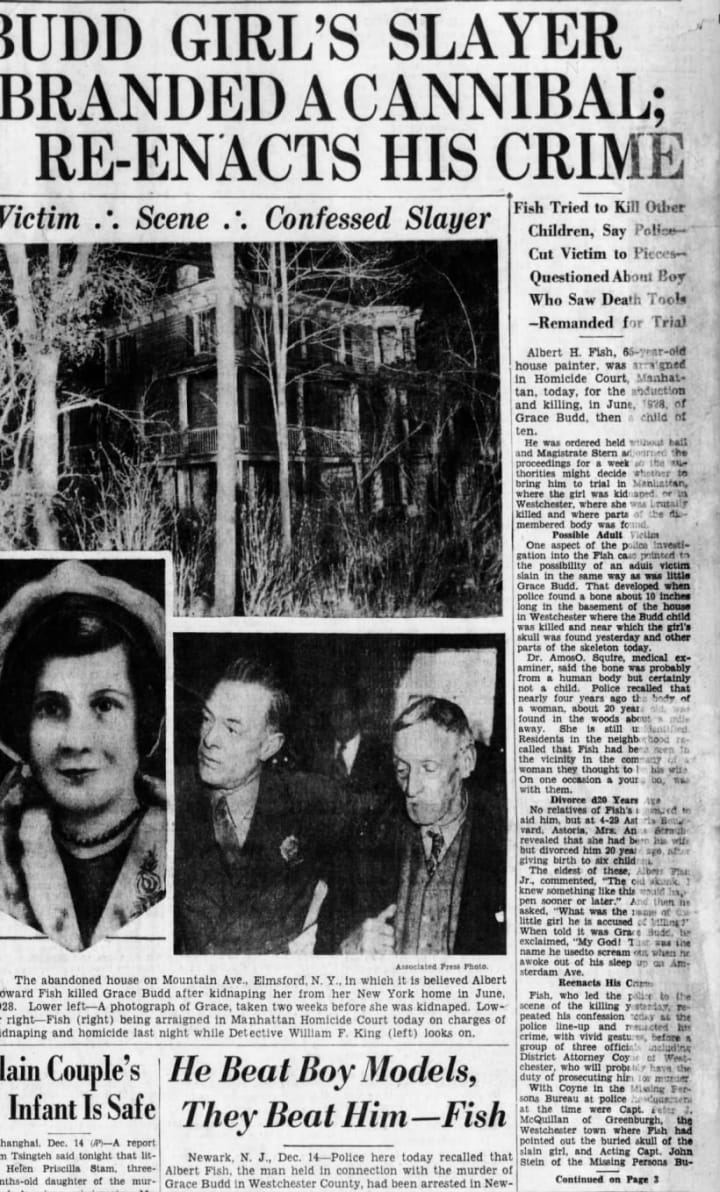
The time for Grace Budd’s return home came and went with no sign of the little girl, and her parents began to worry. When they called the police and discovered that the address that they’d been given for the party didn’t exist, concern turned to panic. At the time of Grace’s disappearance, there had been a number of disappearances of other children in the area.
With the only description of a suspect being, an elderly man, anyone who even remotely matched Fish’s description, was either reported to police, chased by lynch mobs, and/or beaten senseless.
As the search for Grace Budd continued, Delia Budd got desperate and constantly misidentified suspects. Things got so bad that the police considered her an unreliable witness. This is particularly well demonstrated by the trial of one Charles Pope. Pope was a 66 year old superintendent who was accused of Grace’s murder by his estranged wife.
From what I gathered, Delia testified at the trial and it quickly came out that Pope’s wife had coached her. Obviously, that made things problematic. Sadly, Pope still spent 108 days in jail between his arrest and trial. The trial concluded on December 22, 1930, with Charles Pope being found not guilty.
The state of New York was in absolute terror at the time, with the papers coming up with a number of names - including the Grey Man and, of course, the Werewolf of Wysteria. Albert Fish was basically a ghost and it seemed he would never be caught. That is, of course, until one of Fish’s bad habits got the better of him. See, early on in his criminal career, Albert Fish was arrested twice; once in 1930 and once in 1931; both times for same crime. What was that crime? Writing obscene letters to women…apparently that was a thing back in the day. It was one such letter, which he sent - anonymously - to the Budd family in November of 1934.
This letter contained the gruesome details of Gracie Budd’s final moments. It reads as follows:
"My dear Mrs. Budd,
In 1894 a friend of mine shipped as a deck hand on the Steamer Tacoma, Capt. John Davis. They sailed from San Francisco for Hong Kong China. On arriving there he and two others went ashore and got drunk. When they returned the boat was gone.
At that time there was famine in China. Meat of any kind was from $1 to 3 Dollars a pound. So great was the suffering among the very poor that all children under 12 were sold for food in order to keep others from starving. A boy or girl under 14 was not safe in the street. You could go in any shop and ask for steak—chops—or stew meat. Part of the naked body of a boy or girl would be brought out and just what you wanted cut from it. A boy or girls behind which is the sweetest part of the body and sold as veal cutlet brought the highest price.
John staid there so long he acquired a taste for human flesh. On his return to N.Y. he stole two boys one 7 one 11. Took them to his home stripped them naked tied them in a closet. Then burned everything they had on. Several times every day and night he spanked them—tortured them—to make their meat good and tender.
First he killed the 11 year old boy, because he had the fattest ass and of course the most meat on it. Every part of his body was Cooked and eaten except the head—bones and guts. He was Roasted in the oven (all of his ass), boiled, broiled, fried and stewed. The little boy was next, went the same way. At that time, I was living at 409 E 100 st., near—right side. He told me so often how good Human flesh was I made up my mind to taste it.
On Sunday June the 3—1928 I called on you at 406 W 15 St. Brought you pot cheese—strawberries. We had lunch. Grace sat in my lap and kissed me. I made up my mind to eat her.
On the pretense of taking her to a party. You said Yes she could go. I took her to an empty house in Westchester I had already picked out. When we got there, I told her to remain outside. She picked wildflowers. I went upstairs and stripped all my clothes off. I knew if I did not I would get her blood on them.
When all was ready I went to the window and called her. Then I hid in a closet until she was in the room. When she saw me all naked she began to cry and tried to run down the stairs. I grabbed her and she said she would tell her mamma.
First I stripped her naked. How she did kick—bite and scratch. I choked her to death, then cut her in small pieces so I could take my meat to my rooms. Cook and eat it. How sweet and tender her little ass was roasted in the oven. It took me 9 days to eat her entire body. I did not fuck her tho I could of had I wished. She died a virgin.”
- Albert Fish's letter to D. Budd
Delia wasn’t able to read so she gave the letter to Edward to read to her. I can’t even begin to imagine what went through their minds as they put the pieces together. It must’ve been horrific. The authorities decided that the letter was legit, although, the story about the famine in China and cannabilism couldn’t be verified. Sadly, this wasn’t the worst statement that Fish made regarding his victims - oh, trust me, we’ll get to that.
First off, I should probably answer the question burning in your brains: how did a letter get Albert Fish caught? Well telegrams are typed, right? Well, there has to be a source for those type-written messages. The authorities were able to track down a draft of one of Albert Fish’s telegrams - which provided them with a sample of his handwriting.
They were also able to get some of the stationery that he’d used because the letter to the Budds had been sent in an envelope with a distinctive logo for the New York Private Chauffeurs Benevolent Association. One of the association’s janitors told the police he’d taken some stationery to his room at a boarding house at 200 East 52nd Street.
Well, the police took that lead and spoke to the landlady at the boarding house and confirmed that, yes, Albert Fish did live there; she did say, however, that he’d already left. The police waited for Fish to come back and, when he did, they snagged him - after disarming him of a cutthroat razor.
Fish didn’t try to deny the murder of Grace Budd at the time. He admitted that he wanted to kill Edward Budd and denied any sexual assault on Grace - although, he did admit to his attorney later, that he’d...erm…finished…twice while he was strangling the little girl. That little bit of information was used to divert the jury’s attention away from the cannibalism and make the crime seem sexually motivated.
The Werewolf Goes on Trial
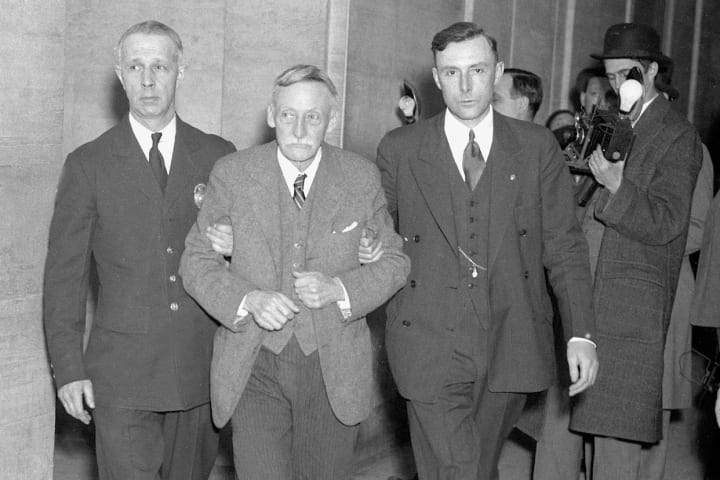
Albert Fish’s trial for Grace’s murder started on March 11, 1935, presided over by Judge Frederick P. Close and it lasted 10 days led to some rather…unpleasant revelations. The players in this game apart from Fish and Judge Close are Elbert F. Gallagher (prosecution) and James Dempsey (defense).
Fish, from what I understand, entered a ‘not guilty’ plea; he plead insanity and claimed to hear voices in his head telling him to kill children. Additionally, several psychiatrists also testified to Albert Fish’s many sexual fetishes including, but not limited to:
- Sadism
- Masochism
- Voyeurism
- Exhibitionism
- Paedophilia
- Cannibalism
As you can imagine, this caused quite a stir in the courtroom - it was the mid-1930s, after all. Both teams had different approaches. The prosecutor, Elbert Gallagher pretty much tore Fish’s insanity plea to shreds. Now, before I go into the how and why of Gallagher’s gameplan, I suppose I should explain a bit about Fish’s plan first.
The Rules of Engagement
So, real quick; I am NOT a lawyer. What I’m talking about here is purely my understanding of what I’ve read on the topic of the insanity defense. I know I’ve said this before, but I think it’s an important thing to add to this section because I don’t want anyone getting the wrong idea regarding qualifications and expertise on my part. With that out of the way, let’s talk about the rules of engagement when mounting an insanity defense.
The basis of the insanity defense is that the defendant, in this case Albert Fish, is a complete nutcase. This involves bringing in mental health professionals - psychologists and psychiatrists and the like - to examine the person on trial and evaluate their mental competency against a particular test. There are 3 tests that are usually used in an insanity defense:
- The M’Naghten Test - British Common Law (1843)
- The Durham Test - Durham v. United States (1954)
- The ALI Test - United States v. Brawner (1972)
There’s also something called the Irresistable Impulse Test - this was added to the M’Naghten Rules later on as part of the determining factors. Before discussing the M'Naghten rules, we'll look at the other two rulesets.
The Durham and ALI Rules
The ALI and Durham rules are very similar. According to the Durham rule, a defendant is not criminally liable if his crime was committed or caused by a mental problem. The ALI rule says something similar:
“A person is not responsible for criminal conduct if at the time of such conduct as a result of mental disease or defect he lacks substantial capacity either to appreciate the criminality of his conduct or to conform his conduct to the requirements of the law.” - American Law Institute
Basically, if you commit a crime, you aren’t held responsible if a mental problem hinders your understanding of how badly you’ve messed up or stops you from following the rules in general…at least, that’s my understanding of it. Now, that’s not a blank slate, the ALI rule also says that its definition of ‘mental disease or defect’ does NOT apply to issues caused by repeated offenses.
In other words, if you commit the same crime over and over again and it causes mental issues, well, tough luck buttercup the ALI rule doesn’t apply to you! Now, what are the M'Naghten rules?
The M'Naghten Rules
The M’Naghten rules are a bit more…complicated. The explanation of the rules given by the House of Lords when they put the rules in place is as follows:
“The jurors ought to be told in all cases that every man is to be presumed to be sane, and to possess a sufficient degree of reason to be responsible for his crimes, until the contrary be proved to their satisfaction; and that to establish a defence on the ground of insanity, it must be clearly proved that, at the time of the committing of the act, the party accused was labouring under such a defect of reason, from disease of the mind, as not to know the nature and quality of the act he was doing; or, if he did know it, that he did not know he was doing what was wrong.” - British House of Lords
In layman’s terms, proving insanity requires proof that:
- The defendant didn’t know what he was doing
- If he knew what he was doing, he didn’t know it was wrong.
We also have the Irresistable Impulse Test which, as I said before, was added to the M’Naghten Test in the mid-20th century. This test basically says that a defendant can’t be held responsible because, even if they knew they were doing something wrong, they couldn’t control their actions.
What makes the M’Naghten rules a bit more complicated than the others, I think, is the focal point of the rules themselves. If we break down the three components I listed above, we have:
- Knowledge
- Understanding
- Choice
If we ignore the Irresistible Impulse rule (Choice) for now, the M’Naghten rules are VERY broad-scoped and don’t distinguish between people who are dangerous to society and people who aren’t. Adding the choice factor in, how do you prove whether or not the defendant had control over their mental faculties to choose whether to commit the crime in the first place? Further complicating matters is the use of expert testimony. What do I mean?
Well…first off, medical professionals on both sides will have different perspectives on the defendant’s sanity. That’s a given, right? The prosecutor’s experts will say the defendant is sane, the defense will usually play the opposite. Additionally, the medical guys don’t have legal expertise - that’s the lawyer’s area of expertise. Their job is to provide a MEDICAL perspective - their opinion, nothing else. The lawyers are the ones who have to argue the legal side and the jury then has to take everything into the deliberation room and decide on whether the defendant is sane or not.
Socially Alright, Just Weird
So, the defense team went to work trying to prove that their client was insane. The way I understand it, if Albert Fish was deemed to be insane, he’d be spared the death penalty. Each of the experts came out and talked about how Albert’s childhood abuse basically wiped out his mental state and made him into a monster. The fact that there were no less than 29 needles lodged in his pelvic region was also used as a demonstration of his insanity. After all, what sane man would stick needles into his nether regions? The defense team’s expert witness, Frederic Wertham, was a psychologist who specialized in childhood development. His focused on Fish’s early years and connected the murder of Grace Budd with the Biblical story of Abraham and Isaac from the book of Genesis. Now, I was vaguely familiar with that story, but I dug out an old copy of the Good News Bible and looked it up.
The story is told in Chapter 22, verses 1 - 14. I won’t put the whole story down, but the gist of it is that God comes to Abraham one day and commands him to offer his son Isaac as a sacrifice. They go to the place God says they should make the offering, and at the last moment, just as Abraham is about to kill his son, an Angel calls out and stops him.
Wertham said that Fish believed an angel would stop him, the cannabilism aspect was connected to communion. He completed his testimony by declaring that Albert was insane.
The prosecution, on the other hand, tore into the defense’s insanity plea using:
- The letter to the Budd family.
- The fact that a secondary location had been selected for Grace’s murder.
- The savagery of the crimes.
There were other bits and pieces, including one of their experts who basically said that Fish’s sexual fetishes were weird but socially fine - I’d like to disagree wholeheartedly. The crucial evidence, however, was Grace Budd herself. Albert had taken investigators to the cottage where he’d killed Grace and her remains were subsequently recovered. The prosecutors brought the little girl’s remains into the courtroom in a small basket - much to James Dempsey’s chagrin.
Dempsey was so incensed that he demanded a mistrial, which the judge shut down immediately.
The jury retired to deliberate, and returned with a guilty verdict - he was also found to be sane. Of course, later one juror admitted that they thought he was nuts, but they wanted him executed anyways…I would say something snarky, but I think that’s pretty snarky already. After his trial, he was sent off to Sing Sing to await his execution. While he waited, Albert got a visit from Billy Gaffney’s mother, Elizabeth who refused to believe that her son was dead until she was told by Albert himself. He refused to see her, but he did give a letter to his letter which discussed Gaffney’s death:
“I brought him to the Riker Ave. dumps. There is a house that stands alone, not far from where I took him ... I took the G boy there. Stripped him naked and tied his hands and feet and gagged him with a piece of dirty rag I picked out of the dump. Then I burned his clothes. Threw his shoes in the dump. Then I walked back and took trolley to 59 St. at 2 A.M. and walked home from there. Next day about 2 P.M., I took tools, a good heavy cat-of-nine tails. Home made. Short handle. Cut one of my belts in half, slit these half in six strips about 8 in. long. I whipped his bare behind till the blood ran from his legs. I cut off his ears – nose – slit his mouth from ear to ear. Gouged out his eyes. He was dead then. I stuck the knife in his belly and held my mouth to his body and drank his blood. I picked up four old potato sacks and gathered a pile of stones. Then I cut him up. I had a grip with me. I put his nose, ears and a few slices of his belly in the grip. Then I cut him thru the middle of his body. Just below his belly button. Then thru his legs about 2 in. below his behind. I put this in my grip with a lot of paper. I cut off the head – feet – arms – hands and the legs below the knee. This I put in sacks weighed with stones, tied the ends and threw them into the pools of slimy water you will see all along the road going to North Beach. Water is 3 to 4 ft. deep. They sank at once. I came home with my meat. I had the front of his body I liked best. His monkey and pee wees and a nice little fat behind to roast in the oven and eat. I made a stew out of his ears – nose – pieces of his face and belly. I put onions, carrots, turnips, celery, salt and pepper. It was good. Then I split the cheeks of his behind open, cut off his monkey and pee wees and washed them first. I put strips of bacon on each cheek of his behind and put in the oven. Then I picked 4 onions and when meat had roasted about 1/4 hr., I poured about a pint of water over it for gravy and put in the onions. At frequent intervals I basted his behind with a wooden spoon. So the meat would be nice and juicy. In about 2 hr., it was nice and brown, cooked thru. I never ate any roast turkey that tasted half as good as his sweet fat little behind did. I ate every bit of the meat in about four days. His little monkey was as sweet as a nut, but his pee-wees I could not chew. Threw them in the toilet.” - Albert Fish
I’m going to be sick…
Albert Fish was led into the execution chamber on January 16, 1936, and plonked in the electric chair and zapped into the void. Good riddance! The day after the execution, James Dempsey told the press that he had his client’s final statement. When asked to reveal the letter’s contents, Dempsey refused.
"I will never show it to anyone. It was the most filthy string of obscenities that I have ever read.” - James Dempsey
Considering what we’ve read in his other notes, that’s probably a mercy.
The Legacy of Albert Fish
Albert Fish’s crimes were sickening and they triggered widespread revulsion and terror throughout the state of New York. It didn’t exactly help that the media had sensationalized his crimes and fuelled the proverbial fire. The increased vigilance heightened awareness on child safety, but it also meant that people eyed each other with suspicion, not knowing who could be the next bogeyman.
The case also challenged social norms at the time and sparked some serious discussions on the limits of human cruelty - given what we read in Fish’s notes, that’s no surprise. Additionally, there have also been some significant debates about the way the legal system handles mentally disabled people and discussions about the insanity defense. On a more positive note, there were also significant changes to how law enforcement handled missing persons cases, especially when kids were involved; and this was before the Amber Alert was a thing.
You may have noticed a lack of my usual snarkiness in this one, and that’s by design. Usually, I have some snarky, funny comments; I cut back on that this time around because it just felt wildly inappropriate. I’ve covered some really disturbing cases in the Crime Chronicles, including Peter Kurten (Vampire of Dusseldorf). Frankly put, I think we’ve just found the winner for Most Disgusting Criminal…please, please don’t let the next one be worse.
About the Creator
Greg Seebregts
I'm a South African writer, blogger and English tutor; I've published 1 novel and am working on publishing a 2nd. I also write reviews on whatever interests me. I have a YouTube Channel as well where I review books, and manga and so on.
Keep reading
More stories from Greg Seebregts and writers in Criminal and other communities.
Whispers Beneath the Wooden Floor
The house on Alder Street had been empty for nearly two decades before the new owners arrived. It was an aging structure with peeling paint, narrow windows, and wooden floors that groaned under the slightest pressure. Most buyers avoided it because of rumors. People claimed the house had a history, though no one explained what that meant. When Amelia and her father purchased it at a low price, they dismissed the whispers as neighborhood exaggeration. Old houses made noise. Old stories survived without proof.
By Sudais Zakwan3 days ago in Criminal




Comments
There are no comments for this story
Be the first to respond and start the conversation.