
Information and Communication Technology Warfare
Digital Warfare Using IoT
As a teenager, I was an avid reader of the science fiction genre of novels. I spent my pocket money on books. What I loved most, was the promise of the future greater technology and a promised easier lifestyle. The idea that humans could make robots that were as smart as themselves thrilled me. It was exhilarating. Now, half a century later, I am witnessing similar book concepts manifest themselves increasingly inserting themselves into our mundane world. Let me express my admiration for Isaac Asimov, Jules Vernes, and H.G. Wells. As I grew older, my taste in books changed. I found elements of future worlds, extreme technologies, and gadgets in the writings of authors like James Patterson, who wrote about cyber attacks on police stations, David Rorvik, who introduced the concept of human cloning, the Sunday comic strips featuring Dick Tracy’s equivalent of the Apple Watch and George Orwell’s description of an authoritarian world where fake news was considered the truth and surveillance was as common as family visits.
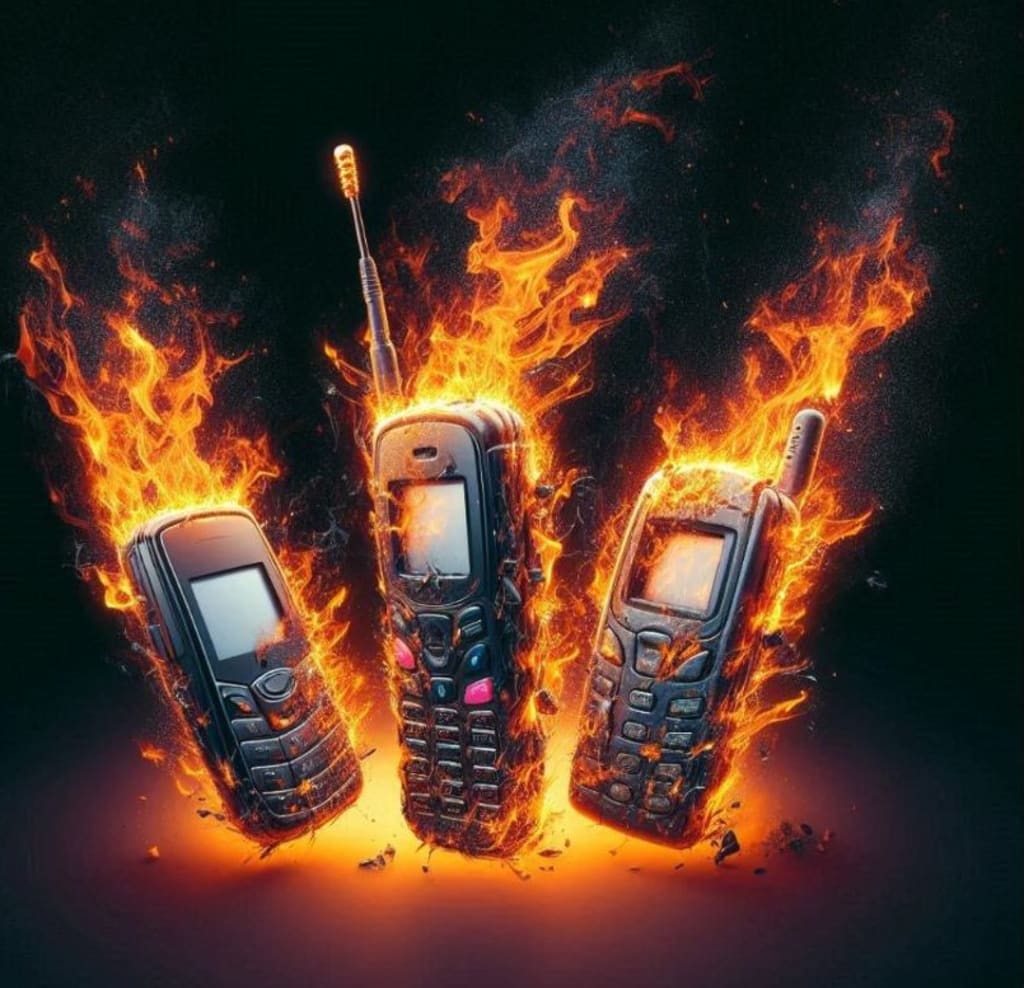
On September 17th and 18th, 2024, thousands of pagers and electronic handheld devices (radios, walkie-talkies, etc) exploded all over Lebanon. 36 persons died and close to three thousand were injured. The collateral damage was severe. It was just a matter of time before another piece of the futuristic puzzle fitted into place. It is not unusual for mankind to take a perfectly useful technology and transform it into an instrument of destruction. Ever since humans realized that their grasp should extend beyond their reach, their God-complex mode was initiated. The potential of humans to destroy themselves is infinite.
There are many lessons to be learned from this tragic chapter in human history. Whether individually or collectively, the citizens of the world need to take stock of the technologies thrust upon them. It is essential to assess the risks associated with the technologies within our homes, offices, and countries. The rapid growth of artificial intelligence (AI) is a prime example. Unregulated and moving at break-neck speed, AI is embraced without concern for the associated dangers. The ubiquitous cell phones and social media platforms are unregulated and are susceptible to cyber-attacks and privacy breaches. Although these deficiencies within the system are known, the mindset of the Millennials and Gen-Z, who are different from Baby Boomers and Gen-X, makes them more susceptible to peer pressure and FOMO (Fear of Missing Out). In essence, these technologies are here to stay and are all-pervasive. The strategies for managing the consequences of the technologies are anyone’s guess.
In a world increasingly dominated by technology, the lines between convenience and vulnerability are becoming blurred. While the conveniences of technology are well known what is less known is the casualness and the indifference to the vulnerabilities it brings. Some of the most obvious threats to man are by way of devices such as cell phones, electronic vehicles (EVs), drones, and robot vacuums, essentially, anything with a programmable chip and an internet connection.
Let’s consider some examples that barely made the news but ought to be reconsidered in light of recent terrorist events as far away as Lebanon. Let’s not, for a moment, assume that it cannot happen to you. Electric vehicles have chips embedded in them. It is worth noting that, any vehicle that can be started remotely has a degree of vulnerability. As long as it can be accessed via cellular connectivity, WiFi, or Bluetooth, it can be hacked. Consumer Watchdog has reported on various EV models that are easily hacked. Researchers from Sandia National Laboratories demonstrated how a vehicle's functions can be remotely controlled, such as the brakes and engine, by exploiting vulnerabilities in the vehicle’s software. The hacked vehicles essentially become autonomous weapons, wreaking havoc on the streets and putting both the main characters and innocent bystanders in grave danger. Watch the 2017 movie, “Fast & Furious 8” to visualize and appreciate the risks involved in taking control of an EV for nefarious purposes.
EVs rely on a network of charging stations, which could potentially be targeted. For example, hackers could shut down charging stations or disrupt grid infrastructure, leading to large-scale disruptions of EV functionality.
Drones are now an integral part of our lives whether for recreation, work, or military purposes. There have been instances of drones being outfitted with dangerous payloads like explosives or firearms. In 2018, a drone carrying explosives was used in an attempted assassination of Venezuelan President Nicolás Maduro, highlighting how personal drones can be weaponized.
In 2018, multiple drone sightings caused the shutdown of Gatwick Airport in the UK, affecting hundreds of flights and tens of thousands of passengers. The incident, although not involving direct hacking, demonstrated how easy it is for drones to disrupt critical infrastructure.
Robot vacuums, while convenient for household cleaning, have been he target of various cybersecurity vulnerabilities and data privacy concerns. One notable breach occurred with iRobot’s Roomba J7 series, where units captured personal images, including private scenes like a woman on a toilet, and these images were leaked by data-labeling contractors. Additionally, a 2020 study demonstrated how the sensors on robot vacuums, specifically LiDAR technology, could be exploited to capture audio from inside homes. This LidarPhone attack was able to classify spoken digits and even identify the gender of speakers with high accuracy. Hackers could gather sensitive household data, such as floor plans and routines, which could be exploited for targeted advertising or more malicious purposes.
Given what happened in Lebanon with the hacked and exploding Internet of Things, we must be extremely vigilant and not rely solely on our government to be the eyes and ears of security. We must play an active role too and demand accountability and transparency.
Many found it unusual when President Jimmy Carter used snail mail (hand-delivered mail via the post office for the Gen Z generation) and a typewriter (pre-dated word processor) to create and deliver his confidential messages. It’s one way to deal with society’s obsession with digital technology.
People's indifference or oversight regarding data collection and privacy issues related to digital equipment can be attributed to several factors. Mental laziness is one of the greatest factors contributing to the prevalence of potential threats. Users need to be more socially conscious and proactive in order to combat those who are intent on destroying us whether physically or virtually.
When I was in my early twenties running an ICT business created with friends, an ICT Consultant, Stafford Martin, was developing an Operating System. I am unsure as to whether he completed it. Looking back, I realize that many of us in the ICT field, may have been discouraging rather than supportive. Reflecting on our actions, I see that we may have killed the spark of entrepreneurship spirit that is challenging to foster in the Caribbean. Stafford had the potential to create the equivalent of Microsoft’s Operating System in the CARICOM Region. Nations should invest in their own social media platforms such as China has done to avoid dependence on platforms like Facebook, X, or TikTok. They should develop their own software applications and technology products. While there will always be the challenge of hackers trying to infiltrate systems, globalization has not been kind to all nations but greatly benefits the superpowers.
But when all is said and done, George Orwell’s dystopian world seems to be already upon us. The ball is still in our court. Carry on smartly!
About the Creator
Wayne W. Barrow
Wayne W. Barrow is a husband and brother who is a writer of diverse themes in non-fiction and fiction. With three acclaimed non-fiction books, he writes about contemporary issues & has published an anthology of 20 captivating short stories.
Keep reading
More stories from Wayne W. Barrow and writers in Criminal and other communities.
An Act of Kindness
I was extremely distressed, to put it mildly. The feeling was so intense that my faith received a low blow due to the sudden death of my father. Heart attacks are so sudden and final. My feelings were such that I was ashamed of myself as I harboured thoughts similar to those of Job’s wife as recorded in the Old Testament. My father meant the world to me. He was the sole breadwinner in a home consisting of my grieving mother, a semi-educated and indolent brother who was unemployable, and me, a current student at the University of the West Indies. My life and that of my family had taken a dreadful and unexpected turn.
By Wayne W. Barrowabout a year ago in Serve
The Banyan Tree Ritual: The Chilling Mystery of the Burari Deaths
The House of Secrets: The Chundawat Family’s Ritual to Nowhere On the morning of July 1, 2018, the Burari neighborhood in North Delhi didn't wake up to its usual rhythm. The Chundawat family, known for their kindness and their thriving grocery shop, hadn't opened their doors. By 7:30 AM, neighbors grew concerned. The shop, which was a cornerstone of the community, was never late. When a neighbor finally climbed the stairs to their home to check on them, he found the front door unlocked. He stepped inside and was met with a sight so horrifying it would traumatize the nation and later become the subject of the chilling Netflix docuseries, "House of Secrets: The Burari Deaths."
By Mayar Younesa day ago in Criminal




Comments
There are no comments for this story
Be the first to respond and start the conversation.