
The Google Maps Murder: How a Satellite Image Solved a Year-Old Disappearance
A 33-year-old Cuban man vanished after visiting his lover — until Google Maps revealed the chilling truth.

It began as a love story — and ended as a digital nightmare.
In October 2023, a 33-year-old Cuban man traveled to the city of Soria, in northern Spain, to meet his lover.
He told friends he’d be back in a few days.
He never returned.
Days later, his family began receiving strange messages from his phone:
“Don’t look for me. I’m fine. I’m turning off my phone.”
The tone was off. The phrasing didn’t sound like him.
His family knew something was wrong.
They filed a missing person’s report with Spanish authorities, hoping for answers — but the trail went cold.
For months, investigators searched without luck. The man’s phone was switched off, his bank cards unused, his car never found.
The case slowly faded from headlines and became one more mystery buried in police archives.
Until one day — more than a year later — a satellite image from Google Maps changed everything.
Someone browsing an updated section of Soria on Google Maps noticed something strange:
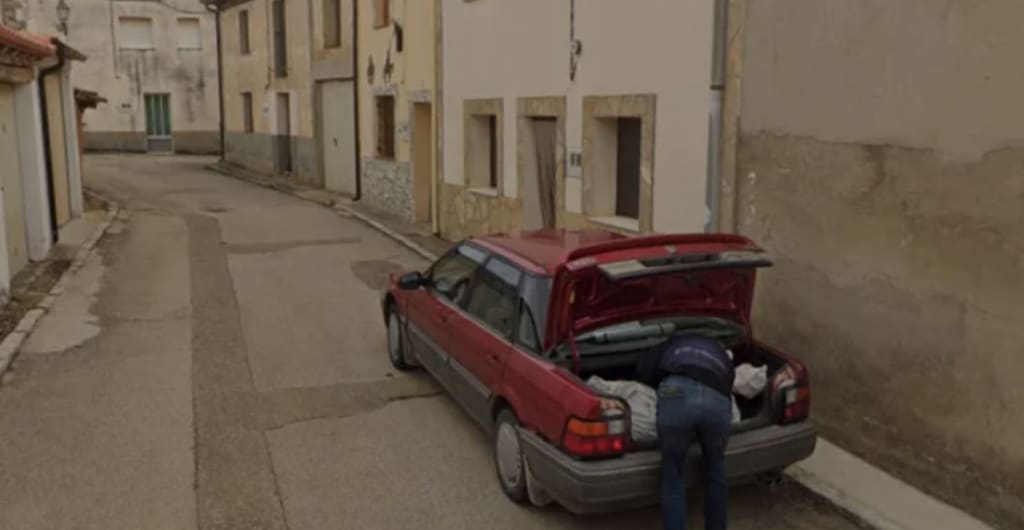
in a quiet area near a cemetery, a car was parked with its trunk open.
And standing behind it was the blurry figure of a man, appearing to place something large — something shaped like a body — into the trunk.
The image had gone unnoticed for months.
But when a local user shared it online, it quickly caught the attention of investigators.
Police compared the car’s make and license plate with missing persons reports.
It matched the Cuban man’s vehicle.
Using this clue, detectives reopened the case. They tracked the GPS data, phone records, and known associates of the missing man.
The trail led to a local couple — the woman he had traveled to see, and her husband.
On November 12, 2024, police arrested both of them.
The woman was the missing man’s secret lover; her husband had discovered the affair.
Investigators believe the two plotted to lure the Cuban man to Soria — and once he arrived, they killed him together.
When questioned, both denied involvement. But phone records, security footage, and traces of blood in their vehicle told another story.
During a search of a local cemetery, authorities found human bone fragments believed to belong to the missing man. DNA analysis is ongoing, but police say the evidence is overwhelming.
The most haunting detail?
The Google Maps image that exposed the crime had captured the moment by sheer coincidence.
That specific area of Soria hadn’t been updated for 15 years — until that one satellite pass, which happened to take a new image right as the suspects were moving the body.
Bad luck?
Or poetic justice?
The case reignited global fascination with how technology can reveal what human eyes might miss.
In the past, Google Earth and Maps have helped locate missing persons, crashed vehicles, even long-hidden graves.
But never before had a random image played such a direct role in uncovering a murder.
Police continue to investigate whether others were involved or helped dispose of the remains.
Meanwhile, forensic teams are working to reconstruct the victim’s final moments — and to identify exactly how he died.
For the victim’s family, the discovery brought both closure and heartbreak.
After a year of silence, they finally had answers — but not the ones they hoped for.
His sister told reporters:
“We prayed he was alive somewhere. Instead, we found him through a satellite photo.”
The haunting irony of this case lies in its timing.
A global map service meant to connect the world ended up exposing a brutal act of betrayal and violence.
A single digital snapshot turned from a tool of navigation into a witness of murder.
And for investigators, it’s a chilling reminder:
even when you think no one is watching — the sky might be.
About the Creator
Faeze Gholami
“Registered nurse and vocal educator — sharing medical insights with clarity, compassion, and care.”
Keep reading
More stories from Faeze Gholami and writers in Criminal and other communities.
The Lost Identity: How a Missing Baby Became a Man Who Solved His Own Case
Introduction Imagine living your entire life with only one family—only to one day discover that the person you believed yourself to be was wrong. That is exactly what happened to Steve Carter, a man who, at the age of 34, stumbled upon the truth: he was once a missing infant named Marx Panama Moriarty Barnes. His journey is a chilling reminder that identity, adoption, and loss often intertwine in the darkest corners of human stories.
By Faeze Gholami4 months ago in Criminal
Still Missing: Savannah Guthrie’s Mother Nancy, FBI Offers $50,000 Reward in Urgent Search
Savannah Guthrie, the familiar face of NBC’s Today show, has been thrust into a deeply personal crisis as her 84-year-old mother, Nancy Guthrie, remains missing in Tucson, Arizona. Authorities and family members alike are urging anyone with information to come forward, emphasizing the urgency of the situation given Nancy’s fragile health.
By Story Prisma day ago in Criminal
The Night the City Learned How Quiet a Crime Could Be
M Mehran At exactly 1:13 a.m., the security cameras on Fifth and Monroe froze for three seconds. Not long enough to trigger an alarm. Not long enough for anyone to notice. But long enough for a man to walk through the blind spot and disappear into the city. By morning, someone would be dead. The victim was Jonah Keller, forty-two, respected real estate consultant, married, no criminal history. He was found seated at his kitchen table, hands folded neatly, a single glass of water untouched beside him. No signs of struggle. No blood. No forced entry. Just silence. Detective Mara Ilyas knew immediately this case would be a problem. Crimes without chaos always were. The medical examiner confirmed the cause of death within hours. A rare toxin. Colorless. Tasteless. Deadly in small doses. It stopped the heart as gently as sleep. “Poison,” Mara muttered. “Someone planned this.” The question was why. Jonah Keller had no enemies. At least none that showed up on paper. His colleagues described him as polite. His neighbors said he waved every morning. His wife, Rachel, collapsed into tears so convincing that even the most cynical officer felt uncomfortable doubting her. But Mara doubted everyone. Especially the quiet ones. Jonah’s phone revealed nothing suspicious. No threatening messages. No secret affairs. His finances were clean. Too clean. People rarely died in kitchens without leaving a mess behind, emotional or otherwise. Then Mara found the voicemail. It was old. Nearly a year back. Jonah’s voice sounded tired. “I did what you asked,” he said. “Please stop calling.” The number was unregistered. That was the crack in the perfect surface. Mara dug deeper, requesting sealed records and forgotten complaints. Eventually, she uncovered a civil case buried under layers of legal dust. A zoning dispute. Jonah’s company had pushed a redevelopment project that displaced dozens of low income families. The case never went to trial. It had been settled quietly. One of the complainants stood out. Elias Monroe. Former schoolteacher. Divorced. Son died during the eviction when their apartment caught fire from faulty wiring. The city blamed outdated infrastructure. The company blamed the city. No one blamed themselves. Elias disappeared shortly after. Until now. Security footage from a pharmacy two blocks away showed a man buying bottled water the night Jonah died. He wore a cap low over his face, but his posture told a story. Straight back. Careful movements. A man used to control. Mara recognized the walk. Elias Monroe had returned. They found him in a small rented room above a closed bookstore. No resistance. No surprise. He sat on the bed as if he had been waiting. “I didn’t hate him,” Elias said during interrogation. “I needed him to understand.” Mara leaned forward. “Understand what?” “That silence is violence,” Elias replied. “And people like him profit from it.” Elias explained everything calmly. He had studied chemistry online. Learned how to extract toxins from common plants. Tested doses on rodents. Documented every step. This was not a crime of passion. It was a message. “I sat with him,” Elias continued. “I made him drink the water. I watched him realize what was happening. I wanted him afraid, just for a moment. The way my son was.” Mara felt a chill crawl up her spine. “Why turn yourself in?” she asked. Elias smiled faintly. “I didn’t. You came to me.” He was right. The city arrested Elias within hours. Headlines exploded. Protesters gathered. Some called him a monster. Others called him a symbol of justice. Jonah Keller’s name slowly disappeared from public sympathy. Investigations reopened. Documents leaked. It turned out Jonah had known about the faulty wiring. Emails proved it. He had approved delays to save money. Rachel Keller stopped answering calls. The trial was swift. The evidence overwhelming. Elias Monroe was sentenced to life in prison without parole. As the verdict was read, he showed no reaction. Later, Mara visited him one last time. “Do you regret it?” she asked. Elias thought carefully. “I regret that it took a death for people to listen.” That night, Mara walked through the city streets. Neon lights flickered. Cars passed. Life continued, loud and careless. But beneath it all, something had shifted. The city had learned that the most dangerous crimes don’t announce themselves. They arrive quietly. They sit at your table. They ask you to drink. And by the time you notice them, it’s already too late. Months later, the case became required reading in criminology classes. Professors debated motive versus morality. Students argued late into the night about whether intent mattered more than outcome. Some insisted Elias was evil. Others claimed the system had created him. Mara followed the discussions from a distance. She never joined. She had seen Elias’s eyes. They were not empty. They were heavy. The city council quietly passed new safety regulations. Developers were forced to disclose risks. Inspectors were no longer optional. No one publicly connected the reforms to Jonah Keller’s death, but everyone understood the cause. Rachel Keller sold the house. Neighbors said she moved like a ghost during her final days there, avoiding eye contact, flinching at sudden sounds. Guilt, like poison, worked slowly. Elias wrote letters from prison. Not appeals. Not apologies. Explanations. He sent them to lawmakers, journalists, and families still fighting eviction notices. Some letters were published. Others were ignored. None were answered by the man himself. Mara kept one letter locked in her desk. It ended with a sentence she could never forget. “I chose a crime that would be remembered,” Elias had written, “because quiet suffering is never archived.” Years passed. New crimes took over the news cycle. Louder crimes. Bloodier crimes. Easier crimes to understand. But every time Mara stood in a silent kitchen, she remembered Jonah Keller’s folded hands and untouched glass. She remembered how easy it was to miss responsibility becoming guilt. And she remembered that justice is often decided long before police arrive. Always.
By Muhammad Mehran2 days ago in Criminal
Cabin Fever Because of Snow, Sleet, and Freezing Rain That Turned to Icy Roads
What Is Cabin Fever? The short answer is that cabin fever is restlessness from being in a confined area. Cabin fever is the distressing irritability or restlessness experienced when a person or group is stuck at an isolated location or in confined quarters for an extended time. Research shows that prolonged cold, gray skies, and being stuck indoors can trigger mood shifts similar to “winter blues.”
By Margaret Minnicks6 days ago in Humans



Comments
There are no comments for this story
Be the first to respond and start the conversation.