
Through the Lens of Midnight
“A Filmmaker’s Journey to Capture Truth in a World Built on Illusion”

.Sophia Collins had always believed in the power of film. Growing up, she’d watched classic movies, feeling the magic of the screen as it transported her into different worlds. But now, after ten years in the business, she had begun to wonder if the movies she’d once adored were simply comforting illusions—constructed realities made to hide the truth.
She was a documentary filmmaker. Her job was to show the world as it was, raw and unfiltered. Or so she had thought. The world she had been capturing for the last few years—the lives of everyday people struggling with the realities of modern life—seemed to blur the lines between truth and fiction more and more. She could no longer distinguish whether the stories she told were real or simply narratives her subjects had created for themselves.
It was this question, this nagging doubt about the reality she was capturing, that led her to “The Midnight Project”—her most ambitious and personal film yet.
---
Chapter One: The Start of the Midnight Project
It all began one rainy evening when Sophia was at a local café, editing footage of a family she’d been documenting for months. The mother, a single parent struggling to raise two children, had been incredibly open and honest with her about their daily life. But the more Sophia watched the footage, the more she felt like she wasn’t seeing the full picture. What was behind those smiles? What were the secrets being hidden in the shadows?
Then, as she sat in the café, a conversation with an old mentor, Jacob Turner, took a turn that set her on this new path.
“I think you’re missing the heart of what you do, Sophia,” Jacob said, sipping his coffee. “You want to show reality, but there’s more to truth than what’s on the surface.”
“What do you mean?” she asked, genuinely puzzled.
“I mean, you’re only capturing what you see with your eyes. But what about what can’t be seen? The things that lie beneath, the stories people aren’t ready to tell you? Maybe you need to stop filming the illusion and start capturing the truth beneath the illusion.”
His words stuck with her. For the first time, she questioned everything about her work. Had she been simply documenting reality, or was she merely recreating illusions? How much of what she captured was truly “real,” and how much was shaped by her own lens, her own perspective?
Jacob’s words didn’t leave her mind, and so she decided to embark on a project that would challenge everything she knew about filmmaking. She called it “The Midnight Project”—a film where she would capture the hidden truths of those around her, focusing on their dreams, their fears, and the things they couldn’t, or wouldn’t, say in the light of day.
---
Chapter Two: Unveiling the Illusion
Sophia began her project with no clear idea of where it would go. She spent weeks filming the lives of people who worked in the shadows, in places where secrets often festered: a homeless shelter, a late-night diner, a dive bar on the edge of town. She’d set up her camera in discreet corners, hoping to catch moments of vulnerability.
But even in these unguarded spaces, people still performed. The waitress who wiped down tables smiled a little too brightly. The man at the bar who had clearly been drinking for hours still kept up the pretense of casual conversation. Everyone was hiding something, and Sophia began to realize that she, too, was participating in this elaborate game of illusion.
She had planned for this documentary to strip away the masks people wore. But what if those masks were all anyone had left? What if the illusion they created was the only thing keeping them whole? The line between truth and illusion seemed to disappear more each day, and soon, Sophia was questioning her own role in the lives of the people she filmed.
Then, one night, something unexpected happened.
---
Chapter Three: A Midnight Encounter
Sophia was filming at an old warehouse district when she met Tom—a man who, unlike anyone else, seemed to wear no mask at all. He was sitting in the dim light of a streetlamp, alone, scribbling in a notebook. When he saw her approaching with the camera, he didn’t shy away or offer a smile for the lens. Instead, he simply raised an eyebrow.
“Do you want to film the truth?” he asked, his voice raspy but calm. “Or do you want to film what’s been told to you?”
Sophia froze. She didn’t know how to answer.
“I’ve been following you,” Tom continued, his eyes narrowing. “I see you, hiding behind your camera, watching these people. But you’re too afraid to ask the right questions, aren’t you?”
He stood up and walked toward her, his presence unnerving. “You think you’re capturing truth, but you’re just documenting the surface. You’ve seen the illusion, but not the truth underneath it. I can show you.”
Sophia felt a chill run through her, but curiosity won out. She nodded, signaling for him to continue.
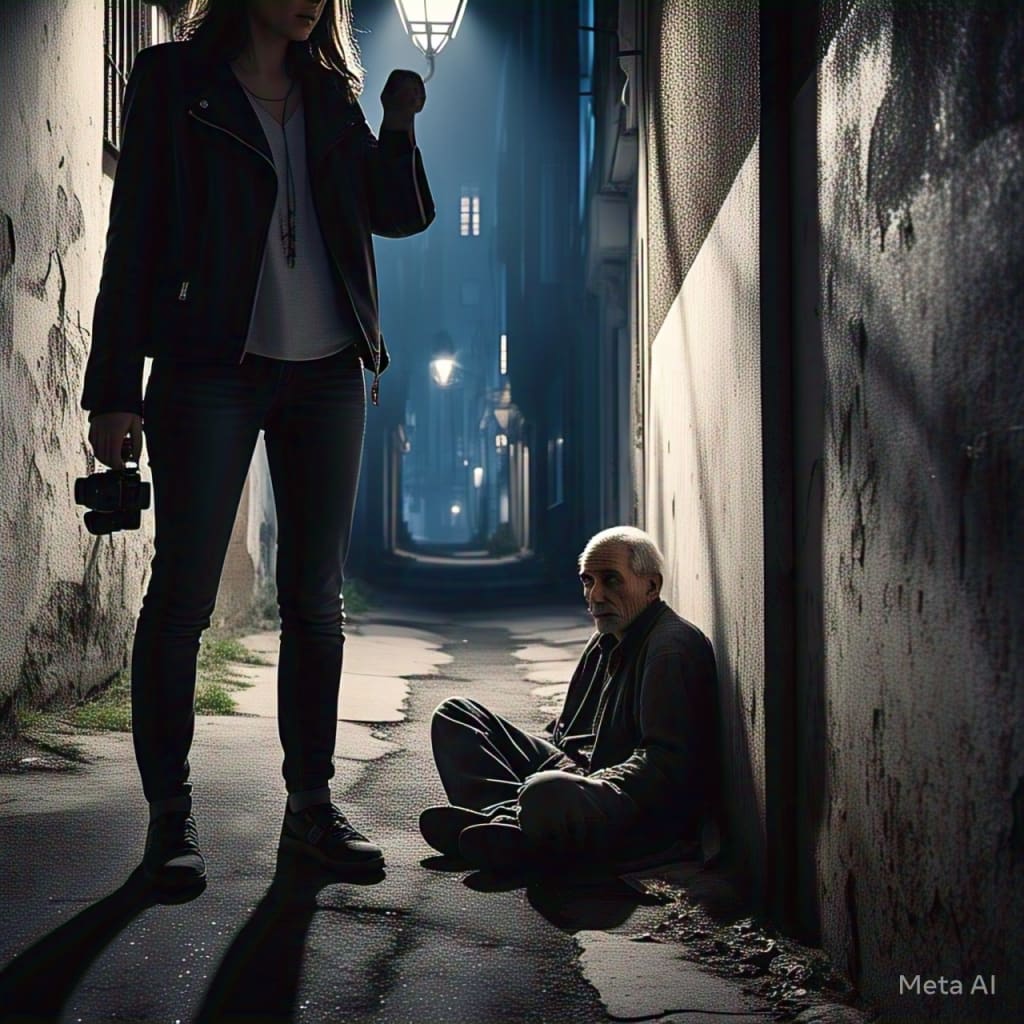
Tom took her to a dark alley in the same district, where the lights were dim and the air smelled of mildew and forgotten time. There, a man sat in front of an abandoned storefront, eyes hollow, staring into space.
“This is real,” Tom whispered. “This is what people don’t want you to see. This is what you’re too afraid to film.”
Sophia raised her camera, but something inside her told her to stop. She lowered the lens and took a step back. The illusion was all she had, and without it, what was left?
---
Chapter Four: The Film That Was Never Finished
The next morning, Sophia awoke with a feeling of dread. She had captured something in that alley, something raw and unsettling, but she knew she couldn’t include it in the film. It felt wrong, too invasive, too personal. She’d crossed a line, and now she wasn’t sure how to return to the world she once knew.
The project, which had started as a search for truth, had morphed into a journey of self-discovery. Sophia realized that no matter how hard she tried to expose the truth, she would always be limited by her own lens, her own biases, her own understanding of what was real.
In the end, she abandoned “The Midnight Project.” It was too personal, too complicated, too messy. The truth, she had learned, wasn’t something that could be captured on film. It was something you lived, something that lived inside of you.
She put the camera down, not because she had failed, but because she had come to understand that sometimes, the most powerful moments were the ones you didn’t try to capture at all.
---
Epilogue: Beyond the Lens
Years later, Sophia would look back at “The Midnight Project” not as a failure, but as a lesson. The truth couldn’t always be captured through a lens. Sometimes, the most important moments were the ones you simply let unfold—without judgment, without a camera, without an agenda.
And in that quiet, unspoken space, she realized that the real story wasn’t about exposing illusion. It was about living through it, and finding a way to see the truth hidden within the quiet spaces between.
---
Would you like this adapted into a screenplay or a visual scene?
About the Creator
Reader insights
Nice work
Very well written. Keep up the good work!
Top insights
Easy to read and follow
Well-structured & engaging content
Excellent storytelling
Original narrative & well developed characters
Heartfelt and relatable
The story invoked strong personal emotions
Keep reading
More stories from Mujeeb Ur Rahman and writers in Criminal and other communities.
Whispers Between Heartbeats
The old clock in the corner ticked softly, almost drowned by the quiet hum of rain tapping the windows of Café Solstice. Maya stirred her coffee, watching the cream swirl into the black like a miniature galaxy forming in slow motion. Her world had felt like that lately—slow, silent, and adrift.
By Mujeeb Ur Rahman10 months ago in Criminal
The Mystery of the Silent Thief
Detective Ravi had seen many cases in his ten years on the force, but the theft at the Grand Market was unlike anything he had ever encountered. Valuable items had gone missing from multiple shops overnight, but there were no signs of forced entry, no fingerprints, and no witnesses. The town was in panic, and the shopkeepers demanded answers.
By Sudais Zakwan5 days ago in Criminal
The Last Confession in Cell No. 14
M Mehran The confession came at 2:17 a.m., scratched onto a torn piece of prison stationery, written with a pen that barely worked. By morning, the man who wrote it would be dead. Cell No. 14 had a reputation inside Blackmoor Central Prison. Guards avoided it. Inmates whispered about it. It was where cases went to die—unsolved murders, buried truths, and men society had already forgotten. Daniel Hargreeve had lived in that cell for twelve years. Convicted of the brutal murder of journalist Clara Whitmore, Daniel was labeled a monster by the media. Headlines called him “The Silent Butcher.” He never defended himself in court. Never cried. Never begged. He simply accepted the life sentence and disappeared behind iron bars. But Daniel wasn’t silent anymore. A Crime That Shocked the City Clara Whitmore was fearless. As an investigative journalist, she exposed corruption, drug trafficking, and political scandals that others were too afraid to touch. Her final article, published just hours before her death, hinted at a powerful criminal network operating inside the city’s justice system. The next morning, she was found dead in her apartment—stabbed seventeen times. There were no signs of forced entry. Daniel Hargreeve, her former neighbor, was arrested within 48 hours. The evidence looked airtight: fingerprints on a glass, CCTV footage placing him near the apartment, and a past argument between the two. The public demanded justice, and the court delivered it swiftly. Case closed. Or so everyone thought. Twelve Years of Silence Inside Blackmoor, Daniel became a ghost. He spoke to no one. He refused visitors. Even when beaten by other inmates, he never fought back. Guards said he slept sitting up, staring at the wall like he was waiting for something. Only one person tried to understand him—Detective Elias Monroe. Monroe was a young officer during the original investigation. Something about Daniel’s blank acceptance never sat right with him. Over the years, Monroe revisited the case files obsessively, finding small inconsistencies that others ignored. Missing phone records. A corrupted hard drive. Witnesses who changed their statements. Still, nothing strong enough to reopen the case. Until the night Daniel asked to see him. The Confession When Monroe entered Cell No. 14, Daniel looked older than his 39 years. His hands trembled, not from fear—but urgency. “I didn’t kill Clara,” Daniel said quietly. “But I know who did.” Monroe leaned forward. “Why now?” “Because they’re cleaning up,” Daniel replied. “And I’m next.” Daniel revealed that Clara had discovered a secret alliance between a powerful businessman, a senior judge, and a prison contractor laundering money through private correctional facilities. She hid encrypted files on a flash drive—and trusted Daniel to keep it safe. The night she was murdered, Daniel found her already dead. Before he could call the police, men arrived. Professionals. They framed him with surgical precision. “They told me if I spoke,” Daniel said, “my family would disappear.” So he stayed silent. For twelve years. The Price of Truth That same night, Daniel was found dead in his cell—official cause: suicide. But Monroe knew better. Hidden inside the prison Bible was the flash drive Daniel mentioned. Inside were documents, recordings, and video evidence—enough to bring down an empire. The story exploded. The judge resigned. The businessman fled the country. The prison contractor was arrested trying to destroy records. And for the first time in twelve years, the media used Daniel’s name without the word “killer.” Justice Came Too Late Daniel Hargreeve was exonerated posthumously. His family received an apology. A weak one. Cell No. 14 was sealed permanently. Detective Monroe often stands outside it, reading the copy of the confession Daniel left behind. The last line still haunts him: “The system didn’t fail me. It worked exactly as it was designed.” Why This Crime Still Matters The case of Clara Whitmore reminds us that some crimes are buried not because they’re unsolvable—but because the truth is dangerous. Criminal justice stories like this expose how power, fear, and silence can destroy innocent lives. And sometimes, the most important confession comes when it’s already too late.
By Muhammad Mehran2 days ago in Criminal
Super Bowl LX Recap: A Team Called Hawks
Sixty. The Super Bowl turned 60! Still amazes me that this was the sixtieth Super Bowl played in NFL history. It seems like yesterday that I watched Super Bowl XXVII, the first SB I ever watched. The QB who won Super Bowl XXVII has since called a few SBs, and will call next year's game, but that's another story. Super Bowl LX took place at Levi's Stadium in Santa Clara, California, the home stadium of the San Francisco 49ers. However, it was one of their division foes who represented the NFC, as the Seattle Seahawks faced off against the New England Patriots.
By Clyde E. Dawkins2 days ago in Unbalanced


Comments (6)
Power of love
Nice
Very good
Good
Give
Best