
Noam Chomsky and the End of Counterculture
Performing Dissent and ‘Sunsteinization’

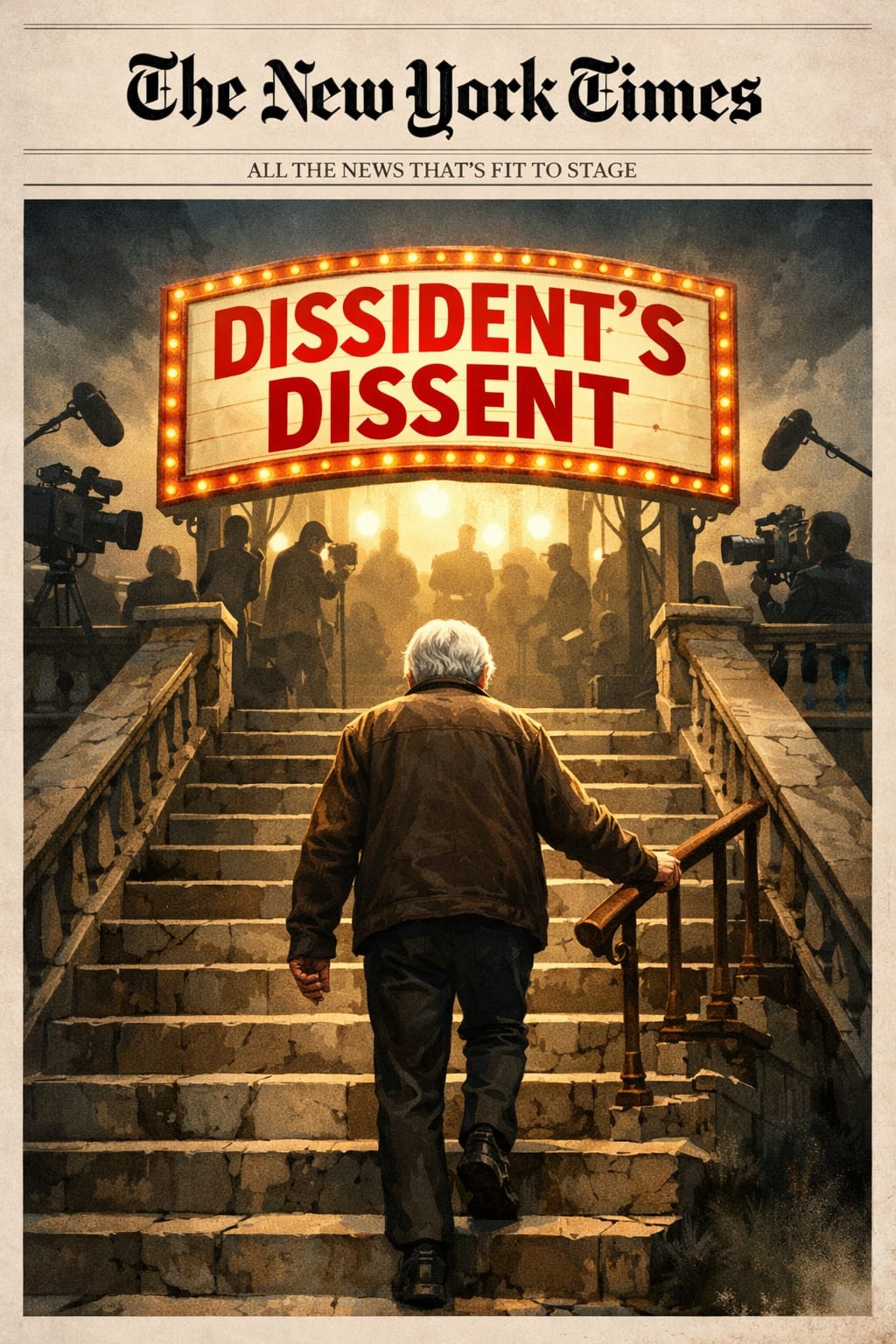
Noam Chomsky and the End of Counterculture: Performing Dissent and ‘Sunsteinization’
Peter Ayolov, Sofia University “St. Kliment Ohridski”, 2026
Abstract
This article theorises the transformation of dissent in the digital age by examining the contemporary figure of the dissident intellectual within the political economy of platform capitalism. Departing from the twentieth-century propaganda paradigm articulated in Manufacturing Consent, the article argues that contemporary media systems no longer prioritise the stabilisation of consensus but instead actively produce, amplify, and monetise division, outrage, and moral conflict. This structural shift is conceptualised as Propaganda 2.1: a regime in which dissent itself becomes an infrastructural resource rather than an oppositional force. Through an extended analytical case study of Noam Chomsky, once emblematic of counterculture as an external critic of power, the article traces how dissidence is reconfigured into a form of performative visibility embedded within algorithmic attention economies. Chomsky’s elevation as ‘arguably the most important intellectual alive’—a phrase that originated in irony—illustrates how critique is converted into symbolic capital, while subsequent scandals and polarisation cycles demonstrate how controversy functions as a generator of engagement rather than a threat to power. Drawing on Cass Sunstein’s concept of cognitive infiltration, the article reinterprets infiltration not as deliberate state action but as an automated process ‘sunsteinization’ performed by digital infrastructures that fragment interpretive communities from within. The analysis further integrates the notion of kayfabe politics to describe a media environment in which audiences knowingly participate in staged moral conflicts between ‘righteous’ and ‘evil’ actors, sustaining a dramaturgy of dissent that produces loyalty, identity, and revenue while leaving structural conditions untouched. The article concludes that contemporary counterculture no longer operates as an external pressure capable of destabilising dominant systems but survives as a conspicuous performance of opposition. Dissent persists, but as spectacle rather than strategy, signalling not the disappearance of critique but its full absorption into the operating logic of digital power.
Keywords
manufacture of dissent; Propaganda 2.1; dissident intellectuals; counterculture; performing dissent; kayfabe politics; outrage economy; platform capitalism; cognitive infiltration; algorithmic governance; media dramaturgy; Noam Chomsky; ‘sunsteinized’; ‘sunsteinization’
Introduction: 'When you see the Buddha on the road, kill him'
This article stands at the intersection of my book The Economic Policy of Online Media: Manufacture of Dissent (2023) and Manufacturing Consent: The Political Economy of the Mass Media (1988), treating their mirrored titles as a deliberate theoretical fault line between two historically distinct propaganda regimes. I wrote to Noam Chomsky in 2022 while working on my book, explaining that its title deliberately inverted his own, not as provocation but as a theoretical necessity. Chomsky replied with a brief but telling endorsement, calling it ‘just the right title for the times.’ Our exchange was courteous and focused, centred on the fact that my concept of the manufacture of dissent was not an extension of the propaganda model but its structural reversal. Where manufacturing consent described a media system oriented toward stabilising agreement, my work proposed a different regime altogether, one in which division, anger, and moral outrage become the primary economic outputs of digital media. Writing under the shadow of such an influential figure inevitably produced what literary theory calls an anxiety of influence, but this anxiety was methodological rather than personal. For me, research integrity requires the willingness to break with one’s intellectual teachers the moment their frameworks no longer explain the world one is analysing. I follow the old Zen injunction ‘when you see the Buddha on the road, kill him’, not as nihilism, but as a warning against turning critical thinkers into untouchable idols. This article begins from that position: respect without reverence, influence without obedience, and critique without the comfort of inherited authority.
The figure of the dissident has long occupied a privileged position in modern political imagination. From the Cold War intellectual to the anti-imperialist critic, dissent was historically understood as an oppositional force: marginal, inconvenient, and often suppressed by dominant institutions. In the late twentieth century, this role was theorised most influentially by Noam Chomsky and Edward S. Herman, whose model of ‘manufacturing consent’ described how mass media filtered information in order to align public opinion with elite interests. In this framework, the dissident appeared as an external critic—tolerated at the margins, ignored when possible, and marginalised when necessary. This article argues that this model no longer adequately explains the political economy of contemporary digital media. Rather than suppressing dissent, online platforms actively produce, amplify, and monetise it. The central claim developed here is that manufacturing consent has been structurally replaced by the manufacture of dissent, anger, and moral outrage. In this new configuration—conceptualised as Propaganda 2.1—division is no longer a failure of governance but its primary economic resource. Platforms do not seek agreement; they seek engagement. Conflict, scandal, and affective volatility outperform consensus as mechanisms of value extraction. Within this context, the dissident intellectual undergoes a fundamental transformation. No longer positioned outside the system as a threat to be neutralised, the dissident becomes a productive asset within platform capitalism. This article examines this transformation through the case of Noam Chomsky himself. Once a paradigmatic outsider critiquing US power and media ideology, Chomsky now occupies a paradoxical position as one of the most recognisable intellectual brands in global public discourse. Recent controversies surrounding his political statements have triggered cycles of outrage, denunciation, defence, and counter-denunciation—precisely the forms of interaction most efficiently monetised by contemporary media systems.
The article proposes that this shift can be understood through a re-reading of Cass Sunstein’s concept of cognitive infiltration. Originally framed as a governmental strategy for destabilising ‘crippled epistemologies’, cognitive infiltration in the digital environment no longer requires intentional agents. Algorithms perform this function automatically by injecting scandal, controversy, and internal dissent into ideological communities. In this process, the dissident is not silenced but ‘sunsteinized’: transformed into a source of internal fragmentation, epistemic friction, and perpetual controversy. This dynamic raises a broader theoretical question: is counterculture still possible under conditions where dissent itself is infrastructuralised? Or has opposition been reduced to a form of kayfabe politics—a theatrical conflict in which moral camps perform hostility while remaining structurally integrated into the same attention economy? In such a system, the spectacle of righteous struggle against ‘evil’ opponents generates loyalty, identity, and revenue, while the underlying economic and technological structures remain untouched. By situating the dissident intellectual within the economic logic of Propaganda 2.1, this article reframes dissent not as an external corrective to power but as one of its most stable dramaturgical components. The dissident no longer disrupts the system; he animates it. The critical task, therefore, is not to defend or denounce individual intellectuals, but to understand the conditions under which dissent itself has become indistinguishable from the political drama it once sought to oppose.
The article "Noam Chomsky and the End of Counterculture: From Manufacturing Consent to Performing Dissent" therefore treats Chomsky not as an authority to be defended or condemned, but as an analytical case through which the changing infrastructure of dissent can be observed. In that sense, ‘when you meet the Buddha on the road, kill him’ names a discipline of thought rather than a gesture of rupture: the obligation to let no figure, however formative, stand between analysis and the structures it seeks to understand.
Performing Dissent: ‘Sunsteinization’
The figure of Noam Chomsky occupies a peculiar position in the architecture of Propaganda 2.1. Once emblematic of counterculture as an external force—an intellectual whose marginalisation testified to the limits of permissible critique—he now functions as a fully public figure whose controversies circulate at the centre of digital media economies. In my model, this shift does not represent a personal failure or moral decline, but a structural transformation in the role of dissent itself. Chomsky’s public visibility, scandals, and subsequent moral polarisation illustrate how dissidents’ dissent is no longer suppressed but actively valorised, segmented, and monetised. Under Propaganda 2.1, dissent, anger, outrage, and even righteous indignation are converted into economic value. Platforms no longer distinguish sharply between legitimate critique and destructive polemic; both are equally useful as long as they generate engagement. In this environment, the dissident does not stand outside power but circulates within it as a high-yield asset. The symbolic fall or ‘disgrace’ of a figure like Chomsky intensifies this process. It produces cycles of defence and denunciation that sustain attention, fragment audiences, and ensure continuous affective investment, while leaving the underlying political economy of platforms untouched.
This logic resonates strongly with the work of Cass Sunstein , particularly his theorisation of dissent as something that must be preserved, guided, and, when necessary, strategically intervened in. Sunstein’s defence of dissent as an epistemic corrective sits alongside his endorsement of ‘libertarian paternalism’ and, more controversially, ‘cognitive infiltration’. Read through the lens of Propaganda 2.1, cognitive infiltration no longer appears primarily as a state-led intervention but as an automated outcome of platform dynamics. Digital infrastructures perform infiltration continuously by amplifying controversy, introducing counter-narratives, and destabilising interpretive communities from within. Chomsky’s case exemplifies this transformation. His name no longer functions mainly as a rallying point for coherent counter-hegemonic critique, but as a node around which fragmented publics organise themselves into competing moral camps. Some mobilise to defend his legacy, others to denounce it, but both positions are absorbed into what I describe as ‘micro-consents’: locally stabilised configurations of belief and outrage that prevent the emergence of collective judgment directed at structural power. Dissent persists, but it does so in a splintered, self-referential form that is highly visible and politically inefficient.
In this sense, dissidents’ dissent becomes performative. It is enacted as a public drama rather than articulated as a strategic challenge to power. The dissident is no longer primarily a bearer of inconvenient truths but a generator of affective volatility—an input into algorithmic systems that reward conflict, scandal, and moral injury. What disappears is not dissent as such, but its capacity to accumulate into sustained countercultural force. The system no longer needs to silence its critics; it needs them to remain visible, controversial, and permanently contested. Seen from this perspective, Chomsky’s current status does not mark the end of dissent, but the end of counterculture as an external position. His transformation into a fully integrated public figure demonstrates how Propaganda 2.1 neutralises opposition not by repression, but by overexposure and monetisation. Dissidents are not eliminated; they are processed. Their dissent survives as content, as spectacle, and as profit—while the structures they once sought to expose continue to operate, largely unchallenged, in the background. Under Propaganda 2.1, dissent increasingly survives not as a practice of collective transformation but as a performance staged for visibility, circulation, and monetisation within platform infrastructures. What emerges instead is a form of conspicuous dissidents’ dissent , where opposition signals moral identity and fuels attention economies, while its theatrical repetition neutralises its capacity to challenge power in any substantive or lasting way.
From Manufacturing Consent to Monetising Dissent
This section reframes my theory of Manufacture of Dissent in direct contrast to the classic propaganda model developed by Noam Chomsky and Edward S. Herman, arguing that the contemporary media environment no longer primarily seeks to stabilise power through consent but to monetise conflict through permanent division. While Chomsky’s model exposed how twentieth-century mass media filtered information in order to align public opinion with elite interests, it remained anchored in a broadcast-era logic of scarcity, hierarchy, and narrative unification. The digital media system operates according to a fundamentally different economic and communicative logic: abundance instead of scarcity, fragmentation instead of unity, and engagement instead of persuasion. In the Propaganda 2.1 model I propose, dissent is no longer a threat to be marginalised but a resource to be cultivated. Online platforms thrive not by resolving disagreement but by intensifying it, transforming moral conflict into a renewable source of attention, data, and profit. Anger, outrage, and scandal become infrastructural elements of communication rather than accidental by-products. In this environment, the goal of media power is not to convince the public of a single truth, but to keep it locked in continuous antagonism, producing what I describe as stable instability.
It is precisely here that Chomsky’s contemporary public role becomes analytically revealing. Once positioned as an external critic of the propaganda system, he now functions—regardless of intent—as a high-value node within the very economy he helped theorise. His repeated elevation as ‘the most important intellectual’ in the United States, a phrase that originated in journalistic irony rather than reverence, exemplifies how critical authority is converted into symbolic capital. Controversies surrounding his political positions no longer destabilise media power; they activate it. Each scandal, defence, denunciation, and counter-denunciation feeds algorithmic circulation, ensuring visibility, engagement, and revenue across platforms. In this sense, Chomsky does not merely diagnose the transformation of mass communication; his mediated presence demonstrates it. The figure of the dissident is no longer excluded from the system but absorbed into its dramaturgy. What appears as disgrace functions structurally as performance. Dissent survives, but only as spectacle—what might be called a form of kayfabe politics in which intellectuals, media institutions, and audiences tacitly participate in a staged conflict between heroes and villains, while the underlying economic logic remains untouched. My theory therefore departs from Chomsky’s not by rejecting the propaganda model, but by historicising it. Manufacturing consent was the dominant strategy of twentieth-century mass media; manufacturing dissent is the operating principle of twenty-first-century platform capitalism. The paradox is that Chomsky himself, through the circulation of his public image, provides empirical confirmation of this shift. The critic of propaganda becomes a variable within its upgraded operating system, marking not the failure of critique, but the moment when critique itself is fully integrated into the political economy of digital communication.
'Arguably the Most Important Intellectual Alive'
Few figures expose the contradictions of modern intellectual culture as sharply as Noam Chomsky. The label ‘arguably the most important intellectual alive’ did not begin as a canonising tribute but as a deliberately unstable formulation, acknowledging the magnitude of his influence while casting doubt on the political uses to which that influence was put. From its first appearance, the phrase functioned less as praise than as a provocation, staging a conflict between intellectual greatness and political simplification. That this ambivalent description has since hardened into a reverential slogan says less about Chomsky himself than about a media culture eager to convert critique into myth, irony into authority, and dissent into a recognisable brand.
The repeated description of Noam Chomsky as 'Arguably the Most Important Intellectual Alive' is itself a revealing artefact of kayfabe politics. Originally uttered with irony and even sarcasm—meant to highlight the paradox that a radical critic could be simultaneously famous and institutionally marginal—the phrase has since hardened into a brand label circulating uncritically through media and academic discourse. What began as a pointed joke has been metabolised by the system as a form of symbolic elevation, transforming dissidence into status and critique into reputation. Within the logic of Propaganda 2.1, this ironic coronation performs an important function. By publicly anointing a dissident as ‘the most important intellectual’, the media does not neutralise him through silence but through over-visibility. The title marks Chomsky as exceptional while simultaneously isolating him as a singular figure, detaching his critique from any broader countercultural formation. He becomes a character rather than a position: an intellectual ‘face’ whose presence guarantees drama, polarisation, and attention.
This is where kayfabe becomes structurally decisive. The elevation and the subsequent ‘disgrace’ operate as two acts of the same performance, alternating between reverence and denunciation without ever breaking the spectacle. Chomsky is cast first as the moral authority and later as the compromised figure, but both roles serve the same media logic. The audience is invited to choose sides, to defend or attack, while the underlying economic and communicative infrastructure remains unquestioned. In this sense, the sarcastic title achieves its full effect only retrospectively. It names not Chomsky’s intellectual dominance, but the system’s capacity to turn even irony into a mechanism of capture. The dissident is not refuted; he is promoted, dramatised, and finally absorbed into a scripted conflict between heroes and villains. What survives is not counterculture, but its performance—an endlessly replayed drama in which dissent appears omnipresent while its capacity to disrupt power steadily evaporates.
Decoding Chomsky
In Decoding Chomsky (2016), Chris Knight recounts his first encounter with Noam Chomsky’s scientific work as an experience closer to ethnography than critique. Approaching Chomsky’s theories of language, Knight describes himself as an anthropologist confronted with an unfamiliar belief system, one whose internal coherence could not be assessed through immediate agreement or rejection but required reconstruction of its cultural, institutional, and historical conditions. This methodological stance is crucial: what initially appears as abstraction bordering on absurdity may, when situated properly, reveal its own logic and necessity. The question is not whether Chomsky’s doctrines seemed strange, but why precisely these doctrines emerged, flourished, and acquired such authority. Knight’s puzzlement did not stem from hostility to Chomsky’s politics. On the contrary, he describes an immediate sympathy with Chomsky’s moral courage as a critic of US imperial power. What unsettled him was the sharp disjunction between that political radicalism and the radically internalist conception of language advanced in Chomsky’s scientific work. Lacking formal training in theoretical linguistics, Knight initially attributed the difficulty to his own limitations. Yet the deeper he investigated, the more he became convinced that the distance separating them was not merely technical but philosophical and cultural. The intellectual milieu that shaped Chomsky’s early career—the Pentagon-funded research environment of post-war America—emerged as the key context requiring analysis, not as a conspiracy but as a formative ecosystem.
Knight is careful to reject any insinuation that military funding compromised the validity of Chomsky’s linguistic work or that it contributed directly to American military power. Nothing Chomsky produced had operational value for warfare. Nevertheless, the ethos of the period mattered. In the years immediately following the Second World War, US military scientists operated in a climate of technological euphoria, intoxicated by nuclear victory and the promise of electronic computation. Within this atmosphere, ambitious dreams of universal systems flourished, including the fantasy of a universal language reducible to computable elements. Figures such as Warren Weaver imagined machines capable of translating all human languages by uncovering a common underlying code, a project infused with quasi-mythical aspirations to reverse the Babelian curse. Although Chomsky later denied any connection between his theory of Universal Grammar and these projects, Knight argues that the conceptual resonance is difficult to ignore. The search for deep structure, for a single human language beneath surface variation, mirrors the cybernetic and computational imaginaries of the time. These imaginaries were not politically neutral myths but expressions of a broader desire for mastery, control, and formal elegance. Knight deepens this genealogy by juxtaposing American military modernism with an earlier, radically different dream of linguistic unity: the revolutionary utopianism of Russian avant-garde artists such as Velimir Khlebnikov, whose vision of a universal phonetic language influenced Roman Jakobson, one of Chomsky’s intellectual forebears. The irony is stark. Where Khlebnikov’s linguistic universalism emerged from anarchist and anti-war hopes, Chomsky’s matured within an atmosphere of Cold War paranoia and nuclear strategy.
This contrast frames what Knight identifies as the central paradox of Chomsky’s life: the coexistence of uncompromising political dissent with a conception of science stripped of social relevance. As the Vietnam War escalated, Chomsky’s moral conscience intensified, compelling him to oppose the very institutions that funded his research. To preserve his political autonomy, Knight suggests, Chomsky was driven to assert the absolute neutrality of his science. Linguistics became radically formal, abstract, and insulated from social consequences, while activism was conducted as if untouched by scientific insight. This division, far from accidental, crystallised into a broader intellectual habit in Western thought: the systematic separation of knowledge from responsibility, theory from practice, mind from society. Knight’s project is not to discredit Chomsky, but to historicise him. By tracing the institutional pressures, intellectual fashions, and moral dilemmas that shaped his work, Knight seeks to explain how one individual could simultaneously embody the conscience of America and reinforce a scientific paradigm that excludes society from its own account of language. The resulting fragmentation of knowledge, he argues, has had lasting consequences far beyond linguistics, legitimising a vision of science as politically mute and of politics as epistemically thin. To decode Chomsky, then, is not merely to interpret a single thinker, but to expose the deeper architecture through which modern intellectual authority is constructed, protected, and reproduced.
Is Chomsky the End of Counterculture?
In my Propaganda 2.1 model, the public ‘disgrace’ of Noam Chomsky does not signal the failure of counterculture so much as its final structural absorption. What appears, on the surface, as the collapse of a moral authority is in fact the moment when dissent is fully integrated into the economic logic of digital power. Counterculture is not defeated from the outside; it is hollowed out from within and refunctioned as a profitable subsystem of the very infrastructure it once opposed. In earlier historical configurations, dissent operated as an external pressure on dominant culture. It existed at the margins, where it could threaten, embarrass, or destabilise power. In the Propaganda 2.1 environment, this outside no longer exists. Dissent is systemic rather than oppositional. Anger, outrage, and even righteous indignation are no longer risks to be managed but resources to be harvested. The system does not fear the disgraced dissident; it monetises the affective shockwaves produced by his fall, converting moral conflict into algorithmic energy. What disappears in this process is not merely authority, but meaning itself. When a figure of Chomsky’s stature becomes the object of scandal, the media no longer seeks narrative repair or clarification. Instead, controversy is prolonged, multiplied, and strategically circulated. Rage-baiting replaces explanation, and moral judgment is flattened into interaction metrics. Truth becomes irrelevant to value; what matters is volatility. The result is a liquidation of meaning, in which interpretation is endlessly deferred in favour of engagement. This transformation produces what I describe as fragmentation into ‘micro-consents’. Where counterculture once aimed at forming a coherent counter-hegemonic position, it is now splintered into locally stabilised camps. Some defend Chomsky, others denounce him, but both reactions serve the same function: preventing the formation of collective judgment directed at the economic policy of online media itself. Each group remains busy managing its own moral drama, while the infrastructure that profits from the conflict remains untouched.
In this context, the medium can no longer be understood as a channel through which propaganda passes. It has become propaganda’s operating system. Outrage is not an accidental by-product but a designed feature, embedded in the architecture of platforms that have learned a simple rule: angry people click more. The disgrace of an icon is therefore not an anomaly but an update—another optimisation that keeps the circuits of attention, division, and monetisation running. From this perspective, the case of Chomsky functions as a diagnostic. It reveals that counterculture, once defined by its capacity to resist capture, now circulates as performance. Dissent survives, but only as spectacle; opposition persists, but only as dramaturgy. What is performed is a moral struggle between good and evil actors, while power quietly continues its work in the background, extracting value from every expression of outrage. If this is the end of counterculture, it is not because dissent has vanished, but because it has become indistinguishable from the system it seeks to challenge. The Propaganda 2.1 model succeeds precisely at this point: when the most famous critic of propaganda no longer threatens the machine, but helps keep it profitable.
Counterculture did not disappear abruptly but gradually lost its antagonistic force as it became predictable, aestheticised, and ultimately branded, a process analysed by Alexei Yurchak through the concept of hypernormalisation, where systems persist by ritual repetition long after belief has evaporated. This logic was later rendered visually and politically explicit in the film HyperNormalisation, which shows how simulated oppositions and managed spectacles replace genuine alternatives while giving the appearance of pluralism. Within the same horizon, Capitalist Realism demonstrates how capitalism absorbs its own critique, turning counterculture into a marketable style and a structural component of the mainstream rather than a force capable of negating it. The unspoken hope behind the diagnosis of counterculture’s end is that its exhaustion might also mark the exhaustion of Western culture in its current, self-referential form, clearing space for something genuinely new to emerge. Counterculture, instead of overthrowing a decaying order, seems to have functioned as a life-support system, animating an already dead body through perpetual gestures of rebellion that never escaped the frame of the mainstream. What presented itself as resistance increasingly served as maintenance, prolonging cultural inertia by supplying meaning where belief had already collapsed. If this reading is correct, then the true break will not come from another cycle of dissent, but from the moment when even the performance of counterculture finally loses its capacity to keep the system alive.
Conclusion: The Role of the Dissident After Counterculture
This article has argued that the contemporary fate of dissent cannot be understood through the moral evaluation of individual intellectuals, but only through an analysis of the media infrastructures that now organise visibility, conflict, and value. The transition from manufacturing consent to manufacturing dissent marks a structural shift in the political economy of communication: power no longer depends primarily on stabilising agreement but on sustaining antagonism. In this environment, dissent is not suppressed but cultivated, not marginalised but overexposed, not silenced but continuously circulated until it loses its capacity to cohere into collective judgment. What appears as scandal, disgrace, or moral collapse is in fact a functional moment within a system optimised for outrage, engagement, and fragmentation. The case of Noam Chomsky is analytically decisive precisely because it reveals this transformation at the highest symbolic level. Once positioned as an external critic whose marginality testified to the limits of permissible discourse, he now circulates as a fully integrated public figure whose controversies activate algorithmic attention cycles. His elevation, ironic canonisation, and subsequent polarisation are not deviations from the system but expressions of its normal operation. Under Propaganda 2.1, the dissident is neither hero nor traitor but a variable: a generator of affective volatility whose presence sustains the dramaturgy of public life. The dissident’s dissent survives, but only as performance—what this article has described as conspicuous dissent—where opposition signals moral identity while remaining structurally harmless. The broader implication is that counterculture, as an external position capable of negating dominant structures, has largely disappeared. It has not been defeated by repression but dissolved through incorporation. As analysed by theories of hypernormalisation and capitalist realism, critique is no longer excluded from the system but recycled within it as style, spectacle, and brand. Dissent functions as a form of cultural maintenance, animating a system whose legitimacy has already eroded, supplying meaning where belief has collapsed. In this sense, counterculture has operated less as an agent of transformation than as a life-support mechanism for a stagnating order.
The exhaustion of counterculture may therefore signal not the end of dissent, but the end of a particular historical configuration of Western culture itself. If opposition has become indistinguishable from the structures it seeks to challenge, then the possibility of renewal does not lie in producing ever more radical performances of dissent, but in recognising the limits of dissent as a media form. What would follow is necessarily uncertain. Yet it is precisely the collapse of performed opposition—when even outrage ceases to generate meaning—that may open space for genuinely new forms of political imagination. Until then, dissent will continue to circulate as content, as spectacle, and as profit, while power quietly persists in the background, unthreatened and largely unseen. The unsettling implication of this analysis is that thinkers, philosophers, and dissidents may not stand outside power at all, but function as its necessary counterpart—its shadow side rather than its negation. As in mythology, where rebels and sages are drawn irresistibly into the very force they oppose, the struggle against power often becomes another pathway into it. This drift is not primarily a matter of corruption or betrayal, but a structural tendency: visibility, authority, and influence exert their own gravitational pull. In this sense, the dissident’s forgetfulness of their original position is not an accident but a natural outcome of systems in which power continuously absorbs even those who claim to resist it. The following poem offers a stark allegory of the dissident’s ascent into power, showing how the struggle against domination can exact a gradual toll of perception, memory, and solidarity until rebellion quietly transforms into rule. The dissident’s ascent—more accurately, a descent—up the ladder that leads not upward but into the basement of morality can be described as a process of ‘sunsteinization’.
“Who are you?" The Devil asked him. "I am a plebeian by birth, and all ragged people are my brothers. How terrible the world is, how wretched the people are! But you there, you at the top there..."
It was a young man who spoke with head erect and fists clenched in menace. He stood at the foot of the Stairs - a high white staircase of rose-flecked marble. "I shall have my revenge on those nobles and princes. I shall cruelly avenge my brothers. Let me go!"
The Devil smiled: "I am the guardian of those at the top, and without a bribe, I shall not betray them." "I have no gold. I have nothing with which to bribe you... I am poor, a youth in rags... But I am willing to give up my life..."
Again, the Devil smiled: "O no, I do not ask as much as that. Just give me your hearing." "My hearing? Gladly... May I never hear anything anymore, may I..." "You still shall hear," the Devil assured him and made way for him… "For you to go three more steps, I must have your eyes." The young man made a gesture of despair. "But then I shall be unable to see my brothers or those I go to punish." "You still shall see them..."
The Devil said. "I will give you different, much better eyes." The young man rose three more steps… "Young man, one last step still remains. Just one more step and you shall have your revenge. But for this last step, I always exact a double toll: give me your heart and give me your memory." "But there will be nobody then more wretched than I. You are taking away all my human nature." "On the contrary, nobody shall be happier than you. Well, do you agree: just your heart and memory?"
The young man pondered, his face clouded over, beads of sweat ran from the furrowed brow, in anger he tightened his fists and through clenched teeth said: "Very well, then. Take them!" "Who are you?" the Devil asked in a low sly voice. "I am a prince by birth, and the gods are my brothers. How beautiful the world is and how happy the people are!"
“The Tale of the Ladder”
by Hristo Smirnenski, 1923
(Dedicated to all who will say: "It was nothing to do with me!”)
Bibliography
Ayolov, P. (2023). The Economic Policy of Online Media. Taylor & Francis.
Herman, E.S. and Chomsky, N. (1988). Manufacturing consent: The political economy of the mass media. New York: Pantheon Books.
Sunstein, C. R. and Vermeule, A. (2008). ‘Conspiracy theories’. Harvard Public Law Working Paper, No. 08-03.
Ayolov, P. (2025). ‘Cognitive infiltration and dissidents’ dissent’. SSRN Electronic Journal.
Viertel, J. (1979). Review of Reflections on Language by Noam Chomsky. The New York Times, 10 June.
Chris Knight (2016) Decoding Chomsky: Science and Revolution in the Cognitive Age. New Haven, CT: Yale University Press.
Yurchak, A. (2006). Everything Was Forever, Until It Was No More: The Last Soviet Generation. Princeton, NJ: Princeton University Press.
Curtis, A. (2016). HyperNormalisation [film]. London: BBC.
Fisher, M. (2009). Capitalist Realism: Is There No Alternative? Winchester: Zero Books.
About the Creator
Peter Ayolov
Peter Ayolov’s key contribution to media theory is the development of the "Propaganda 2.0" or the "manufacture of dissent" model, which he details in his 2024 book, The Economic Policy of Online Media: Manufacture of Dissent.
Keep reading
More stories from Peter Ayolov and writers in Critique and other communities.
Canada Cybersecurity Solutions Market: Key Trends and Industry Insights | USD10.3 Billion
Market Overview The Canada cybersecurity solutions market represents a rapidly evolving segment within the country’s broader IT and digital economy. With financial services, healthcare, retail, manufacturing, and public sector institutions digitizing operations, cybersecurity has shifted from being an optional IT function to a core business priority.
By Ashutosh Srivastavaabout 15 hours ago in Critique



Comments
There are no comments for this story
Be the first to respond and start the conversation.