

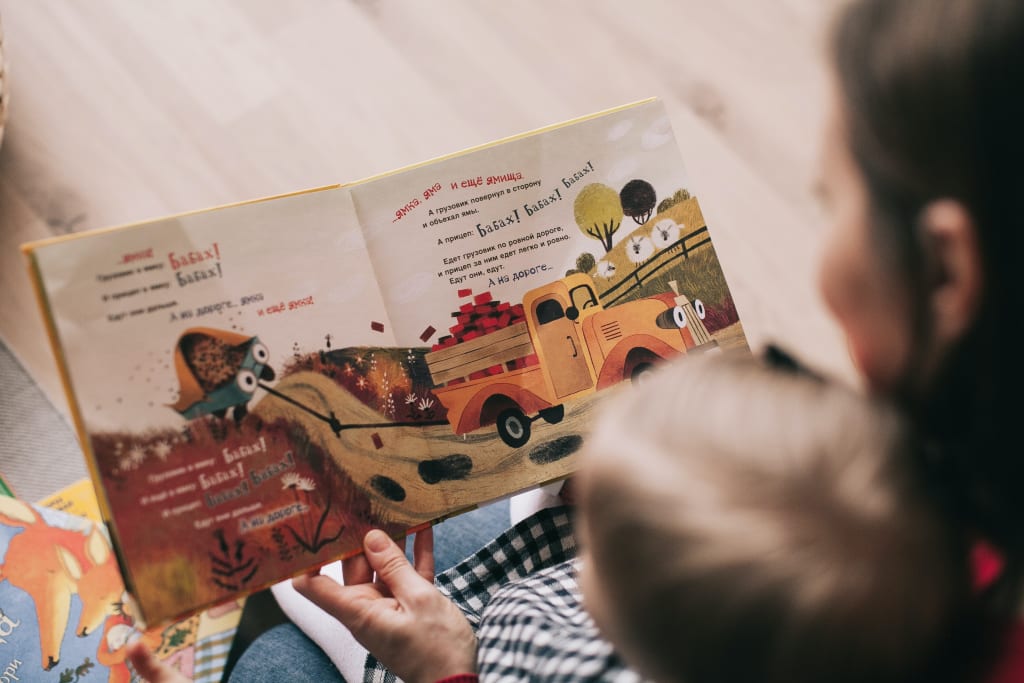
'Super Dudes' written by Christopher Vigil is a children's book that will have you saying 'Surf's Up, Dudes!' This is the story that is a dream of an island of surf dudes and family that is led by Eddie and son named Raymond teaching him how to surf. Actually it is a story of learning about how to gain a certain aspect to living life in general. This is a story that illustrates some aspects of this sport and of a family accepting what may happen and what has happened in the past and looking for answers.
About the Creator
Mark Graham
I am a person who really likes to read and write and to share what I learned with all my education. My page will mainly be book reviews and critiques of old and new books that I have read and will read. There will also be other bits, too.
Keep reading
More stories from Mark Graham and writers in Critique and other communities.
A Green Hairy Thing Wearing Dad's Old Vest
'A Green Hairy Thing Wearing Dad's Old Vest' is a children's picture book written by Jennifer Coville. We can dream anything in our dreams? This is the story that is to me written as a poem and uses all her interests in writing in this story about a little boy who has an adventure that takes him to unknown places, but interesting ones that seem to have familiar things. It is also a story that will 'teach' various skills in an enjoyable way in a quite modern story.
By Mark Graham2 years ago in Critique
Lil Wayne Complains About Yet Another Grammys Snub
Hang it up, sir. You're a legend in this game, but you played like Jordan on the Wizards with this last album. I actually like most of the songs including “Cotton Candy.” But it’s time to retire, homie. You’ve achieved great critical and commercial feats during your tenure in this rap sludge.
By Skyler Saunders5 days ago in Critique
The Ignorance Tax: Why Your 20$ Gourmet Burger is a Scam
A friend of mine charges twenty dollars for a piece of ground beef and two slices of bread. He calls it a "burger." In private, he calls it an "Ignorance Tax." We’ve reached a point where basic survival is marketed as a luxury, and frying an egg is treated like cold fusion. While the West pays a premium to be fed like infants, I’m sitting in my kitchen in Croatia, watching the world forget how to live—one overpriced burger at a time. *** Last night, I committed a miracle. At least, that’s what a modern-day lifestyle influencer would call it. I actually made dinner. In about fifteen minutes—roughly the time it takes an average Californian to find their car keys—I produced six gourmet burgers. Beef, veggie, and fish. All sourced from a local organic shop where the ingredients actually remember being alive. I toasted the buns with ghee, caramelized some onions, and watched the local cheese melt over the patties like a slow, delicious tragedy. I assembled them with the precision of a watchmaker: a thin slice of tomato, a leaf of lettuce, a pickle. Total cost? About the same as a mediocre latte in San Francisco. My wife, my daughter, and I “suffocated” ourselves in the goodness of it. It was healthy. It was fast. It was, frankly, a joke how easy it was. And that’s the problem. The Teeth-Brushing Paradox I’ve been cooking since I was fifteen. Not because I had a “passion” for culinary arts, but because life is a series of unfortunate events. My parents were divorced and busy; I lived with my grandfather, a man who viewed a stove as a decorative object. So, I cooked to survive. To me, cooking is like brushing your teeth. You don’t stand in front of the mirror and congratulate yourself for five minutes because you managed to clean your molars. You just do it so your mouth doesn’t rot. In Croatia—this little patch of earth that used to be Yugoslavia—a man in the kitchen isn’t a “sensitive modern hero.” He’s just a hungry guy. Roughly 90% of the people here, even the kids obsessed with TikTok, can actually whip up a decent meal. We are like the Italians, but with more cynicism and slightly worse PR. We value the origin of the food, but more importantly, we value the “table.” In the States, dinner is the big event. Here, it’s lunch. Even in the middle of a workday, the world stops. We drink coffee, we eat, we talk. The capitalist model of “time is money” hasn’t completely strangled us yet. We still think time is for living. Charging a Tax on Ignorance When I lived in California, I felt like a wizard from a superior civilization. I watched people—educated, successful people—treat the act of frying an egg like it was complex engineering. If someone “cooked” for you, it usually meant they’d taken three semi-finished products, dumped them in a pan, added too much salt, and called it a masterpiece. The flavors were aggressive, the execution was sloppy, and the conversation about the meal lasted longer than the eating itself. I have a friend who owns a burger joint. I asked him once, “Why the hype? It’s a piece of meat between two pieces of bread. Why are people paying $20 for this?” He looked at me with the weary eyes of a man who understands the decline of Western civilization. “They don’t know how to cook,” he said. “That’s it. To you and me, it’s nothing. But I’m not charging for the meat. I’m charging a tax on their ignorance. I charge for the service of doing what they’ve forgotten how to do.” The Survival of the Simplest We’ve turned a basic survival skill into a luxury “experience.” We’ve made it so expensive and so hyped that we’ve lost the simple reflex of feeding ourselves. Knowing your way around a kitchen is no longer just a domestic chore—it is the ultimate act of rebellion. It’s a stand against a system that wants to sell you back your own autonomy at a 500% markup. Back in my kitchen, my family is full, the dishes are done, and I didn’t even notice I was “cooking.” I was just hanging out. Maybe I’m ready to become a professional chef. Or maybe the rest of the world is just ready to admit they’ve forgotten how to live. Either way, the burger was great—and it didn't cost me twenty dollars to realize it.
By Feliks Karić2 days ago in Critique
Public Announcement Challenge Winners
For the Public Announcement Challenge, writers were asked to work inside voices built for control. These were notices, warnings, and updates meant to inform rather than confess. The strongest entries committed to that form and didn't break from it. Corporate memos, formal government alerts, and internal policy language were held consistently, allowing emotion, fear, grief, or humor to surface indirectly through pressure rather than declaration. The following poems recognize the voice of authority, and let human feeling slip through despite all its rules and restraint.
By Vocal Curation Teama day ago in Resources




Comments (1)
Cool article and Critique❗