
The Boy Who Built His Future With Broken Radios
about a young boy from Lahore who turned a childhood

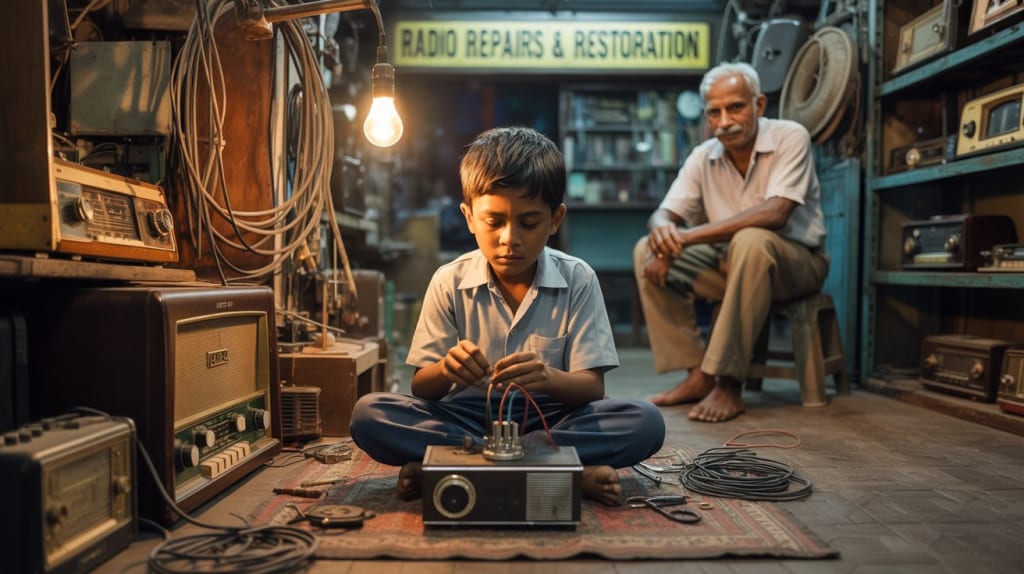
In the narrow lanes of Lahore’s Anarkali Bazaar, where the noise of motorbikes and street vendors filled the air, lived a boy named Sameer with an unusual obsession—broken radios. While other children collected comic books or played cricket in the alleyways, Sameer scavenged discarded electronics from junk piles. He didn’t know it at the time, but those broken radios would rebuild his entire life.
Sameer came from a family of modest means. His father was a street food vendor, selling spicy chana chaat near the mosque. His mother stitched clothes for neighbors to earn a little extra. Money was tight, but their house was full of love. Sameer was a curious child, always taking apart his toys to see how they worked. Unfortunately, he could rarely afford new ones.
One afternoon, when he was eight, he found a cracked, dust-covered radio in a heap of garbage near an electronics shop. He took it home, much to his mother’s dismay. That night, under a single flickering bulb, Sameer opened the radio. He didn’t fix it—he made it worse. But he didn’t stop. Over the next few years, Sameer learned from trial, error, and a kind old shopkeeper named Irfan who started lending him tools and explaining how resistors and circuits worked.
By the age of 13, Sameer could fix nearly any small appliance: radios, clocks, even old DVD players. He set up a tiny repair stall outside his house, using a wooden crate as a workbench. His reputation grew, and people came to him not just for repairs, but for advice. He was still in school, but he saved every rupee he earned.
In 2012, when Sameer was 15, his school announced a science fair. Most students were building volcanoes or solar cookers. Sameer decided to build a homemade radio transmitter. It was ambitious, maybe even reckless—but he poured weeks into it, soldering at night, sketching diagrams during lunch breaks. On the day of the fair, his project wasn’t the prettiest, but it worked. He transmitted a short message from one end of the courtyard to the other. Teachers clapped. A local university professor who happened to be visiting took notice.
That professor changed Sameer’s life. He offered him access to the university’s electronics lab on weekends. There, Sameer discovered microcontrollers, software coding, and automation. He wasn’t just repairing anymore—he was inventing.
Despite limited resources, Sameer won a regional science competition and then a national one. He was awarded a full scholarship to study engineering at the National University of Sciences and Technology (NUST). The boy who once dug through trash was now designing smart home devices in a state-of-the-art lab.
In college, Sameer co-founded a startup called “NaiTech,” which focused on low-cost electronics for underserved communities. Their first product: a solar-powered radio that doubled as a phone charger, designed for rural villages without reliable electricity. It sold over 50,000 units in its first year.
By 2022, NaiTech was featured in international tech magazines. Sameer was invited to speak at conferences in Singapore and London. But he never left his roots behind. He built a community tech center in his old neighborhood, offering free classes in electronics, coding, and entrepreneurship.
When asked what drove him, Sameer once said, “A broken radio taught me that things—people—can look damaged on the outside and still be full of potential inside. You just need someone to open them up, believe in them, and rebuild.”
Today, Sameer is recognized as one of South Asia’s rising tech entrepreneurs. But he still visits Irfan’s shop, still eats his father’s chana chaat, and still keeps that first broken radio on his office shelf—a reminder that greatness can begin in the most unexpected places.
Because sometimes, all it takes is one broken thing—to fix everything else.
About the Creator
Farzad
I write A best history story for read it see and read my story in injoy it .
Standing While Falling
Quotation from Friedrich Nietzsche "He who wrestles long with monsters should beware lest he himself become a monster. And if you gaze long into an abyss, the abyss also gazes into you. Man is not destroyed by suffering, but by the meaning he makes of it."
By LUCCIAN LAYTHabout a month ago in Critique




Comments
There are no comments for this story
Be the first to respond and start the conversation.