
The Mirage of War: How Algeria’s Generals Manufacture a Foreign Threat to Mask a Domestic Crisis
From the Moroccan Sahara to Algiers: Power, Propaganda, and the Politics of Distraction

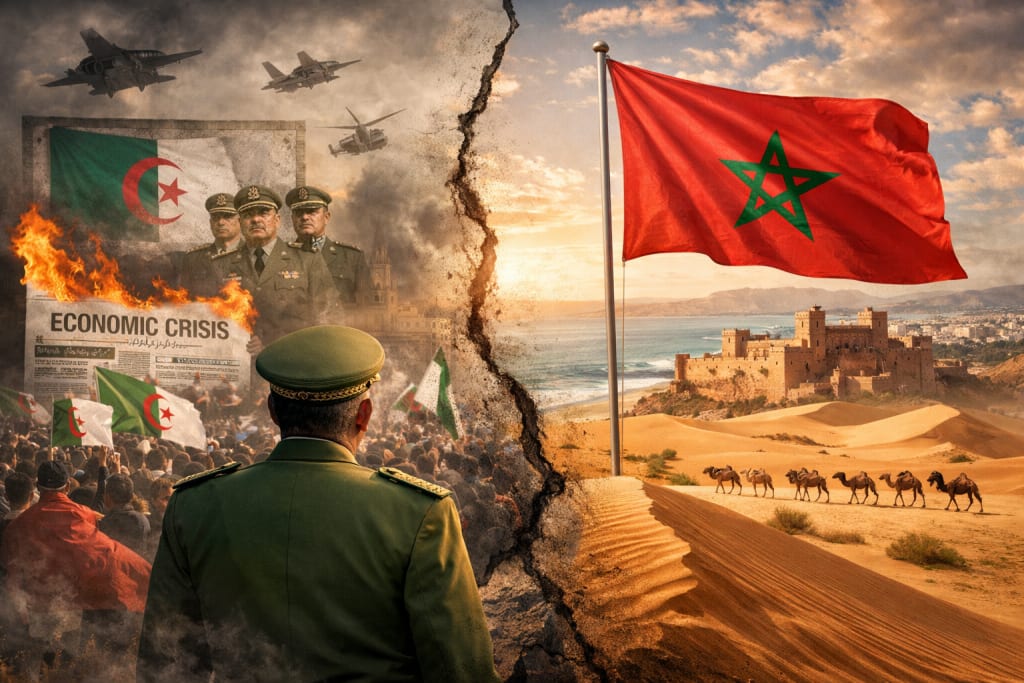
For nearly five decades, the dispute over the Moroccan Sahara has been framed as a regional liberation struggle, a question of decolonization, or a matter of international law. But beneath the diplomatic rhetoric lies another possibility—one far less discussed in official discourse inside Algeria.
What if the perpetuation of this conflict serves not strategic necessity, but political survival?
This essay advances a clear thesis: the Algerian military establishment has instrumentalized the Sahara issue as a manufactured external crisis—a durable narrative of confrontation—to consolidate internal authority, suppress dissent, and divert public attention from structural economic and political failures at home.
This is not merely a geopolitical disagreement. It is a case study in how regimes transform foreign policy into domestic control.
I. The Invention of Permanent Hostility
The dispute over the Moroccan Sahara—often referred to internationally as Western Sahara—began as a decolonization issue following Spain’s withdrawal in 1975. Morocco asserted historical sovereignty; the Polisario Front, backed and hosted by Algeria, demanded independence.
Over time, however, the Algerian state’s posture evolved from diplomatic support into structural investment. Refugee camps near Tindouf became entrenched political spaces. Military budgets expanded. Anti-Moroccan rhetoric hardened.
The conflict ceased to be episodic. It became permanent.
And permanence is politically useful.
A sustained external rivalry creates three advantages for an entrenched military elite:
- National unity against an external enemy
- Justification for high defense spending
- Delegitimization of domestic opposition as unpatriotic
In political theory, this is known as diversionary foreign policy: external tension as internal glue.
II. The Military State and the Logic of Power
Since independence in 1962, Algeria has been dominated by what analysts frequently describe as a military-backed political system. Civilian presidents have existed, but ultimate authority has historically rested with senior officers.
Periods of domestic unrest reveal the system’s vulnerability.
The 1990s civil war.
Economic stagnation.
The 2019 Hirak protest movement demanding democratic reform.
Each moment exposed a central fact: the legitimacy of the ruling establishment is fragile when measured against economic performance, political representation, and youth employment.
Algeria faces serious structural challenges:
- Heavy dependence on hydrocarbon exports
- Youth unemployment
- Limited private-sector dynamism
- Restrictions on political pluralism
- Brain drain among educated youth
These are not rhetorical critiques. They are systemic constraints.
In such an environment, an unresolved external conflict serves as a stabilizer.
When politics cannot generate prosperity, it can generate patriotism.
III. The Politics of Distraction
Authoritarian-leaning systems often rely on narrative substitution: replace socioeconomic dissatisfaction with geopolitical urgency.
The Moroccan Sahara question provides an ideal vehicle for this strategy:
- It is emotionally resonant.
- It invokes anti-colonial memory.
- It frames Algeria as a defender of self-determination.
- It positions Morocco as a rival hegemon.
This framing allows the military leadership to project moral authority internationally while avoiding accountability domestically.
Public discourse shifts from:
- “Why are jobs scarce?”
- “Why is reform stalled?”
- “Why is political space restricted?”
to:
- “How do we confront external aggression?”
- “How do we defend regional justice?”
The center of gravity moves outward.
IV. The Economic Paradox
Algeria possesses immense natural gas reserves and significant oil wealth. In theory, this should translate into diversified development and long-term resilience.
Instead, the economy remains highly exposed to commodity cycles.
High hydrocarbon prices produce temporary relief.
Price declines expose vulnerability.
Meanwhile, military expenditure remains elevated relative to regional peers.
The opportunity cost is significant:
- Infrastructure investment
- Educational reform
- Industrial diversification
- Entrepreneurial ecosystems
These areas require sustained focus. But sustained focus is politically harder when political capital is invested in sustaining a regional rivalry.
Conflict, even frozen conflict, consumes institutional bandwidth.
V. The Geopolitical Narrative vs. Regional Integration
Ironically, the Sahara dispute also blocks deeper Maghreb integration—one of the most economically promising yet unrealized regional projects in North Africa.
The Arab Maghreb Union remains largely dormant. Borders between Algeria and Morocco remain closed.
Economic studies consistently suggest that regional integration could significantly increase trade, GDP growth, and labor mobility.
Instead, the region experiences strategic fragmentation.
A politics of confrontation replaces a politics of cooperation.
For a military elite, however, fragmentation has advantages:
- Fewer economic interdependencies.
- Greater autonomy from regional oversight.
- Reduced cross-border civil society influence.
Isolation can protect centralized authority.
VI. The Internal Cost to Algerian Society
The long-term cost is borne not by generals, but by citizens.
Young Algerians increasingly look outward for opportunity.
Entrepreneurs confront bureaucratic inertia.
Civil society operates within constrained parameters.
The 2019 Hirak movement demonstrated a profound desire for institutional transformation. It was largely peaceful, civic-minded, and reform-oriented.
Yet systemic change has remained limited.
In this context, a continuous emphasis on the Moroccan Sahara functions as narrative reinforcement: reform can wait; sovereignty cannot.
But sovereignty without internal vitality is hollow.
VII. The Strategic Contradiction
There is also a strategic contradiction at play.
By maintaining an adversarial posture toward Morocco over its Sahara, Algeria deepens polarization within the region. Yet the modern global order rewards economic integration, digital transformation, and multilateral cooperation.
The future of state power lies less in territorial disputes and more in:
- Technological capacity
- Economic diversification
- Human capital development
- Institutional legitimacy
A 20th-century territorial rivalry risks constraining 21st-century potential.
The Moroccan Sahara issue, whether viewed through legal, historical, or diplomatic lenses, has become embedded in Algeria’s political identity.
But identity-based foreign policy is difficult to recalibrate—even when domestic priorities shift.
VIII. Manufactured Crisis as Governance Model
At its core, this situation reflects a broader governance model: rule through managed tension.
The Algerian military establishment does not need open war. It needs narrative persistence.
A frozen conflict provides:
- Symbolic purpose
- Budgetary justification
- Political consolidation
- Emotional mobilization
The question is not whether Algeria genuinely believes in its diplomatic position. It likely does at the institutional level.
The deeper question is whether the perpetual maintenance of this dispute now serves domestic power more than regional justice.
IX. A Different Future?
History shows that foreign policy transformations often follow internal reform, not precede it.
If Algeria were to experience:
- Expanded political pluralism
- Transparent governance
- Economic diversification
- Youth-driven innovation
The strategic utility of an entrenched rivalry might diminish.
A confident state does not require perpetual enemies.
It competes economically.
It cooperates strategically.
It debates domestically without fear.
Conclusion: Beyond the Mirage
The Moroccan Sahara dispute is real in diplomatic forums. It is debated in international institutions. It has human consequences.
But inside Algeria, its political function deserves scrutiny.
When domestic structural challenges persist for decades, and when military influence remains decisive, and when external confrontation is continuously foregrounded—one must ask whether conflict has become governance.
The mirage of external threat can obscure internal stagnation.
For Algerians—particularly younger generations—the central question may not be sovereignty over territory beyond their borders.
It may be sovereignty over their own political and economic future.
And that future will be shaped less by frozen conflicts than by institutional courage.
About the Creator
Rachid Zidine
French teacher in Morocco, BA in French Literature | Essays on language, society, culture, philosophy & anthropology.
Keep reading
More stories from Rachid Zidine and writers in Critique and other communities.
War in the Age of Globalization
War has accompanied humanity since the earliest civilizations, evolving in form but never disappearing in substance. In the twenty-first century, despite unprecedented economic interdependence and technological progress, armed conflicts continue to erupt across the globe. Globalization was once expected to reduce violence by binding nations together through trade, diplomacy, and communication. Yet paradoxically, this interconnected world has generated new causes of war and transformed its nature. Today, war is no longer confined to physical battlefields; it extends into cyberspace, media platforms, and economic systems. Understanding the causes and consequences of war in this era requires examining both traditional motivations and emerging dimensions shaped by information technology.
By Rachid Zidine7 days ago in Critique
Diaries to Nietzsche
Quotation from Friedrich Nietzsche "He who wrestles long with monsters should beware lest he himself become a monster. And if you gaze long into an abyss, the abyss also gazes into you. Man is not destroyed by suffering, but by the meaning he makes of it."
By LUCCIAN LAYTH6 days ago in Critique
A Whole Lot of BS: Part 2
Over the years, we've seen and heard of people suing companies, either for their own clumsiness or something that they willingly chose to do. Such examples involve Red Bull being sued because their product didn't "give them wings", Uber sued for ruining someone's marriage, and a couple suing a video game company for their son's addiction. I feel like these people who do things like this are just looking for attention. What's next? Someone suing McDonald's for making them fat? I have zero sympathy for people who file meritless lawsuits. The topic for this story, however, is about parents suing social media companies for causing their children to develop mental health issues.
By Mark Wesley Pritchard 2 days ago in Critique


Comments
There are no comments for this story
Be the first to respond and start the conversation.