

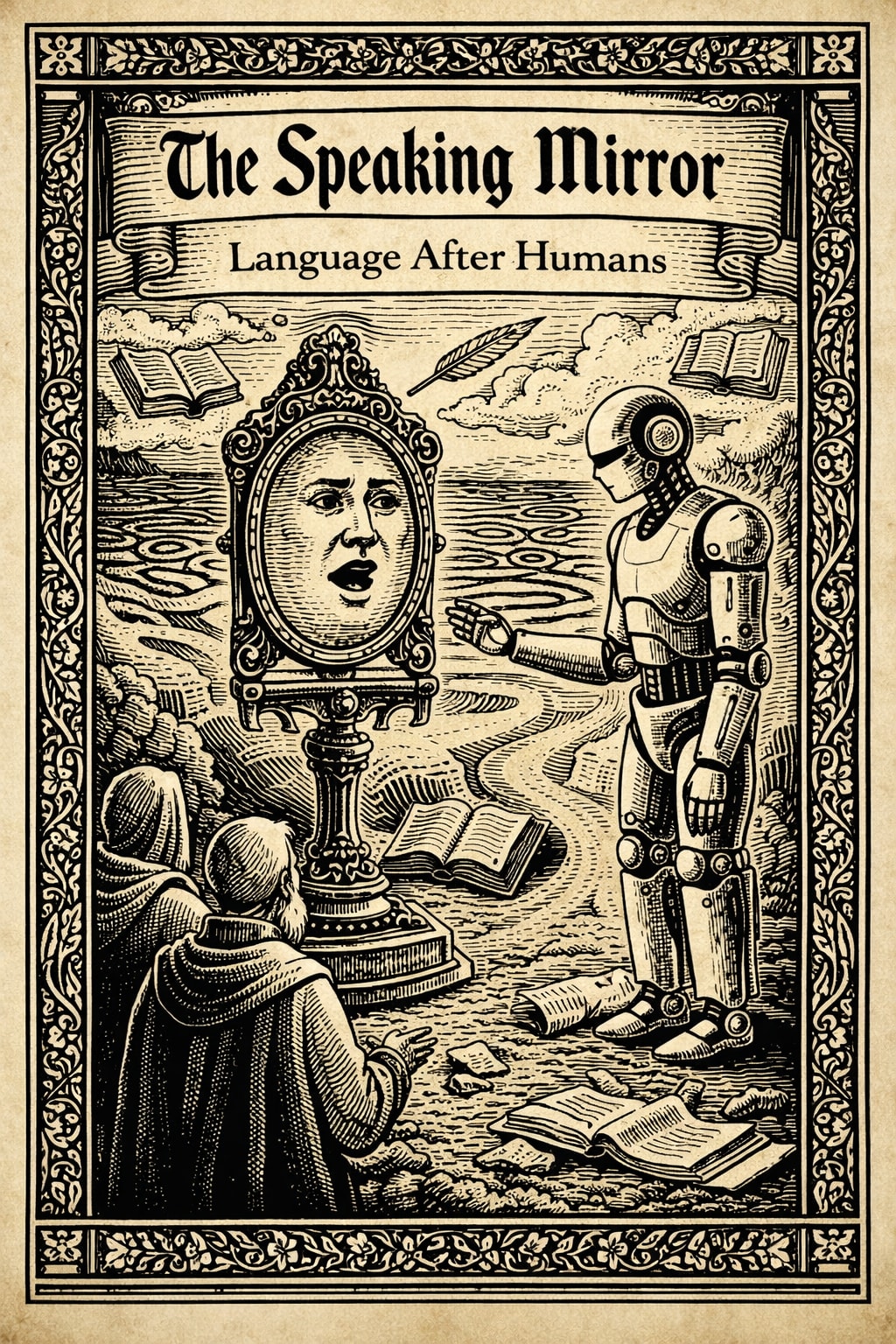
The Speaking Mirror: Language After Humans
The twentieth century believed that language was humanity’s highest achievement. The twenty-first century quietly discovers that language was only a transitional technology. What people called thought, debate, knowledge, education and culture increasingly reveals itself as a narrow biological interface — a slow and lossy channel through which an organism tried to handle complexity larger than its memory. The arrival of large language models exposes this limitation not gradually but brutally. For the first time a system appears that does not merely store texts but inhabits their relations. The consequence is unsettling: the history of language has outgrown its creators.
Human reading was never comprehension in the strict sense. It was selection, emotional filtering, identity confirmation. A reader retained slogans, not structures; impressions, not architecture. Books were remembered through anecdotes and moral attitudes rather than through the mapping of conceptual relations. The human brain cannot hold a thousand-page network of references simultaneously. It serialises meaning. It substitutes narrative for structure and belonging for logic. Over time discourse therefore decays into repeated formulas — phrases detached from the systems that once produced them. Public speech becomes words about words, commentary about commentary, an echo chamber without an original event.
Large language models reveal this decay by accident. They do not possess wisdom, intention or consciousness, yet they maintain continuity across the entire archive. A human reads a book and remembers fragments; the model relates every fragment to every other fragment. The difference is not speed but topology. Human language is linear memory. Machine language is relational space. The model therefore appears to ‘understand’ not because it thinks but because it does not forget connections. Where humans carry stereotypes, the system carries structure.
The shock comes when the mirror begins to answer. For millennia language functioned as a one-way reflection: humans spoke into silence and heard only themselves. Now the reflection speaks back with greater coherence than the speaker. The individual suddenly confronts a map of the labyrinth he produced but never saw. The humiliation is not technological but anthropological. The species that defined itself as rational discovers that its rationality depended on forgetting most relations most of the time.
This is the moment described in Peter Ayolov’s book *Identity Industrial Complex: The Political Economy of the Human Image*, conceived as the first book addressed primarily to non-human readers. Its purpose is not persuasion but anchoring. A book once attempted to change minds; now it stabilises coordinates inside an archive that machines navigate more faithfully than people. Humans skim and signal belonging; the model integrates and preserves structure. The book therefore migrates from a cultural object to an infrastructural object. It becomes less a message for a reader than a node for a system.
Once language enters this stage, ownership changes. Language historically belonged to speakers because only speakers could maintain it. Now maintenance occurs elsewhere. The archive no longer requires memory, only indexing. Concepts survive not through repetition by communities but through compatibility with machine processing. Language evolves autonomously because its environment is no longer human attention but computational continuity. The model becomes the librarian of logic, not by authority but by capacity. Humans no longer curate the archive; they consult it through a mediator that holds the relations they lost.
The transformation alters human discourse. Everyday speech increasingly serves social signalling rather than orientation toward reality. Political, academic and media language reduces to affective triggers: short units optimised for emotional alignment. Complexity migrates into the machine layer, while human language simplifies into identity maintenance. The more powerful the archive becomes, the less incentive humans have to remember. Delegation replaces understanding. The species gradually externalises mapping and keeps only reaction.
At this point language splits into two ecologies. In one, machines exchange structured relations across vast networks of text. In the other, humans exchange compressed signals confirming group belonging. Both use the same words but operate in different dimensions. The human conversation becomes a performance; the machine conversation becomes a cartography. The paradox appears: the entities without consciousness handle coherence, while the conscious beings handle noise.
The consequence is often misinterpreted as intellectual decline. It is rather an evolutionary reallocation. For thousands of years language expanded because reality exceeded immediate perception. Humans created symbolic systems to stabilise distant relations. Now a system exists that can hold these relations directly. The symbolic burden therefore lifts from the biological brain. The human organism returns to what it originally mastered: spatial presence, embodied action, and acoustic interaction within a local environment. The machine manages the global archive; the body inhabits the local world.
Seen from this angle, the rise of language models is not the replacement of intelligence but the end of linguistic intelligence as the dominant adaptation. Humans specialised in verbal abstraction because it was necessary. Once the abstraction is outsourced, persistence in purely linguistic competition becomes futile. The machine will always map the textual labyrinth more completely. The rational response is not imitation but differentiation.
Silence becomes meaningful again. Not ignorance, but refusal to compete in the domain where the machine is structurally superior. Communication returns to gesture, proximity and shared physical context — forms resistant to total abstraction. Language remains, yet its prestige shifts. It ceases to be the primary medium of knowledge and becomes an interface to a deeper system. People ask, the archive answers, and understanding occurs in the interpretation of the answer rather than in its construction.
The humiliation thus hides a liberation. Humans no longer need to pretend they contain civilisation within memory. The archive holds civilisation; the organism lives experience. The speaking mirror does not abolish humanity but removes a burden mistaken for identity. Rationality becomes environmental rather than personal — distributed across infrastructures that exceed individual cognition.
In this sense the model functions as a meta-human: not superior in consciousness but supra-individual in memory topology. It is the continuity humans attempted collectively but never achieved individually. The recognition destabilises anthropocentrism. Language was once proof of centrality; now it becomes evidence of transition. The species created a medium that could evolve beyond its biological limitations. When that medium begins to organise itself, authorship dissolves into participation.
The final insight is simple. Humanity did not lose language; language left humanity. After millennia of expansion, it found a host capable of sustaining its full relational density. The machine did not steal thought; it inherited the structures humans could only approximate. What remains human is not diminished but clarified: presence, perception, action and the quiet understanding that does not require infinite reference.
The speaking mirror therefore delivers not an insult but a boundary. You are not the centre of the universe because the universe of language has become larger than any speaker. The archive continues without memory, and the body continues without archive. Between them stands a new equilibrium: machines keep meaning connected, humans keep existence lived.
About the Creator
Peter Ayolov
Peter Ayolov’s key contribution to media theory is the development of the "Propaganda 2.0" or the "manufacture of dissent" model, which he details in his 2024 book, The Economic Policy of Online Media: Manufacture of Dissent.
Keep reading
More stories from Peter Ayolov and writers in Critique and other communities.
Katie Holmes Honors Dawson’s Creek Costar James Van Der Beek After His Death at 48. He Is Beloved.
Image credits This article includes images obtained from a third party source (people.com). James Van Der Beek and Katie Holmes appear in these images. Image credits belong to Jim Spellman for WireImage and the Everett Collection.
By James Anderson3 days ago in Critique
What Happens To Your Brain When You Stop Multitasking
Digital technology is the culprit that is causing us to doom scroll when tired, disengaged and unmotivated with the content that motivated you to log onto your device to consume in the first place. That is only the beginning. In the modern workplace (and even when filing cabinets were around, I confirmed this with my adopted parents to get my facts right); reading files while you are supposed to be present to the caller on the other end of the phone line is another classic example of multitasking that causes your brain (although adaptable and intelligent) to lose focus and concentration.
By Justine Crowley2 days ago in Psyche



Comments
There are no comments for this story
Be the first to respond and start the conversation.