
Trump Makes History: The First Former President Sentenced for a Felony
A No-Punishment Sentence Highlights the Legal and Political Complexities Surrounding Donald Trump

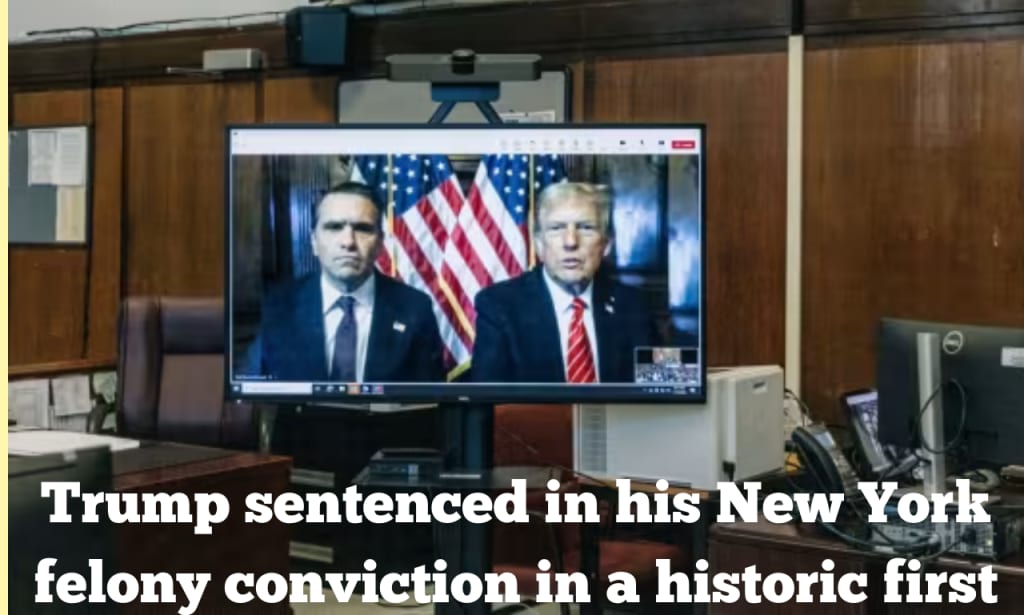
In an unprecedented moment in American history, former President Donald Trump became the first ex-president to be sentenced for a felony. The court proceedings, held on a quiet Friday morning, concluded with a sentence that left many stunned: unconditional discharge, which carries no punishment. This legal milestone underscores the unique intersection of power, privilege, and accountability in the life of one of the most polarizing figures in modern politics.
The felony charge stemmed from Trump’s role in covering up hush money payments made to an adult film actress during his 2016 presidential campaign. This case, though sensational in nature, represents broader questions about ethics, accountability, and the lengths to which political figures will go to protect their reputations.
Justice Juan Merchan, who presided over the proceedings, acknowledged the weight of the moment. His sentencing decision—unconditional discharge—reflects the complex reality of holding a former president accountable. “The extraordinary protections and privileges of the presidency have shielded Mr. Trump from more severe consequences,” Justice Merchan remarked. His words highlighted a sobering truth: the office of the presidency carries with it not only immense power but also unparalleled legal and societal insulation.
Throughout the half-hour court session, Trump remained defiant, maintaining his innocence and portraying himself as a victim of political persecution. His legal team, echoing this sentiment, argued that the charges were motivated more by political vendetta than by genuine legal merit. For Trump and his supporters, the case serves as further evidence of what they perceive as a concerted effort to derail his political career.
Yet, the implications of this sentencing extend far beyond Trump’s rhetoric. Legal scholars and political commentators have been quick to point out that while the unconditional discharge spares Trump from immediate punishment, the felony conviction itself carries a symbolic weight. It is a formal acknowledgment of wrongdoing—a blemish on the record of a man who has consistently defied political and legal norms.
The timing of the case adds another layer of intrigue. With Trump positioning himself as a frontrunner for the 2024 presidential election, the conviction raises questions about how this legal chapter will influence his political trajectory. Will it galvanize his base, further solidifying his image as a political outsider fighting against the establishment? Or will it sway undecided voters, casting doubt on his suitability for another term in the White House?
Public reactions to the sentencing have been predictably polarized. Trump’s supporters view the case as a politically motivated attack, while his critics see it as a long-overdue reckoning. Social media has been ablaze with debates, with hashtags like #TrumpConvicted and #PoliticalPersecution trending worldwide.
However, the broader implications of this case go beyond Trump himself. It forces a national conversation about the legal and ethical boundaries for those in the highest offices of power. Can a president—or a former president—be truly held accountable under the law? Or does the inherent power of the presidency create a shield that even the justice system struggles to penetrate?
Despite the lack of direct punishment, Trump’s conviction serves as a reminder that no one is entirely above the law. It also sets a precedent, albeit a complex one, for how future cases involving high-ranking political figures might be handled. Critics of the sentence argue that the lack of tangible consequences undermines the principle of accountability, while supporters contend that the felony conviction itself is a significant step forward in holding leaders to account.
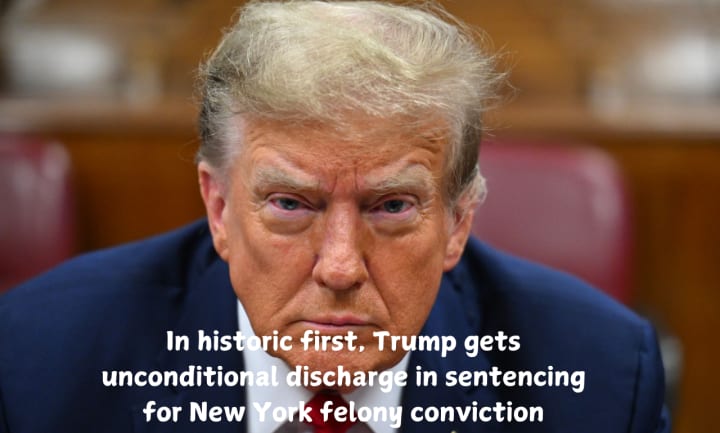
As the dust settles, one thing is clear: this case is far from the end of Trump’s legal and political saga. With other investigations and potential charges looming on the horizon, the former president’s legal battles are likely to remain a focal point of national attention.
In his characteristic style, Trump is expected to use the conviction as a rallying cry for his supporters, framing it as evidence of a corrupt system determined to stop him. Whether this strategy will propel him to new political heights or further isolate him from the mainstream remains to be seen.
Ultimately, Trump’s sentencing marks a historic moment in American politics and law—a moment that forces the nation to grapple with its ideals of justice, accountability, and leadership. While the lack of immediate punishment may leave some unsatisfied, the broader implications of this conviction will likely resonate for years to come.
About the Creator
mureed hussain
Hi, I’m a creative writer passionate about health & wellness, love, longevity, aging, and pet care. With extensive Quora experience, I craft engaging posts, thoughtful questions, and insightful answers.
Find me at>>[email protected]
Keep reading
More stories from mureed hussain and writers in Critique and other communities.
Trump 2.0: Can Disruption Deliver a New Era?
Donald Trump, one of the most polarizing figures in modern American history, stands at the dawn of a second term, poised once again to challenge the status quo. His re-election, driven by a combination of his unapologetic style, economic promises, and the unwavering loyalty of his base, signals a renewed commitment to disrupting Washington and reshaping the global order. Yet, while his resolve has only strengthened, questions linger about how far his brand of disruption can go in an increasingly polarized political landscape.
By mureed hussainabout a year ago in Critique
Standing While Falling
Quotation from Friedrich Nietzsche "He who wrestles long with monsters should beware lest he himself become a monster. And if you gaze long into an abyss, the abyss also gazes into you. Man is not destroyed by suffering, but by the meaning he makes of it."
By LUCCIAN LAYTH27 days ago in Critique
The Blue Sword
The Blue Sword by Robin McKinley Nothing says a childhood classic like white savior Mary Sue! I snagged this one after listening to an episode of Brandon Sanderson’s podcast where he said this inspired one of the stained glass windows decorating his house (because of course he has presumably awesome stained glass windows).
By Matthew J. Fromm3 days ago in Critique
Off the Book
It ended like every other stupid idea. Badly, and alone. I’m researching digital confession ethics, he said. A tech ethicist. He gestured at floating data I couldn’t see then pulled out a physical notebook. Actual paper, fountain pen. He held it up like he was showing me scripture.
By Nicky Frankly4 days ago in Fiction


Comments
There are no comments for this story
Be the first to respond and start the conversation.