
Climate change, sustainability & adaptation
Rising Temperatures, Shifting Futures: How the World Is Adapting to a Changing Climate and Building a Sustainable Tomorrow

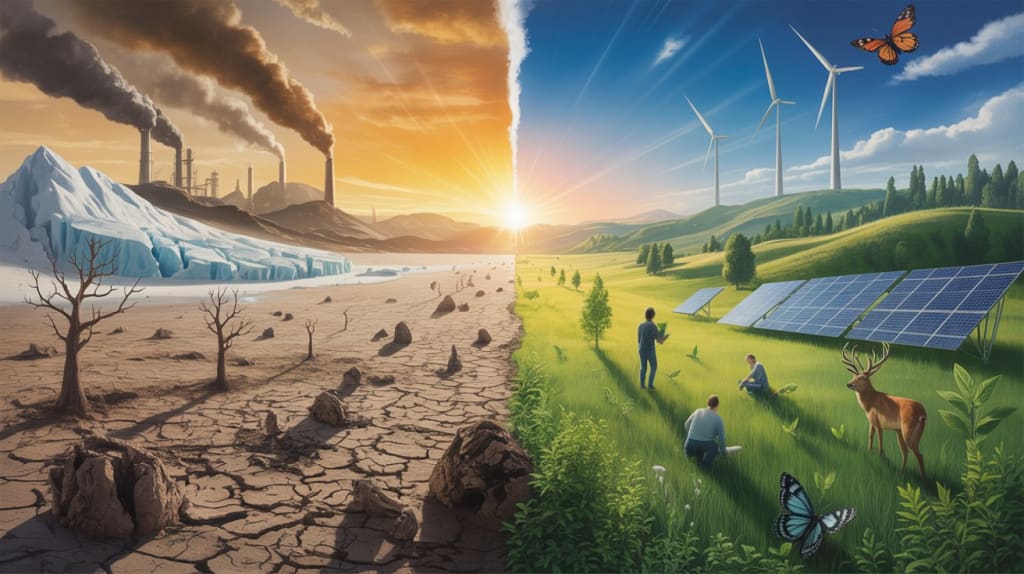
The sky above the small coastal town of Mirador was painted in shades of orange—not the warm glow of a setting sun, but the haunting hue of wildfire smoke drifting across the horizon. The ocean waves, once calm and inviting, now surged with an unpredictable rage. Fishermen stood at the shore, their boats tethered and unused. In the distance, a young girl named Amara held her little brother’s hand as they watched the tide creep closer to their doorstep, swallowing the sand they once played on. In that single moment, the world’s biggest crisis didn’t feel global—it felt personal.
The story of climate change isn’t just about numbers, charts, or distant warnings anymore. It’s about people—millions of them—facing a future rewritten by rising temperatures, vanishing ecosystems, and shifting seasons. What was once a scientific prediction has now become our lived reality. Every drought, flood, storm, or wildfire tells a chapter of the same story: humanity’s urgent need to adapt.
Across continents, the symptoms of a warming planet are impossible to ignore. The Arctic’s ice melts faster each summer, causing sea levels to rise and coastal cities to brace for floods. Crops wither in the heat of South Asia, while African farmers battle soil that can no longer hold moisture. Coral reefs, the lungs of our oceans, are bleaching at record rates, leaving behind ghostly white skeletons where life once thrived. And yet, amid this chaos, a quiet revolution is taking shape—a movement toward sustainability that is rewriting the future, one choice at a time.
In northern Europe, vast fields of wind turbines stretch toward the horizon, spinning gracefully under gray skies. Solar panels glisten atop desert rooftops in Morocco and India, transforming the power of sunlight into energy that fuels entire communities. Farmers in Kenya are adopting regenerative agriculture—methods that heal the soil instead of depleting it. These changes are not just about survival; they are about resilience and hope. Humanity, after all, has always been at its best when challenged to adapt.
But sustainability goes beyond technology—it’s also a mindset. It’s in the way cities are being redesigned to breathe again. Green rooftops cool the concrete jungles of Tokyo and New York. Urban gardens in Berlin and Singapore grow vegetables where parking lots once stood. Even the fashion industry, one of the world’s most polluting sectors, is slowly transforming as designers turn to recycled fabrics, natural dyes, and ethical production. The movement isn’t just ecological—it’s cultural.
However, adaptation is not equally possible everywhere. In the developing world, communities that contribute the least to global emissions suffer the most. Islands like Kiribati and Tuvalu face extinction beneath rising seas. Farmers in drought-stricken regions of Pakistan or Ethiopia struggle to keep their families fed as rain patterns vanish. The imbalance between responsibility and suffering has become one of the greatest moral challenges of our time. Climate justice is now inseparable from climate action.
Governments and international organizations are beginning to respond—though many argue, not fast enough. The Paris Agreement was a starting point, but the journey toward net-zero emissions is complex and uneven. Some countries are accelerating renewable projects, while others remain trapped in fossil fuel dependence due to economic constraints. Still, the momentum is undeniable. Young activists like Greta Thunberg and Vanessa Nakate have inspired a generation to raise their voices, turning climate anxiety into collective action.
Meanwhile, innovation continues to rise from unexpected corners. Scientists are developing carbon-capturing technologies that literally pull CO₂ out of the air. Architects are designing self-sustaining smart homes that generate their own power and recycle water. Entrepreneurs are creating biodegradable packaging, lab-grown meat, and even algae-based plastics. Each invention represents a small but vital step in humanity’s journey from destruction to regeneration.
Yet the real transformation must come from within—from the choices individuals make every day. The food we eat, the energy we use, the products we buy, and even the stories we tell all shape the planet’s destiny. Sustainability is no longer a luxury for the conscious few; it is a necessity for everyone. Small acts—like reducing waste, supporting clean energy, or choosing local produce—might seem insignificant, but multiplied by billions of people, they become a force stronger than any storm.
Amara, the girl from Mirador, still walks to the shoreline each morning. The ocean continues its slow advance, but something new has emerged in her community. The fishermen have started planting mangroves to hold back erosion. The local school runs entirely on solar power. Rainwater is collected in tanks for irrigation. The town that once feared the tide now learns to live with it—to work with nature instead of against it.
As the sun rises over Mirador, golden light breaks through the smoke, reflecting on the waves like a promise. The world may be warming, but it is also waking up. Humanity’s greatest test has begun—not just to survive, but to evolve. And somewhere between the fading fires and the whispering wind turbines, we are learning that the future is not something to fear. It is something we can still shape—together.
About the Creator
[email protected]
Living life, one smile at a time 😎
Coffee lover ☕ Dreamer 🌟"
Just vibin’ and creating memories ✌
Curious mind, happy heart 💛
Chasing sunsets and good vibes 🌅
.
Keep reading
More stories from [email protected] and writers in Earth and other communities.
Supermoons in the U.S.
In the crisp evening air of early October 2025, millions of Americans stepped outside, gazing upward in awe. The moon—bright, immense, and glowing with an almost surreal brilliance—hung low on the horizon, casting silver reflections across oceans, lakes, and rooftops. It was the beginning of an extraordinary celestial sequence: four consecutive supermoons that would illuminate the skies over the United States from October through January, a phenomenon unseen for decades.
By [email protected]4 months ago in Earth
Prince Archie’s Ex-Nanny Lifts Lid on Truth of Working for Prince Harry and Meghan
Public interest has intensified following claims from a former nanny linked to Prince Archie, who has reportedly spoken about her experience working for Prince Harry and Meghan, the Duke and Duchess of Sussex. While details remain subject to interpretation and public discussion, the story has sparked wider conversations about privacy, media scrutiny, and the realities of working in high-profile households.
By Aarif Lashariabout 12 hours ago in Earth
Catherine O’Hara at 71: Celebrating a Comedy Icon as False Death Rumors Circulate
Catherine O’Hara, the beloved actress known worldwide for her unforgettable roles in Schitt’s Creek and Home Alone, has recently been the subject of false online reports claiming she died at the age of 71. These claims are untrue. O’Hara is alive, active, and continues to be celebrated as one of the most influential comedic performers of her generation.
By Aarif Lashari2 days ago in Earth


Comments
There are no comments for this story
Be the first to respond and start the conversation.