

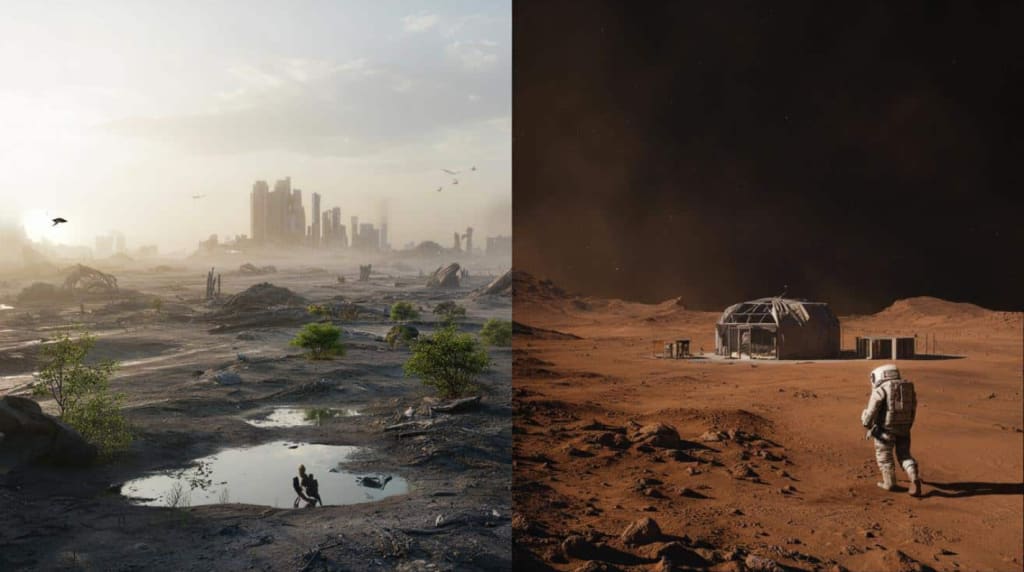
An astrophysicist openly challenges Elon Musk: “Even after a nuclear apocalypse, Earth would still be paradise compared to Mars”
This essay was written by Cultys Erwa / 4 February 2026 .
I’m a fan of space travel and planetary colonization, but his essay brings home the reality, and pours cold water on my enthusiasm.
The room goes quiet the moment his slide changes. On the screen, a fire-scarred Earth spins slowly next to a dusty, rusty marble: Mars. An astrophysicist at the back of the hall clears his throat, leans into the mic, and drops the line that will later blow up on social media: “Even after a nuclear apocalypse, Earth would still be paradise compared to Mars.”
Some people laugh. Others shift uncomfortably, thinking of Elon Musk’s promises of a “backup planet” and stainless-steel rockets tearing through the sky.
The scientist keeps going, patient but sharp. He talks about air so thin your blood would boil, radiation that cuts through flesh, and dirt you can’t grow potatoes in without serious cheating.
The message lands with a thud.
What if the dream of escaping to Mars is blinding us to the world we’re quietly wrecking under our feet?
Elon Musk’s Mars dream meets a cold scientific reality
Scroll through Elon Musk’s feed and you’ll see it: gleaming Starships, animated Mars colonies under domes, talk of “making life multiplanetary”. It feels bold, cinematic, almost comforting
The story is simple: if we mess up Earth, we’ll have Mars. A second chance, a cosmic reset button, sponsored by reusable rockets and Silicon Valley optimism.
Then an astrophysicist steps in and says, “Not quite.”
Because from a physics, biology, and survival point of view, Mars isn’t a Plan B. It’s a brutally hostile rock where every breath, every sip of water, every patch of green has to be engineered, maintained, and defended.
Earth, even damaged, is still a miracle.
One researcher summed it up on stage with a thought experiment that hit everyone like a bucket of ice water.
Imagine, he said, a worst-case nuclear war on Earth: cities flattened, skies darkened by soot, temperatures dropping. Horrifying, chaotic, deadly. Now place that ruined Earth next to present-day Mars and ask a brutal question: where would you rather try to survive with zero outside help for 10 years?
On apocalypse-Earth you’d still find pockets of breathable air, scattered wildlife, contaminated yet treatable water, abandoned infrastructure you could salvage.
On Mars you step outside your habitat without a suit and you’re dead in minutes. No oxygen, bone-crushing cold, cosmic rays slicing through your cells.
The point stung: our “broken” planet would still outperform Musk’s red frontier.
The logic behind the comparison is chillingly straightforward. Earth, even wounded, keeps doing you favors for free. The atmosphere filters radiation. Gravity hugs you at a comfortable 1g. Liquid water flows or can be cleaned. Plants can grow under an open sky.
Mars gives you none of that. Its air is 1% of Earth’s pressure, mostly carbon dioxide. Its gravity is only about a third of ours, which long-term wrecks bones and muscles. Its surface is blasted by radiation because its magnetic field is basically gone.
So when an astrophysicist says “after a nuclear apocalypse, Earth still beats Mars,” he’s not being dramatic. He’s just following the numbers. And the numbers are ruthless.
Why surviving on Mars is way harder than Musk’s memes suggest
When space scientists talk about Mars, they don’t imagine sleek sci‑fi cities first. They think about life-support spreadsheets.
Want to live on Mars? You need a sealed habitat, oxygen generators, water recyclers, radiation shielding, spare parts, medical supplies. You need energy for all that gear, 24/7, with no blackout days, because one power failure might mean no air to breathe.
On Earth, you walk out your door and your lungs fill with oxygen someone else didn’t have to manufacture. On Mars, every breath comes from an industrial process that can fail.
That’s the detail you rarely see in the glossy renderings.
We’ve all been there, that moment when a sci‑fi movie shows farmers smiling in a glass dome on Mars. It looks peaceful, orderly, almost cozy. The reality is closer to living inside a submarine, forever.
Ask engineers at NASA or ESA to list the problems. They’ll talk about water locked in ice you need to mine and melt. Dust that clogs every moving part. Martian soil laced with perchlorates — toxic chemicals you’d have to clean out before growing a single tomato.
Add to that the 20‑minute delay in communications with Earth, and the brutal psychological cost of knowing you cannot just “go outside” if something goes wrong.
On post‑nuclear Earth, you’d be scavenging and rebuilding in a nightmare. On Mars, you’d be fighting physics itself.
Strip away the romance and the comparison becomes oddly clear. On Earth, our survival is strongly supported by biosphere systems we didn’t build: oceans, forests, microbes, clouds. Even damaged, they still buffer temperatures, recycle carbon, and slowly repair.
Mars has no biological safety net. No self-healing forests. No oceans to moderate climate. No ozone layer to soften the Sun’s rage.
Every system you rely on in a Mars base is fragile technology inside a place that wants you dead. Let’s be honest: nobody really runs life‑critical systems perfectly, every single day, for decades, without serious glitches.
That’s why so many scientists flinch when they hear people talk about Mars as an “escape route” for humanity.* It reverses the basic logic of survival.
What the Mars buzz is doing to how we see Earth
There’s a subtle mental trick hidden inside the “Mars as backup” story. Once you start telling yourself there’s a second home waiting somewhere out there, your first home starts to feel slightly more disposable.
Astrophysicists who criticize Musk’s narrative aren’t anti-exploration. Many of them love rockets. They’re just painfully aware that talking about Mars as a refuge can blur the urgency of protecting Earth.
It’s like spending your time designing an emergency bunker at the bottom of the ocean while ignoring the fire in your kitchen.
One scientist shared a small, revealing moment with his students. He asked a class of undergrads whether they felt humanity would “always find a way,” even in the face of climate change and ecosystem collapse. Almost half raised their hands, citing colonizing other planets as a reason for their optimism.
These were smart, informed young people. Yet somehow the Musk narrative had seeped deep enough that Mars felt like a vague safety valve, a last resort that made today’s choices feel less final.
That’s the quiet danger. When the fantasy of leaving gets louder than the responsibility of staying, our sense of risk goes numb.
Suddenly, protecting this atmosphere feels less urgent if there’s another one “we can build” somewhere else — even if that somewhere is a frozen desert.
Astrophysicists pushing back on Musk are not saying, “Don’t go to Mars.” They’re saying: **Don’t confuse a frontier with a fallback.**
One researcher put it starkly during a panel debate:
Treating Mars as a lifeboat is like planning to survive a house fire by moving into your car — while your house is still standing and fixable.”
They argue for a different framing:
Explore Mars as a science and engineering challenge, not a climate guilt escape hatch.
Use Mars tech — closed-loop life support, efficient recycling — to strengthen life on Earth first.
Stop repeating the line that a few rockets can “save humanity” if we trash our own biosphere.
What they’re really defending is not Earth as a rock, but Earth as a living system we still deeply underestimate.
Earth, even damaged, might remain our only real paradise
The more you listen to people who study planets for a living, the more a strange truth surfaces: Earth is not just “nice to have”, it’s absurdly, astronomically rare.
The right distance from the Sun. The right air pressure for liquid water. A magnetic field that deflects deadly radiation. A climate balanced by oceans and clouds and countless tiny organisms we barely understand.
If humanity somehow ruins that, what we lose is not just comfort. We lose the one place in reach where humans can walk outside, squint at the sky, take a deep breath, and not die.
That’s why the line from the astrophysicist hits so hard. Even after a nuclear nightmare, Earth would still give us a head start that Mars never will.
It doesn’t make apocalypse “okay”. It just underscores how wildly generous this planet remains, even when mistreated, compared to the cold indifference of the red world Musk dreams about.
Earth still beats Mars, even in ruins Post-nuclear Earth keeps breathable air, water sources, and a functioning biosphere Shifts how you see “doomsday” narratives and space as a real escape option
Mars is brutally hostile by default Thin atmosphere, intense radiation, toxic soil, full dependence on fragile tech Helps cut through hype around easy colonization or “backup planet” talk
The Mars dream changes our behavior now “Backup planet” thinking can weaken urgency around climate and ecosystem protection Invites you to question comforting tech myths and refocus on defending Earth
Is Elon Musk really saying we should abandon Earth for Mars?
Not exactly. Musk often says he wants to “preserve consciousness” by spreading life beyond Earth. The tension comes from how his words get interpreted: many people hear a subtext of “we’ll have Mars if Earth fails,” which scientists argue is deeply misleading.
Could humans actually survive long-term on Mars?
In theory, yes — with massive infrastructure, constant supplies, and extremely robust life-support systems. In practice, long-term survival would be fragile, energy-hungry, and medically risky, especially because of low gravity and high radiation.
Is a nuclear apocalypse really less bad than living on Mars?
From a planetary habitability standpoint, yes. A post-nuclear Earth would be horrific, but it would still offer air, water, and ecosystems. Mars starts with none of that. That’s the brutal comparison astrophysicists are making when they call Earth a “paradise” by contrast.
Does criticizing Mars as a backup mean we should stop space exploration?
No. Most scientists who push back on the Mars narrative are passionate about exploration. They just want the story to be honest: Mars as a research frontier and inspiration, not a realistic safety net for 8 billion people.
So what’s the takeaway for non-scientists?
Treat Mars as an amazing scientific dream, not a guilt-free exit plan. Support climate action and protection of ecosystems here, because this planet is still our only true home — and even in disaster scenarios, it’s the friendliest world we’re going to get.
About the Creator
Guy lynn
born and raised in Southern Rhodesia, a British colony in Southern CentralAfrica.I lived in South Africa during the 1970’s, on the south coast,Natal .Emigrated to the U.S.A. In 1980, specifically The San Francisco Bay Area, California.
Flooding wetlands in an effort to combat climate change could backfire.
Despite making up a fairly small portion of the planet's surface area, wetlands store a disproportionate amount of carbon on land. Wetland soil disturbance can release massive volumes of greenhouse gases, which is why they are at the centre of climate debates.
By Francis Damia day ago in Earth
Rachel Reeves Delivers ‘Killer Blow’ to UK’s Most-Loved Place Tomorrow – Has It Gone Too Far?
The UK is bracing for a major policy announcement from Chancellor Rachel Reeves that critics have described as a potential “killer blow” to what many call one of Britain’s most-loved national features. While supporters argue the move is necessary for economic stability and modernization, critics warn it could damage businesses, communities, and cultural identity.
By Aarif Lashari4 days ago in Earth



Comments
There are no comments for this story
Be the first to respond and start the conversation.