
Meteorologists Sound the Alarm as Early February Arctic Anomaly Rattles Climate Models
Scientists Divided Over Whether an Unusual Polar Shift Signals a New Era of Winter Chaos
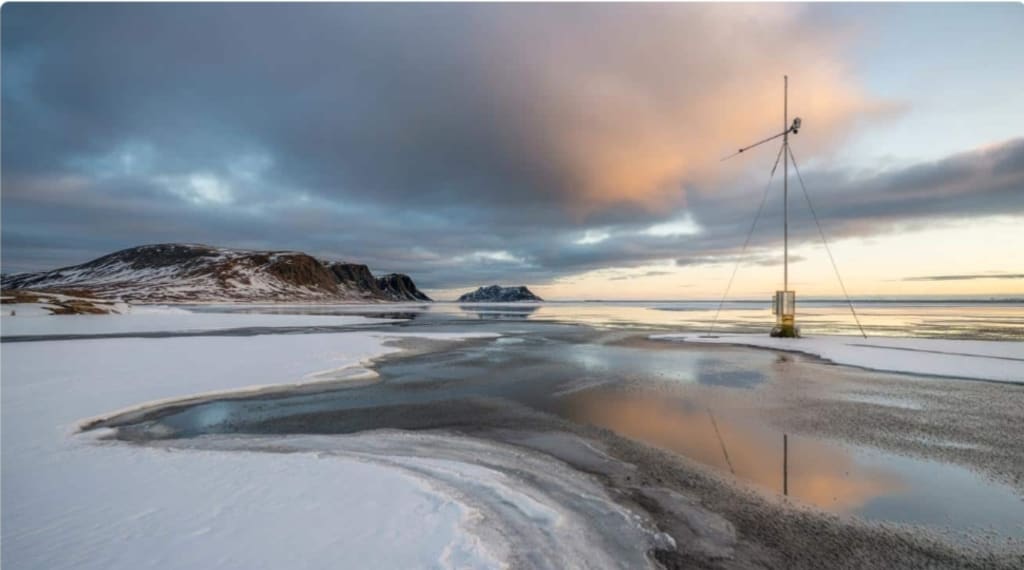
An unusual atmospheric disturbance in early February has sent shockwaves through the global meteorological community. What began as a cluster of irregular data points over the Arctic quickly evolved into something more troubling: a large-scale anomaly disrupting temperature patterns, jet stream flow, and seasonal forecasts across the Northern Hemisphere.
Now, meteorologists are sounding the alarm. Climate models have struggled to interpret the event, and experts are increasingly divided over its implications. Is this a rare but temporary atmospheric fluctuation? Or does it signal the beginning of a new era of unstable, chaotic winters shaped by a rapidly warming planet?
The debate is intensifying — and so are the consequences.
---
What Happened Over the Arctic?
In early February, monitoring systems detected abnormal warming in parts of the Arctic stratosphere. Temperatures in some upper-atmospheric layers surged dramatically, disrupting the stability of the polar vortex — a large ring of cold air that typically circulates around the North Pole.
When the polar vortex weakens or splits, frigid Arctic air can spill southward into Europe, Asia, and North America. Simultaneously, other regions may experience unusual warmth.
Such events are known as sudden stratospheric warmings (SSWs), and while not unprecedented, the timing and intensity of this February anomaly caught scientists off guard.
Weather models that had predicted relatively stable winter patterns suddenly required major adjustments. Forecast confidence dropped, and meteorological agencies scrambled to update seasonal outlooks.
---
Climate Models Under Stress
Modern forecasting relies on advanced computational simulations. Agencies such as the National Oceanic and Atmospheric Administration (NOAA) and the European Centre for Medium-Range Weather Forecasts use complex models to project atmospheric behavior weeks or months in advance.
But Arctic anomalies present a unique challenge. The polar atmosphere is influenced by ocean temperatures, sea ice coverage, solar radiation, and even tropical weather systems. When multiple variables shift simultaneously, models can struggle to maintain accuracy.
In this case, some projections underestimated the strength of the warming event and its ripple effects. The sudden recalibration has renewed discussions about whether climate change is amplifying Arctic volatility beyond what models were originally designed to handle.
---
A Divided Scientific Community
The anomaly has sparked debate among climatologists and meteorologists.
One camp argues that extreme Arctic disruptions are becoming more common due to rapid polar warming — a phenomenon known as Arctic amplification. The Arctic is warming roughly four times faster than the global average, largely because melting sea ice reduces the planet’s ability to reflect sunlight.
This group suggests that as the temperature difference between the Arctic and mid-latitudes shrinks, the jet stream weakens and becomes more wavy. The result? More frequent cold snaps in some regions and unseasonal warmth in others — in short, winter chaos.
Others caution against drawing sweeping conclusions from a single event. They note that sudden stratospheric warmings have occurred historically, even before significant industrial-era warming. Atmospheric systems, they argue, remain naturally variable and occasionally extreme.
The truth may lie somewhere in between: natural variability supercharged by a changing climate.
---
Real-World Impacts
Already, unusual weather patterns have emerged across parts of Europe, Asia, and North America.
In some regions, record-breaking cold has followed unseasonably mild conditions just weeks earlier. Elsewhere, heavy snowfall has hit areas that were expecting moderate winter weather. Meanwhile, certain Arctic zones have experienced temperatures near or even above freezing — highly unusual for early February.
These swings have tangible consequences:
Disruptions to energy grids due to sudden heating demand spikes
Transportation delays from heavy snow and ice
Agricultural damage from freeze-thaw cycles
Heightened flood risks from rapid snowmelt
For policymakers and emergency planners, unpredictability may be the most dangerous factor of all.
---
Is This the “New Normal”?
The concept of a “new normal” in climate science has become increasingly controversial. Extreme heat waves, record-breaking storms, and prolonged droughts have already reshaped global expectations of summer weather. Now winter may be entering its own period of instability.
Research published in journals over the past decade suggests that Arctic sea ice decline can influence atmospheric circulation far beyond the polar region. Some studies indicate that weakened polar vortices may become more frequent in a warming world.
However, long-term data is still limited. Climate systems operate over decades and centuries, and separating short-term anomalies from structural shifts requires sustained observation.
---
Implications for the Future
If Arctic disruptions intensify, the consequences could extend far beyond winter inconvenience.
Energy markets may face heightened volatility as demand spikes unpredictably. Insurance industries could struggle to price risk accurately. Infrastructure built for historical weather norms may prove inadequate.
Perhaps most importantly, public trust in seasonal forecasting could erode if model accuracy continues to falter under rapidly shifting conditions.
Yet many scientists emphasize that this anomaly should be seen as a call to improve models, not abandon them. Advances in satellite data, ocean monitoring, and machine learning may help refine predictions in the years ahead.
---
A Climate System in Transition
The Arctic anomaly of early February is more than just a weather headline. It represents a stress test for modern meteorology and a stark reminder of how interconnected Earth’s systems truly are.
Whether this event marks the dawn of a new era of winter chaos or simply a dramatic fluctuation within natural variability remains uncertain. But one thing is clear: the Arctic is no longer the stable, frozen anchor of global climate it once appeared to be.
As scientists continue analyzing data and refining projections, the world watches — aware that what happens at the top of the planet rarely stays there.
About the Creator
Keep reading
More stories from Sadaqat Ali and writers in Earth and other communities.
Police Identify 18-Year-Old as Suspect in Tumbler Ridge Shooting
On February 10, 2026, one of the deadliest mass shootings in recent Canadian history unfolded in the remote community of Tumbler Ridge, British Columbia, leaving the nation reeling. Police have officially identified the suspect as an 18-year-old local resident, Jesse Van Rootselaar, following a violent rampage that resulted in multiple deaths and scores of injuries.
By Sadaqat Ali8 days ago in Earth
“It Has Ventilation Systems, Food Storage, Nurseries, Toilets and Highways” – 11 Animals That Build Villages, Towns and Even Cities
When we think of cities, we picture skyscrapers, highways, sewage systems, and carefully designed neighborhoods. Yet long before humans mastered architecture and infrastructure, animals were already building complex settlements complete with ventilation systems, food storage facilities, nurseries, waste management areas, and transportation routes.
By Ayesha Lashari7 days ago in Earth
Think for Me
"How do you calculate the circumference of a circle? Submit your answer when ready." [Pause] "Excellent! Every student was able to call up the answer electronically very quickly. If I, as a robot had feelings, I would express pride. You may break for lunch. Return to this cyber room in 45 minutes."
By Julie Lacksonen6 days ago in Humans


Comments
There are no comments for this story
Be the first to respond and start the conversation.