

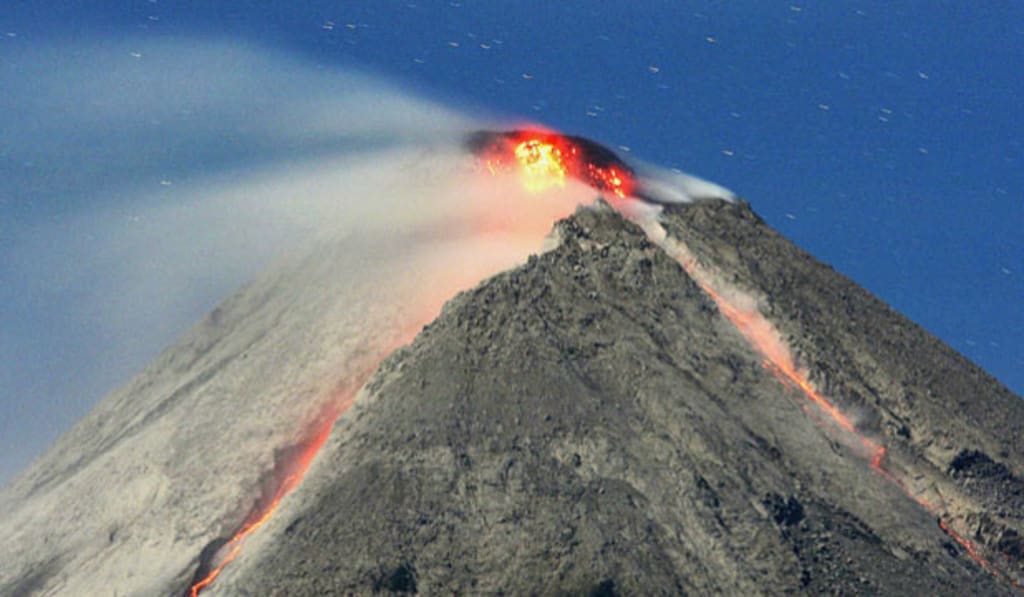
Monstrous tsunamis and devastating tornadoes, colossal meteorites and catastrophic earthquakes, oh, the importance of having insurance! Yet, these are mere minor natural disasters when compared to the cataclysmic eruption of a volcano. Certain volcanoes possess the power to annihilate entire cities, as witnessed in Pompeii or certain Pacific islands. However, there exists a perilous type of eruption that has the potential to eradicate all life on our planet. This catastrophic phenomenon is known as a flood basalt eruption.
Before delving into the intricacies of a flood basalt eruption, let us first comprehend the nature of a volcano. Deep within our planet, rivers of scorching molten metals and incandescent rocks flow, growing increasingly hotter as they delve deeper. The source of this seething inferno is the mantle, the middle layer of the Earth situated between the core and the crust. These fiery currents, known as magma, permeate every crevice. Due to the thick layer of the Earth's crust, we remain shielded from the searing heat. Magma, being lighter than the crust, persistently strives to breach the surface. In certain regions, it succeeds at the junctions of tectonic plates, erupting forcefully when one plate submerges beneath another. Once magma reaches the surface, it transforms into lava, scorching the surrounding terrain before rapidly cooling and solidifying, adding a new layer to the Earth's surface. Over millions of years, this accumulation of layers forms majestic mountains. Within these mountainous formations, at the juncture of tectonic plates, magma surges forth, giving birth to a volcano. This fiery behemoth spews forth lava and ash into the sky, periodically awakening during seismic activities.
Now, let us imagine the scenario where numerous colossal volcanoes simultaneously unleash an endless torrent of magma, consuming an entire continent. This is the cataclysmic flood basalt eruption. Such an event did occur approximately 252 million years ago, in the northern regions of our planet. Vast quantities of magma accumulated beneath the Earth's crust, trillions of tons of scalding broth converging in a single colossal territory. Gradually, this fiery energy seeped through the surface, resulting in the emergence of hot gases from various locations within this expansive territory. The ceaseless trembling of the ground and the crust's gradual ascent, rising hundreds of feet, heralded the impending catastrophe. Then, at a certain point, magma began to surge forth, giving rise to colossal fountains of fire erupting from the ground, reminiscent of geysers in Iceland, but many times higher, with searing lava and ash instead of water and steam. The forceful streams of lava and molten rock reached such heights that they pierced the clouds, while below the Earth's crust, a colossal magma bubble developed, releasing fiery jets under immense pressure. As the rift widened, magma flowed freely, rapidly engulfing the entire northern continent. The flood of scorching lava sprawled wider and wider, inundating forests, rivers, lakes, and meadows, pouring forth for hundreds of thousands of years. Concurrently, billions of tons of volcanic ash ascended into the atmosphere, potentially inducing a volcanic winter. The sulfur dioxide within the ash reflected the sun's rays, leading to a decrease in temperature on the continent by several degrees. Dust and ash likely condensed, forming massive clouds that showered the surface with toxic acid rain.
However, the deluge of cold lava eventually formed a thick, impenetrable shield, halting the escape of magma from the unending inferno beneath. The global catastrophe subsided, albeit temporarily. Trillions of tons of magma continued to flow beneath the sturdy layer of solid basalt. These fiery rivers, unable to breach the surface, spread laterally, creating immense networks beneath the hardened rock. Like a spider's web, these networks extended in various directions, superheating the Earth's crust. Consequently, gases began to permeate the surface once more, accumulating immense energy until an unimaginably forceful explosion ensued. Alongside magma, carbon dioxide and ash erupted, filling the atmosphere and triggering the greenhouse effect. The overall temperature of the planet escalated by several degrees. This release instigated yet another calamity, commencing within the ocean. On the seabed, vast reserves of methane and explosive gases lay beneath the frigid waters. While previously frozen and harmless due to the cold, these deposits underwent a transformation as the greenhouse effect warmed the entire ocean. Millions of tons of methane ascended to the surface. Being more potent than carbon dioxide, its release resulted in a further increase in global temperatures. The entire globe transformed into a scorching sauna. Regions once cool and humid experienced temperatures comparable to the modern Sahara. Naturally, most animals and insects were unable to endure such a cataclysm. Oceanic life suffered the greatest toll. The combination of heat and methane depleted the oxygen within the ocean, rendering it inhospitable for fish and other marine creatures. As anaerobic bacteria multiplied in the oxygen-deprived water, they fed on methane and carbon dioxide, releasing hydrogen sulfide—a toxic substance that further poisoned the water. Approximately 75% of land animals and 95% of marine species were driven to extinction.
This flood basalt eruption stood as the only disaster in the planet's history capable of annihilating almost all plant life and severely diminishing the insect population. A handful of resilient species managed to endure these harsh conditions. Complete recovery of the planet took approximately 10 million years, and from there, a new phase of evolutionary development commenced.
Now, onto two pieces of news: the bad news is that another flood basalt eruption will occur in the distant future, bearing no less devastation than the event that transpired 252 million years ago. The good news, however, is that this eruption is expected to transpire in hundreds of millions of years. When that fateful day arrives, humanity must be adequately prepared. The cataclysm will commence on the ocean floor, with magma fountains soaring miles high, boiling the water and releasing sulfur dioxide into the atmosphere, leading to sunlight reflection. Accompanied by ash and magma, copious amounts of water vapor will ascend into the air. Livestock will struggle to survive, and people will face respiratory difficulties. Acid rain and heightened humidity, resulting from oceanic evaporation, will induce corrosion in buildings, necessitating the use of gas masks. Many animals will be unable to withstand the eruption's aftermath, but humans will adapt swiftly. Nevertheless, subsequent eruptions will follow in quick succession, depleting humanity's resources and impeding the rapid recovery of plants and trees. Oxygen production will undergo a significant decline. One can only hope that by that time, humanity will have colonized other planets, including those beyond our solar system.
Returning to the present, it is worth noting that approximately 70% of seismic activities associated with volcanoes occur underwater. Thus, let us explore the workings of ordinary volcanoes situated on the ocean floor. Similar to landmasses, water rests upon tectonic plates. Consequently, when the structural integrity of these plates is compromised, magma permeates the fractures. However, unlike terrestrial volcanoes, the lava emitted by underwater volcanoes does not spread indiscriminately, consuming everything in its path. Instead, it solidifies under the immense pressure of cold water. Underwater volcanoes can experience eruptions lasting for extended periods, with intermittent intervals. The magma blankets the ocean floor, gradually building layer upon layer over hundreds or thousands of years. Eventually, a volcano emerges from beneath the water's surface, with magma erupting and elevating its height. Thus, a sizable volcanic island is formed. Over time, the volcano enters a dormant phase, and life takes root on the newly created landmass. The magma, originating from the Earth's mantle and infused with various chemical elements, enriches the soil, fostering the growth of plants and trees. Subsequently, birds and other animals colonize the island, transforming it into a paradise. However, when humans arrive, they often replace this paradise with parking lots and franchise burger joints.
That concludes our discussion for today. If you found this information intriguing, please give the video a like and share it with your friends. If you crave more knowledge, click on the suggested videos and stay enlightened on the bright side.
About the Creator
James Mburu
I am a professional Content Writer.
Keep reading
More stories from James Mburu and writers in Earth and other communities.
Wreckage!
They claimed it to be the pinnacle of technological advancement, an unsinkable marvel. When the Titanic tragically sank, it became globally renowned. This disaster's notoriety stemmed from these factors, but regrettably, it was not the sole large-scale shipwreck. Unfortunately, there have been cases far worse than the Titanic's tragedy.
By James Mburu3 years ago in 01
The Watering Wisdom: AI Creates a Custom Schedule Based on Your Home's Environment
The quest for the perfect watering routine is the holy grail of houseplant care. It’s a dynamic equation with variables that change with the seasons, your home’s climate, and even the plant's growth cycle. But what if you could stop guessing? Modern plant care, powered by artificial intelligence, is moving beyond static advice to create dynamic, personalized watering wisdom that responds to your environment.
By Emma Wallace38 minutes ago in Earth
Can You Guess Our Screen Time? A Priest, Pensioner, Tech CEO, and Teenager Reveal All
In today’s digital age, screen time affects everyone—whether you’re managing a company, leading a community, staying in touch with family, or navigating school life. To understand how much time people really spend staring at devices, we spoke to four individuals from different walks of life: a priest, a pensioner, a tech CEO, and a teenager. Their answers highlight just how varied—and sometimes surprising—screen habits can be.
By Aarif Lashari5 days ago in Earth



Comments (1)
Let me know your thoughts about the story.