
The Saga of Pangaea
Earth’s Epic Puzzle and the Continents’ Endless Dance

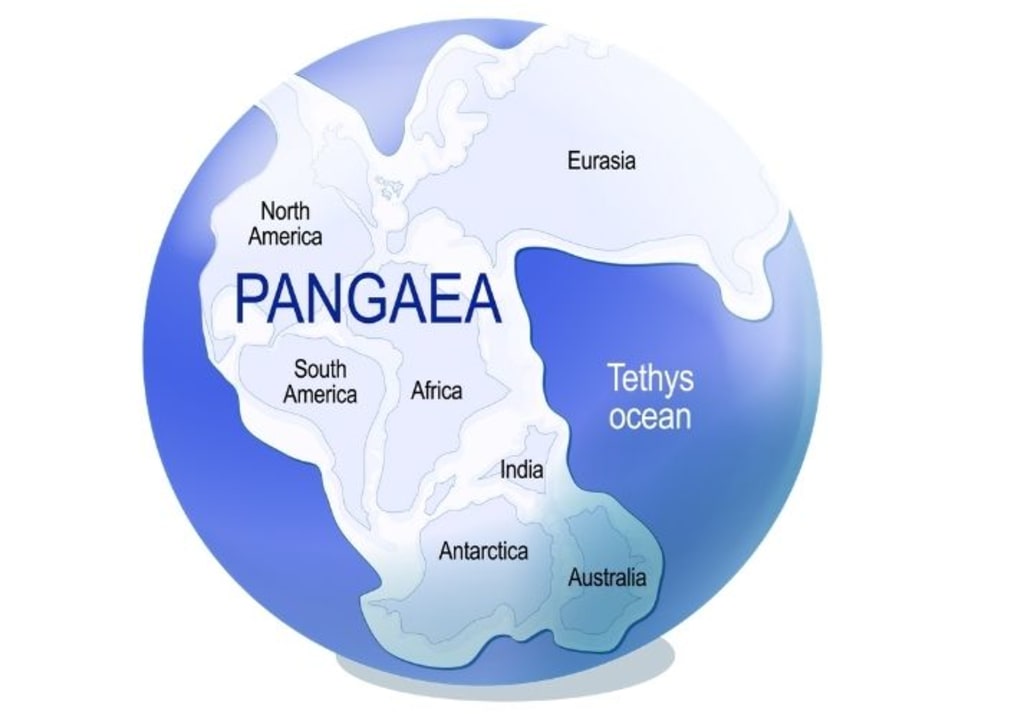
Imagine Earth 300 million years ago—a place where all continents were best friends, united in one massive supercontinent called Pangaea. This colossal landmass was surrounded by an equally gigantic ocean, Panthalassa. Together, they created a world like no other—a sprawling, unbroken expanse of land, bordered by an endless sea. But just like any legendary crew, this union couldn’t last forever.
Pangaea’s Rise and Fall
Pangaea came together during the late Paleozoic Era, around 300 million years ago, and began to break apart roughly 200 million years ago during the Jurassic Period—prime dinosaur time. It wasn’t a dramatic explosion but a slow-motion drift, as the Earth’s crustal plates shifted beneath the surface. The continents started to wander, giving birth to the world map we recognize today. Along the way, the splitting of Pangaea formed the Atlantic and Indian Oceans, transforming the planet’s geography forever.
Uncovering the Mystery of Pangaea
The story of Pangaea was first pieced together in 1912 by Alfred Wegener, a German meteorologist. Wegener noticed a fascinating detail: the coastlines of South America and Africa fit together like pieces of a puzzle. This observation led to his groundbreaking theory of continental drift—the idea that continents move over time.
But Wegener didn’t just rely on his eyes. Fossils provided crucial evidence. For example, identical fossils of ancient plants and animals were found on continents now separated by vast oceans. These creatures couldn’t have swum across the seas, meaning the lands must have once been connected. Mountain ranges also played a part, with geological formations across continents matching like jigsaw pieces.
The Science Beneath Our Feet
What powered this grand continental shuffle? The answer lies deep beneath the Earth’s surface. The planet’s crust is broken into tectonic plates, which float on a layer of molten rock. Heat from the Earth’s core creates convection currents, causing these plates to shift. Sometimes they collide, forming towering mountain ranges. Other times, they pull apart, creating vast rift valleys and oceans.
The Supercontinents Before and After
Pangaea wasn’t Earth’s first supercontinent. Before it, there was Rodinia, which existed about a billion years ago, and Pannotia, around 600 million years ago. And Earth’s tectonic dance isn’t over yet. Scientists predict that a new supercontinent will eventually form—perhaps in 200 million years.
The Next Supercontinent: Four Scenarios
The future of Earth’s continents is a guessing game, with scientists proposing four possible outcomes:
1. Novopangaea: The Atlantic Ocean continues to expand while the Pacific Ocean shrinks, bringing the Americas together and joining them with Africa and Europe.
2. Pangaea Ultima: The Atlantic reverses its expansion, shrinking to bring all continents back together into a new supercontinent surrounded by the Pacific Ocean.
3. Amasia: Most continents drift northward and cluster around the North Pole, leaving the Atlantic and Pacific Oceans intact.
4. Aurica: A new ocean, the Pan-Asian Rift, emerges as the Pacific and Atlantic close. This brings Australia to the center of the action, creating a new landmass.
A Dynamic Future
Regardless of the scenario, a new supercontinent will transform the Earth once again. It could alter climates, reshape oceans, and challenge life as we know it. How will plants, animals, and humans adapt? These are questions only time will answer.
As we look to the past to understand our planet’s history, we’re reminded that Earth is ever-changing—a dynamic puzzle in motion. Who knows? In millions of years, a new generation may stand on a united supercontinent, marveling at the history written in its rocks, fossils, and coastlines.
For now, Earth’s continents continue their slow but steady waltz, reminding us of the incredible forces at play beneath our feet. So, let’s keep exploring, stay curious, and prepare for the next chapter in our planet’s epic story!
About the Creator
Keep reading
More stories from Georgia M. and writers in Earth and other communities.
The Earth’s Secret Dance
At first glance, our continents might seem like massive rafts adrift on an ocean of molten lava, waiting to collide like bumper cars. But the truth is far more intricate—and fascinating. Let’s dive into Earth’s layers, tectonic tango, and the tantalizing future of our ever-shifting world.
By Georgia M.about a year ago in Earth
The Holiday Cactus Conundrum: Tell Your Thanksgiving, Christmas, and Easter Cactus Apart
A Trio of Holiday Classics First, a little botanical history to understand the confusion. All three plants are tropical cacti (epiphytes) native to the rainforests of Brazil, where they grow on trees. The Thanksgiving (Schlumbergera truncata) and Christmas (Schlumbergera × buckleyi) cacti are close cousins within the same genus. The Easter cactus (Hatiora gaertneri), however, has been reclassified into a different genus altogether, which explains its more significant differences.
By Emma Wallace4 days ago in Earth
China Has Planted So Many Trees Around the Taklamakan Desert That It’s Turned This ‘Biological Void’ Into a Carbon Sink
For generations, the Taklamakan Desert in northwestern China was considered one of the most lifeless places on Earth. Stretching across more than 330,000 square kilometers, this vast sea of sand earned the nickname “biological void” because almost nothing could survive its blistering heat, shifting dunes, and extreme lack of rainfall.
By Sajida Sikandarabout 21 hours ago in Earth


Comments
There are no comments for this story
Be the first to respond and start the conversation.