
A New Story About Henry Blair
Black farmer in the early 1800s
Henry Blair rose before the sun most mornings, long before the fields warmed under the Maryland sky. As a free Black farmer in the early 1800s, he understood the land as if it were kin — stubborn at times, generous at others, and always demanding more from a man than daylight could give.
But Henry was never satisfied with doing things the way they had always been done. He had a restless mind, one that saw problems not as burdens but as unfinished puzzles. Planting corn by hand was one of those puzzles.
He watched men spend endless hours bending, dropping seeds, covering them, and moving painfully slow down long rows. It wasn’t right, he thought — not when the world was full of tools, wheels, levers, and ideas waiting to be shaped into something new.
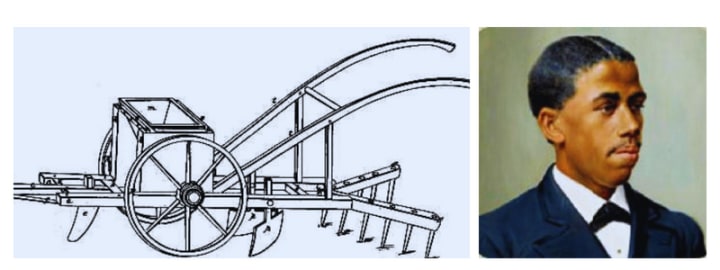
One autumn evening, after a long day in the fields, Henry sat on an overturned bucket with a scrap of wood in his hand. As the shadows stretched across the farm, he carved and carved — a funnel here, a chute there, the skeleton of a tool that hadn’t existed yet.
“Why can’t a machine plant the way a man does?” he murmured.
And once he asked that question, he couldn’t rest until he had the answer.
For months he tinkered in a small shed behind his home.
He tried angled blades, hollow tubes, curved handles, larger wheels, smaller wheels — whatever it took. Neighbors passed by shaking their heads.
“Blair’s chasing wind again,” they joked.
Henry just smiled.
“Inventions don’t laugh,” he’d reply. “But they help.”
Finally, one crisp morning, he hitched a mule to his newest creation. As he guided it across the soil, a blade split the earth, a seed dropped neatly into the opening, and a flap swept the soil closed in one smooth motion.
It worked.
A full row planted in the time it normally took to plant a quarter of one.
Word spread quickly, and in 1834 Henry traveled to the U.S. Patent Office to file what would become one of his most important achievements: the corn seed planter. Even though Henry couldn’t read or write, the examiners wrote the application for him — the strength of his invention spoke louder than any penned words.
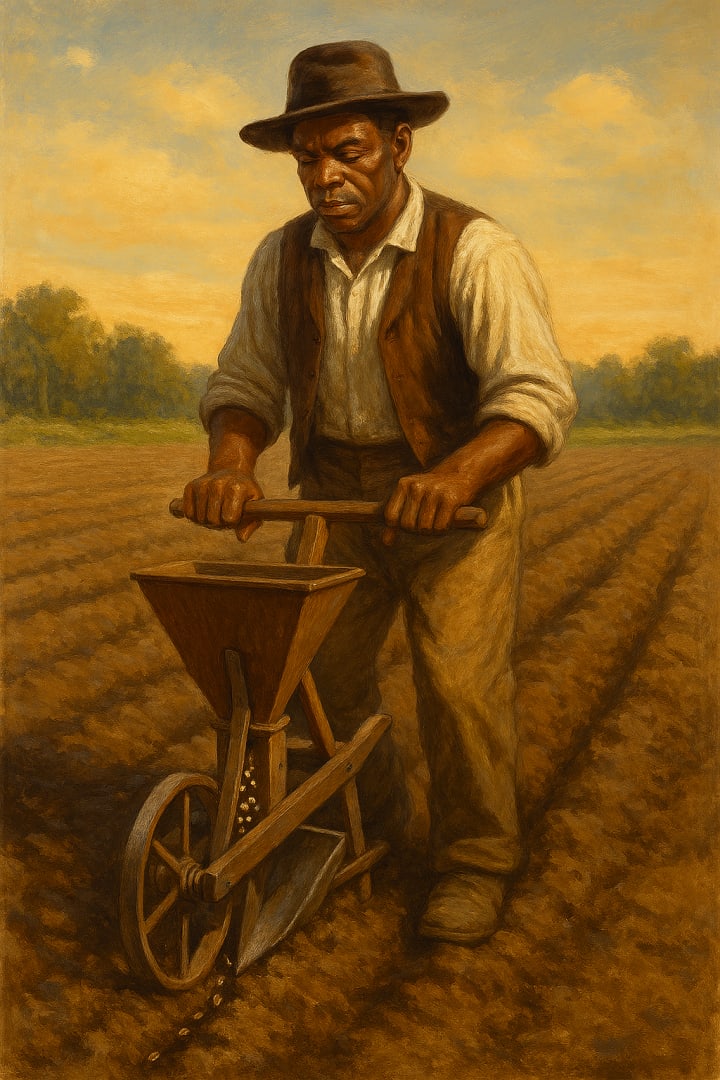
Two years later, he patented a cotton planter as well, proving that innovation could come from anyone, anywhere, with nothing more than determination and vision.
Henry Blair never sought fame.
He wanted dignity in labor, efficiency in work, and a future where invention wasn’t reserved for the wealthy or the schooled — but for anyone with an idea burning in their heart.
And though history recorded only the facts, the real legacy of Henry Blair lives in every farmer who plants smarter, not harder… and in every dreamer building something no one has seen yet.
If you enjoyed this story and want more inspiring history, inventions, and original writing…
➡️ FOLLOW ME & SUBSCRIBE for the next one!
About the Creator
TREYTON SCOTT
Top 101 Black Inventors & African American’s Best Invention Ideas that Changed The World. This post lists the top 101 black inventors and African Americans’ best invention ideas that changed the world. Despite racial prejudice.
Keep reading
More stories from TREYTON SCOTT and writers in Education and other communities.
The Story of George Peake
In the early winds of American history, long before cities rose and skylines filled the horizon, a quiet but determined innovator walked across the unsettled fields of what would one day become Cleveland, Ohio. His name was George Peake, a man born in 1722, who lived a remarkable 105 years — a lifetime that stretched across centuries of change.
By TREYTON SCOTT5 days ago in Education
History and Evolution of Navigation Buoys
History and Evolution of Navigation Buoys For as long as humans have sailed the seas, they have sought ways to navigate safely. Ancient mariners looked to the stars, the sun, and familiar coastlines to find their way. But as trade routes expanded and ships ventured into less familiar waters, a more reliable system was needed to mark hidden dangers and guide vessels into safe harbors. This need gave rise to one of the most fundamental tools in maritime navigation: the buoy.
By social xpertsolutions8 days ago in Education
Is AI Transcription Accurate Enough for Professional Use?
The rise of artificial intelligence has transformed the way professionals handle audio and video content. Meetings, interviews, podcasts, court hearings, lectures, and media productions can now be converted into text within minutes using AI-powered transcription tools. What once took hours—or even days—can now be done almost instantly.
By Mahesh Kumar3 days ago in Education




Comments
There are no comments for this story
Be the first to respond and start the conversation.