
AI and Its Impact on Jobs
How Artificial Intelligence is Changing the Way We Work

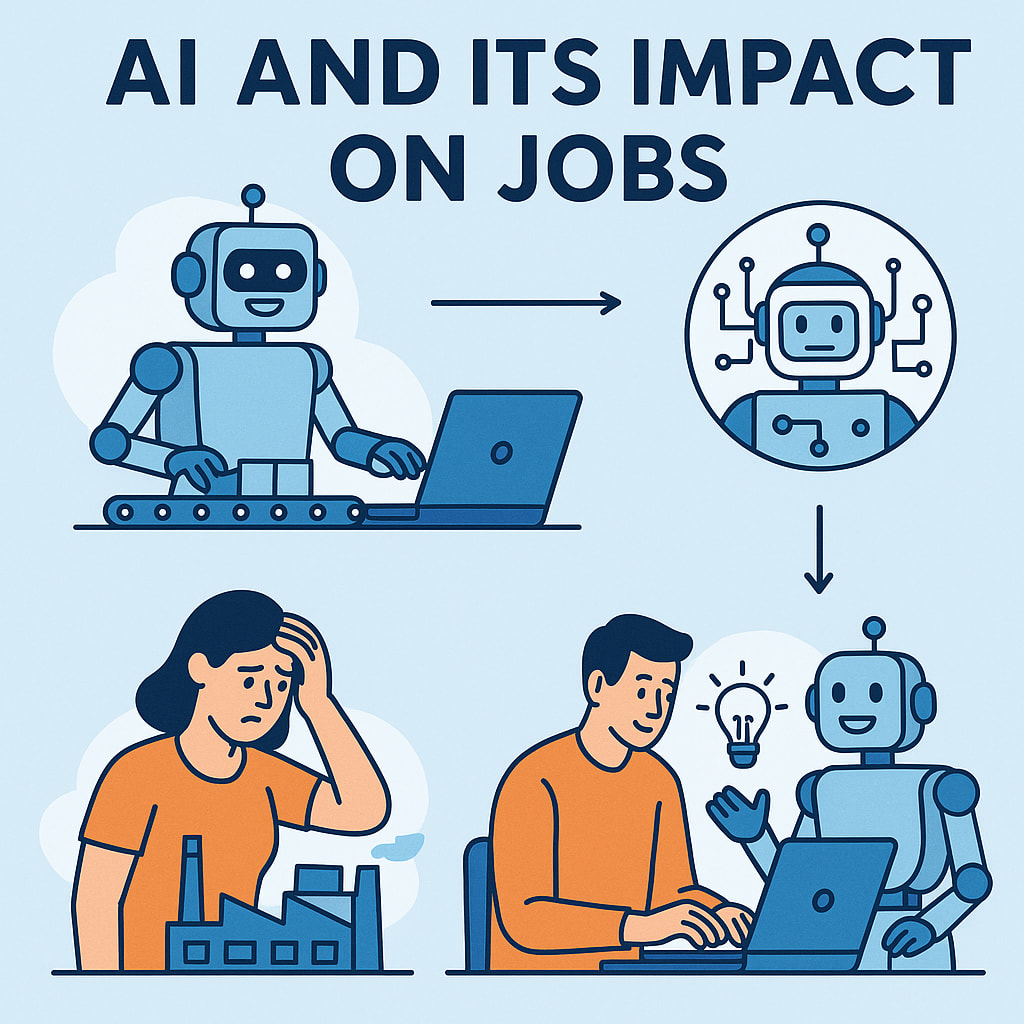
Artificial Intelligence, or AI, is a smart technology that helps machines think and work like humans. AI is growing fast and is now a part of our daily lives. It helps us with maps, chatbots, online shopping, face recognition, and more. But as AI becomes more powerful, people are asking: Will AI take away our jobs? Or will it create new ones?
Let’s explore how AI is changing jobs and what we can do about it.
---
What is AI?
AI (Artificial Intelligence) is when machines learn to do things that usually need human thinking. These things include:
Solving problems
Understanding language
Recognizing images or voices
Making decisions
Learning from experience
For example:
Siri or Alexa use AI to understand your voice.
Google uses AI to show you the best search results.
Self-driving cars use AI to understand the road.
---
Jobs AI Can Do
AI is now doing many jobs that humans used to do. These jobs are usually simple or repetitive. Examples include:
Factory work: Robots pack, sort, and move items faster than people.
Customer service: Chatbots answer customer questions online.
Cashiers: Self-checkout machines in stores.
Data entry: AI software can enter and organize data quickly.
Delivery: Drones and self-driving cars are being tested to deliver goods.
These changes help businesses save time and money. But they also mean fewer people are needed for these jobs.
---
Jobs AI Cannot Replace Easily
AI is smart, but it cannot replace everything. It is still not as good as humans at doing jobs that require:
Emotions and empathy (understanding how others feel)
Creative thinking (like writing, art, or music)
Hands-on work that needs care and skill (like plumbing or nursing)
Teamwork and leadership
So, many jobs are safe — for now. These include:
Teachers
Nurses and doctors
Artists and designers
Electricians and plumbers
Managers and team leaders
Mental health counselors
These jobs need the “human touch” — something AI cannot copy.
---
New Jobs Created by AI
Even though some jobs disappear, AI also creates new jobs. Here are some examples:
AI engineers: People who build and train AI systems.
Data scientists: People who analyze data using AI tools.
Cybersecurity experts: People who protect systems from hackers.
Robot technicians: People who fix and control robots.
AI ethicists: People who guide how AI should be used safely and fairly.
There will also be new jobs in areas we can't even imagine yet — just like how the internet created jobs like social media managers or app developers.
---
How AI Helps People at Work
AI doesn’t always replace workers. In many cases, it helps people do their jobs better. This is called "working with AI" instead of "fighting against AI."
For example:
Doctors use AI to detect diseases earlier.
Farmers use AI to know when to plant or water crops.
Teachers use AI tools to make learning more fun.
Drivers use GPS and AI maps to find the best routes.
Writers use AI to check grammar and get new ideas.
When people and AI work together, they can do amazing things.
---
Problems AI Can Cause
While AI has many good sides, there are also problems:
1. Job Loss
Some people may lose their jobs because machines can do them faster and cheaper.
2. Unfair Systems
If AI is trained badly, it may make unfair choices (like judging people wrongly in job interviews or court cases).
3. Less Human Contact
In some jobs, AI takes away the human feeling — for example, talking to a robot instead of a real person.
4. Skill Gap
Many people don’t have the skills to work with AI or new technology. This can make them feel left behind.
---
What Can We Do About It?
We cannot stop AI, but we can prepare for the future. Here’s how:
1. Learn New Skills
People should learn new skills that AI cannot do easily — like communication, teamwork, creativity, and emotional intelligence.
2. Focus on Education
Schools and training centers should teach students how to work with AI, not fear it.
3. Lifelong Learning
Even adults should keep learning — through online courses, workshops, or training programs.
4. Support Workers
Governments and companies should help people who lose their jobs. They can give them training or support to find new work.
5. Use AI with Responsibility
AI should be used carefully and fairly. We must make sure it helps people, not hurts them.
---
AI and the Future of Work
In the future, AI will be a normal part of most jobs. It will not replace all humans, but it will change how we work. Some jobs will disappear, some will stay, and many new ones will appear.
The most important thing is to stay ready. People who can learn, adapt, and work with AI will do well in the future.
---
Conclusion
AI is not the enemy. It is a powerful tool that is changing our world — including the way we work. While it may take away some jobs, it also brings new opportunities. If we learn the right skills, stay creative, and work together, we can build a better future with AI.
Remember: AI is smart, but people are smarter — especially when we keep learning.
About the Creator
Reader insights
Outstanding
Excellent work. Looking forward to reading more!
Top insight
Easy to read and follow
Well-structured & engaging content
Keep reading
More stories from Hamza Tahir and writers in Education and other communities.
Light: More Than Meets The Eye
Throughout the tapestry of human history, none has captured our collective imagination more than the profound enigma of light. This luminous entity has been the subject of enduring fascination. With questions as ancient as our existence, we have probed the very essence of light: its composition, its absence, and the way it bathes our world in its glow.
By Hamza Tahir6 months ago in Education
Best Vibe Coding Platforms for Building AI-Native Products
Vibe coding platforms are transforming how teams develop AI-native products by enabling the conversion of ideas into functional software through natural language and AI collaboration. They help startups and enterprises move faster from concept to execution without losing alignment.
By Mobisoft Infotech5 days ago in Education
Growing Together: How Community Service Strengthens Lives and Neighborhoods
Community service creates positive change by connecting people through shared effort and responsibility. When individuals step forward to help, they address real needs while building trust within their neighborhoods. Because service encourages collaboration, it allows residents to see one another as partners rather than strangers. This sense of unity strengthens a community's social fabric.
By Kevin Knasel7 days ago in Education




Comments (1)
Amazing and easy to read