
Bagua Feng Shui: Everyday Practical Guide (3)
The Principle of the Front Door in Feng Shui

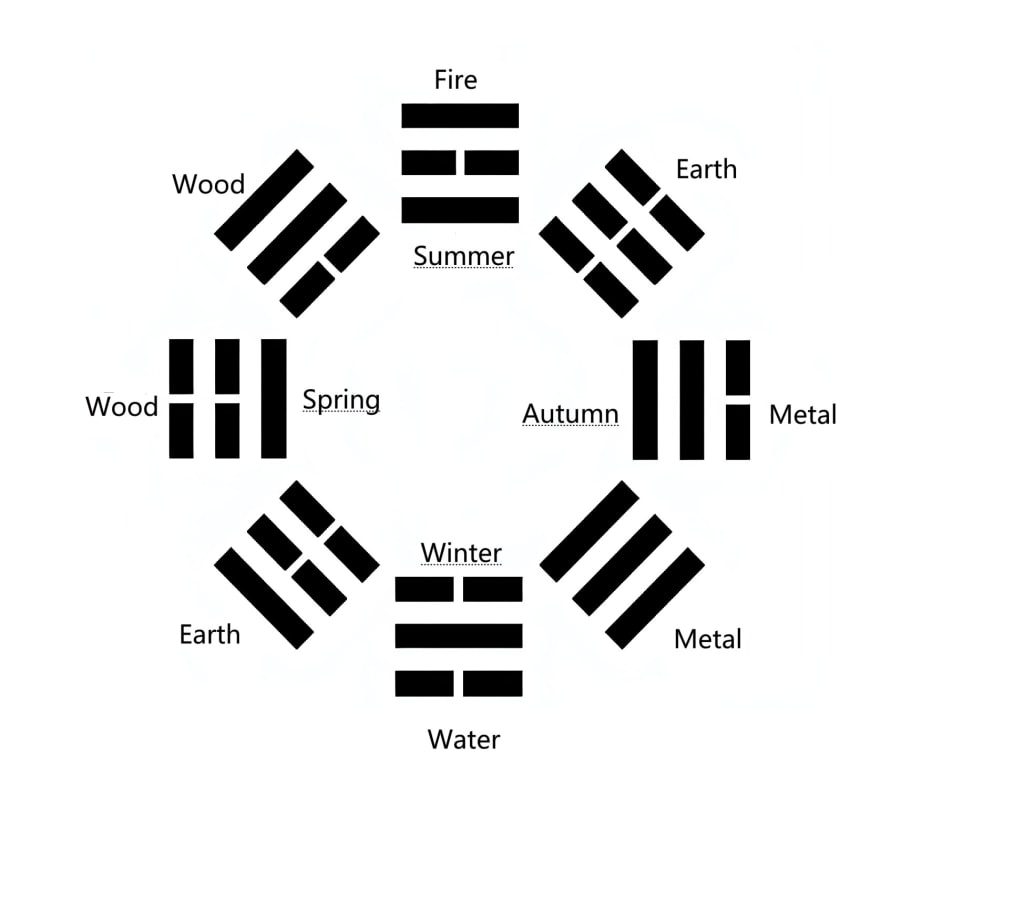
According to Feng Shui theory, the front door of a building is regarded as the main entrance of Qi and is considered the most important part of the structure. Many classical Feng Shui texts emphasize this point, describing the front door as “the key element that determines the fortune or misfortune of a household,” or “the entrance of Qi for the dwelling, just like the human mouth through which we breathe.” Building on this idea, Feng Shui also views a residence as a living body, with the front door functioning as its “mouth,” through which it breathes.
Any kind of building—whether large like a skyscraper or small like a single-family house—has a front door. In professional Feng Shui practice, analyzing and defining the Qi characteristics of a front door can be very complex.
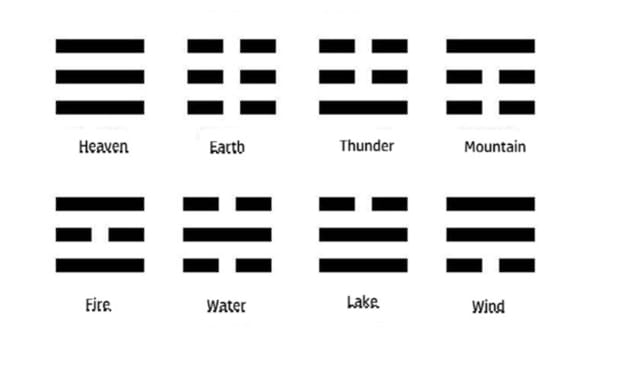
In this series, however, we take a simplified approach. We define the front door’s characteristics based on the qualities of the Qi associated with each Trigram. Looking only from the perspective of the Bagua (the Eight Trigrams), there are eight possible positions for the front door on the Later Heaven Bagua Chart, each linked to one Trigram and its corresponding Qi, as shown below:
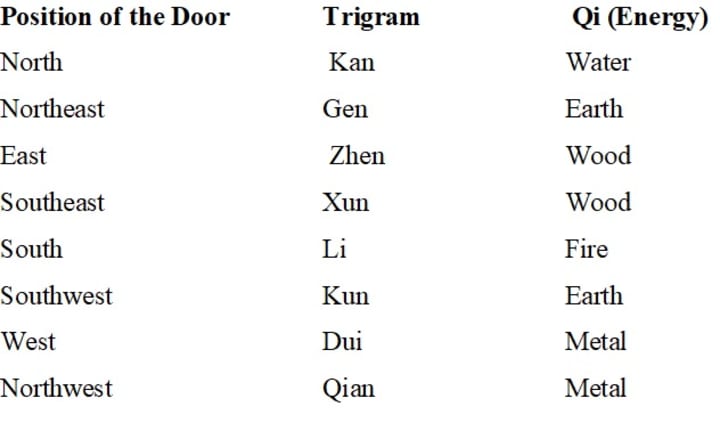
Even within the Eight Trigrams, some elements appear twice—two Trigrams with Wood energy, two with Earth energy, and two with Metal energy—but each pair is different.
For example, Wood Qi appears in both the east and southeast. The Zhen Trigram in the east represents vigorous, life-force Wood—the springtime Wood, full of growth and vitality. The Xun Trigram in the southeast also represents Wood, but of a different quality: the flourishing Wood of plants and flowers in the warm winds between spring and summer. Thus, although both are Wood Qi, their characteristics are distinct.
In the Qing dynasty (1644–1912), Feng Shui scholar Jiu-Feng Zhao, in his book Three Elements in the Dwelling, pointed out the principle of the Three Elements: the Door, the Main Hall, and the Kitchen. In traditional residences, the Main Hall was regarded as the most important room of the house; in modern life, however, the master bedroom has taken over this role. According to the Later Heaven Bagua Chart, the positions of these three parts should belong to the same group—that is, they should all be within either the “East Four Trigrams” or the “West Four Trigrams” (as introduced in the previous blog). Only with such an arrangement can good energy circulate positively throughout the house. In other words, in a residence, the front door, master bedroom, and kitchen should support one another in terms of the Five Energies.
In real life, when we assess the Feng Shui characteristics of a house, the front door is the first major focus. In Feng Shui analysis, we approach it from two aspects.
The first is Form Feng Shui, which is the most basic and most important. Here, we observe the physical surroundings of the house and its front door. The objects of analysis include the natural environment—such as hills, rivers, forests, and lakes—as well as man-made structures like highways, roads, and buildings. Different environments create different Qi (energy) fields—good or bad, strong or weak. For example, a highway is associated with a strong but unstable Qi field, while a circular road at the end of a street creates a quiet and stable Qi field.
The second aspect is to define the Qi field of the house through the Bagua Qi fields associated with the Later Heaven Bagua Chart.
Below is a list of the 24 auspicious Qi fields for front doors in dwellings of the eight orientations:
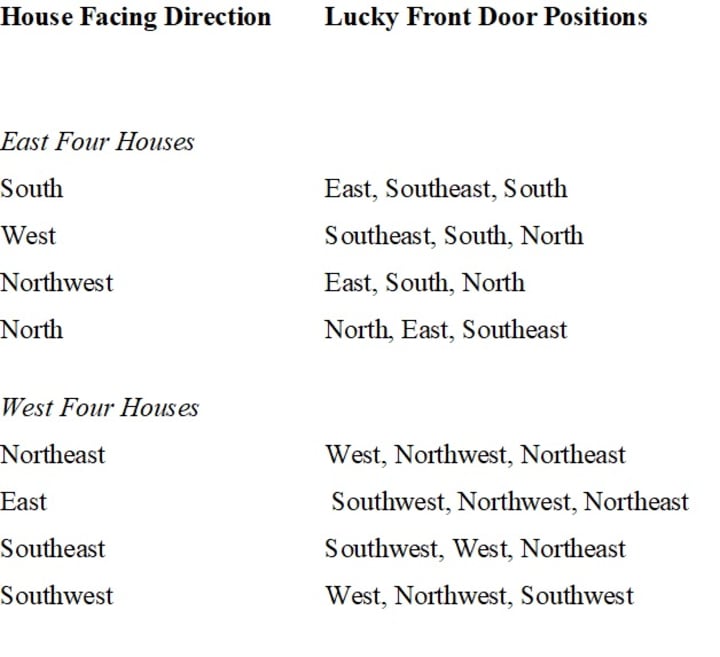
(Note: “House facing direction” refers to the orientation of the front side of the house. The siting direction is the opposite of the facing direction — for example, a house facing south has a siting direction of north.)
You can use a compass to determine the facing direction of your house, and then identify whether it belongs to the “East Four Houses” or the “West Four Houses.” After defining which group your house belongs to, check the location of the front door. If the front door falls within the same group as the house—either East Four or West Four—then the front door orientation is auspicious. If they belong to different groups, however, there is an underlying inauspicious influence. In the next lecture, we will look at an example.
About the Creator
Lidong Yu
I am a Chinese Feng Shui consultant and educator, raised and trained in China. My work draws on classical Feng Shui traditions to help people better understand the relationship between themselves, their environments, and time through Qi.
From Play to Purpose: How Fun Fuels Success Beyond the Office
In today’s fast-paced professional world, success is often measured by productivity, deadlines, and measurable outcomes. Yet, many overlook an equally important factor that can drive performance and innovation: play. Engaging in playful activities outside of work, whether it’s cooking, sports, or creative hobbies, is not merely a form of relaxation. It is a powerful tool for developing skills, fostering creativity, and enhancing overall well-being. Play may seem unrelated to professional growth, but its effects often ripple into the workplace, shaping how individuals lead, solve problems, and collaborate.
By Evan Weiss St Louis6 days ago in Education



Comments
There are no comments for this story
Be the first to respond and start the conversation.