
Banal Globalism vs. Electronic Nationalism, National Culture and Internet
Peter Ayolov, Sofia University “St. Kliment Ohridski”, 2018

Abstract
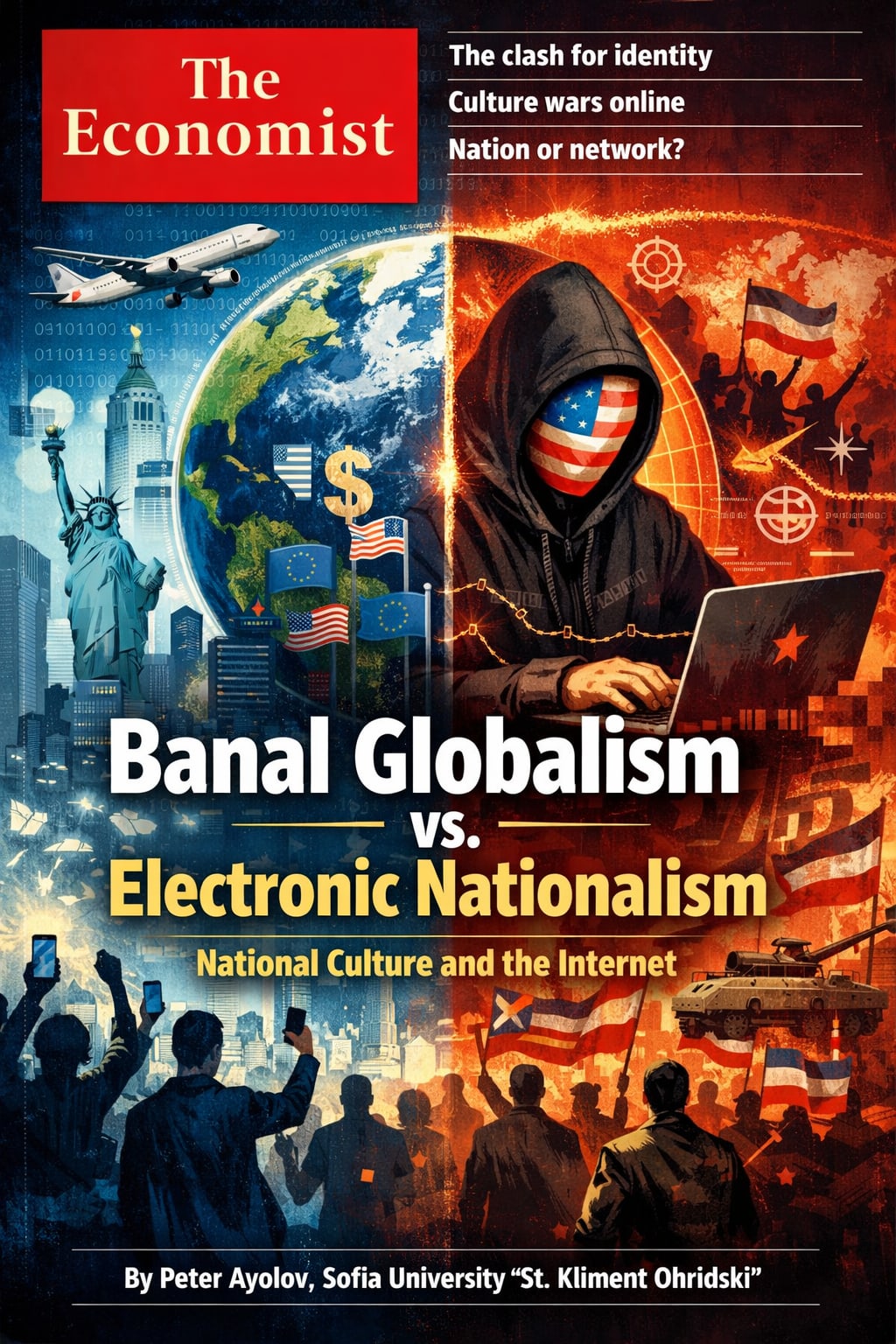
Following the introduction of the term "banal nationalism" by Michael Billig in 1995, scholars began to speak of other banal ideologies such as globalism, Americanism, and Europeanism. These formations operate on a symbolic level within the mass media and articulate a performative ideal and a superficial sense of identity within certain groups. Banal nationalism functions as a form of soft propaganda, censoring inconvenient truths about a nation’s past by repeatedly circulating the same national myths through national mass media. With the development of Internet-based media, this system has been disrupted: the full range of facts concerning a nation’s shared history has become accessible, and many of these myths have been challenged or dismantled. The ideology of globalism has gradually taken the place of nationalism, generating discourses on the decline of the nation-state and the emergence of a new global order. Yet this shift, together with the imposition of banal globalism in official mass media, has produced the opposite effect within online platforms and social networks, contributing to the revival of nationalism in a new electronic form. This article examines the role of Internet media and social networks in sustaining national systems and in facilitating the rise of electronic nationalism as a contemporary mode of constructing and maintaining national identity.
Keywords: banal nationalism, banal globalism, Europeanism, electronic nationalism, Internet media, national identity, nation-states
Banal nationalism and Internet media
"Banal nationalism" is a term introduced by Michael Billig in his book "Banal Nationalism" (1995) to denote the shared representations of a nation that constitute a common sense of national belonging. The term is used critically: by banal Billig refers to the everyday use of emptied-out national symbols whose effectiveness lies in their constant repetition through national mass media and their subconscious impact. The rise of social networks has exponentially intensified the operation of this banal nationalism, making it necessary to analyse it in relation to the development of new Internet-based media. In its extreme (or hot) forms, the ideology of nationalism differs from these banal, everyday manifestations of national identity. Yet it is precisely this hidden nature that contains its real power as a mechanism of social cohesion. The banality of the public and media performance of nationalism functions like a vigil lamp before the national altar: in moments of crisis or threat, hot nationalism can ignite and reassert itself. Contemporary nationalism remains a remarkably powerful ideology because it is largely uncontested and is perceived as natural, almost as a second nature, by large groups of people. National belonging continues to serve as a foundation for mass political mobilisation and the generation of consent among vast populations. To date, no other ideology (with the exception of religion) has managed to produce a comparable degree of cohesion and durable identity. Despite postmodern claims concerning the decline of the nation-state, the traditional, everyday forms of nationalism remain the only state ideology that still commands the trust of the masses and can unify them in times of crisis or war. In conditions of military conflict, nationalism is an even stronger unifying force than religion. Societies that maintain armies presuppose that certain values are worth more than life itself and must be defended even at the prospect of death and destruction. The nation is, above all, a moral ideal that gives meaning to life and in whose name alliances are forged and wars are waged. The nation is not an empirically measurable entity, like genetic origin, but an abstract or imagined community. It persists as a daily plebiscite in which large groups publicly affirm their belonging to confirm to one another the existence of the nation. It is a mechanism for generating social communities among vast populations, grounded from the outset in a banal ideology expressed through the demonstrative display of national symbols and the uncritical repetition of national history. This is especially important during crises and wars, when the manufacture of consent and a sense of unity safeguard collective security. War constitutes the ultimate test of national unity and of individuals’ trust in the national ideal, and every war is preceded by a propaganda campaign in the media. The language of national media facilitates the division between us and them, between allies and enemies. In this sense, nationalism is activated through the linguistic strategies of national propaganda in mass communication.
In the era of the Internet, this system continues to operate but is destabilised by easy access to information that undermines national myths built over decades and introduces new, increasingly critical discourses. The language used in Internet media and social networks differs drastically from the language of banal nationalism in official national media, and this inevitably weakens faith in the national ideal. The creation of nation-states has always been linked to the creation of a national language: the distinction between dialect and national language is determined more by political considerations than by linguistic criteria. The boundaries of language become the boundaries of national culture, and the daily repetition of linguistic symbols associated with banal nationalism becomes part of the national idiom. An important contemporary development is the expanding use of national languages online, including the possibility of creating domain names in languages other than English. The development of Internet media increasingly enables the revival of nationalism in new forms through new channels of communication. Thus new media and social networks play an ever-growing role in sustaining the system that produces consent and affirms the national ideal. Through media stereotypes, nationalism—an ideology at its core—becomes lived reality and everyday identity, constantly reminded in situations of economic crisis or military threat. The ideology of nationalism has become so deeply embedded in modern culture and modes of thought that it is exceedingly difficult to study. It is perceived as natural and speaks with the language of nature. For individuals, national belonging appears the most natural feeling and the foundation of self-identification. This ‘forgetting’ that nations are ideologies is essential to their construction, for they become inseparable from people’s worldview and self-understanding. Nations are built on the memory of shared history, traditions, and a glorious past, sustained through continual remembrance and circulation of national symbols. At the same time, nationalism requires a continuous process of forgetting shameful or inconvenient historical episodes. Traditional national media maintain a selective memory of waved and unwaved flags, shaping the censorship of historical moments and figures and sustaining the national ideal. Yet this process is challenged online. Freedom of access to information exposes uncomfortable truths from a nation’s past, generating distrust and scepticism within national communities. After this initial negative effect, national systems naturally seek mechanisms to regulate and synchronise online messaging with the national ideal. The role of the national language is to create an imagined community on whose behalf communication takes place and whose interests are defended, with mass media playing a central role in disseminating this language. The national language draws boundaries between us and them, and its use signals the articulation of one’s identity. Stereotypes about other nations—hostility, ridicule, or even hatred—help differentiate us from them, since every nation exists only in relation to others. Competition among nations and their relative status in global hierarchies strengthens national belonging and identity.
In liberal democracies, this system is disrupted by the Internet, which enables the formation of transnational groups united by diverse principles, for whom we and they acquire different meanings. In online media and social networks, it becomes increasingly evident that we no longer primarily signifies we, Bulgarians or we, Europeans, but refers instead to smaller groups sharing a worldview or interest. By contrast, in authoritarian regimes and formal democracies, the national communication system still controls media language, including online discourse, and the language of banal nationalism constructs an imagined large society by defining the linguistic and moral boundaries of our nation. The language of banal nationalism employs a syntax of hegemony, speaking in the plural, where we may even include alliances of nations with shared interests. Thus national pathos is reduced to cheap populist clichés and the banalities of political discourse. A nation survives only through a daily plebiscite enacted by the media, which publicly expresses individuals’ desire to belong. Without this expression of shared life and shared memory, nations disappear from history. For this reason, mass media articulate the language of the nation each day. The work of the press consists of continually mapping the nation and cultivating a sense of the community’s presence here and now by discussing national issues, problems, weather, news, and even sport. The danger of the freedom afforded by Internet media is that, in the absence of control or regulation, various groups and private interests may impose their own ideology in opposition to the national one. Traditional national media have diminishing audiences and declining influence, and some are owned or shaped by multinational media corporations that promote the ideology of globalism. Global mass media and Internet companies increasingly control global information flows and impose globalist ideology at the expense of nationalism. This, predictably, produces a counter-effect: a reaction and revival of nationalism within the virtual space of the Internet.
Banal globalism and Europeanism
One of the major postmodern theses concerns the “decline of the nation-state” and the rise of consumerism as a global ideology that blurs and ultimately dissolves the boundaries between national states. This new ideology, whose flag is waved daily by global mass media, is described as “banal globalism”. When the state can no longer sustain the symbolic and linguistic boundaries of the nation, it begins to lose its integrity, and national identity becomes diluted across thousands of competing narratives and stereotypes. This process benefits multinational corporations and global economic and financial alliances, which promote a new system of global media aligned with their own interests. It creates the impression that within virtual Internet communities individuals receive their daily dose of “banal ideology”, allowing them to exist outside the symbolic linguistic borders of traditional national systems. Such an argument is superficial and fails to capture the full set of tendencies involved in the confrontation between globalism and nationalism. The ideal of the nation-state continues to exist within the global world, and the “forgotten” nationalism is revived precisely by the premature proclamation of its death and by the daily waving of the flag of “banal globalism”. A comparison between the USSR and the European Union is natural in this context, as both represent attempts at international unions of states bound by common ideals, principles, and territorial proximity. The daily repetition of a banal ideology meant to sustain such unity produces the opposite effect, triggering a return to dormant nationalism and even new separatist movements. National flags continue to be waved today, as more ethnic and linguistic groups demand recognition as independent nations. “Banal globalism” in Internet media cannot provide a coherent identity for all groups of individuals and fails during economic crises or moments of military threat. Nationalism operates by “forgetting” certain historical facts of shared memory and by recalling unifying symbols, whereas “banal globalism” lacks a shared past, history, or tradition capable of uniting individuals.
Following Michael Billig’s 1995 book, debates on the “banal” ideologies of globalism and nationalism have become increasingly relevant in the context of Internet media and social networks. In 2008 Michael Cronin published his article “The Languages of Globalization”, where he interprets “banal globalism” as a simplified worldview that presents the world as a single whole and imagines a “global society” consisting of citizens of the world. The paradox, he argues, is that despite the symbol of the globe as a sphere, such a worldview makes the world appear increasingly “flat” and close, much like Thomas Friedman’s metaphor in “The World is Flat”, due to advances in transportation and communication technologies. This “flattening” results from the shrinking of physical distance, which makes nearly any point on the planet accessible, and from the growing availability of organised information on the Internet. This image of an ever more accessible world generates an euphoric notion of a homogeneous human community in which conflicts are understood as misunderstandings that can be resolved through global knowledge. It produces the belief that civilisational, ideological, religious, or national oppositions might disappear through a unified global understanding of the world. Cronin challenges this “banal” thesis of globalism by emphasising the distinction between physical and social distance: increasing social inequality separates people far more profoundly than physical proximity achieved through technological progress. Social division creates new forms of distance that manifest linguistically. The language of globalism increasingly diverges from local national cultures, provoking a counter-reaction in the form of renewed nationalist linguistic expressions. The freedom of expression afforded by the Internet allows individuals to articulate their views openly, even when these views contradict both national ideals and the norms of political correctness associated with globalism. People begin to divide themselves according to language and, more importantly, according to the value-oriented meanings that their language carries in relation to national belonging and identity. Education and social status can divide people within the same nation into speakers of the “language of globalism” and the “language of nationalism”. Meanwhile, mass migration creates growing communities of foreigners in Western countries who speak the national language of the host state while infusing it with meanings drawn from their own cultural traditions. This linguistic fragmentation gives rise to new “ideological nations” whose borders are linguistic and semantic rather than territorial, even when their members live in close physical proximity. In the era of virtual communities and social networks, differences between groups within a single city can be so profound that constant “translation” between their linguistic worlds becomes necessary. A clear example is the division within EU member states after the Syrian war and the arrival of large groups of refugees, which fractured national societies along ideological lines. Citizens of European states differ sharply in their views on migration and the prospects for integrating newcomers into national systems. This disagreement is articulated in Europe’s public sphere through the language of “Euro-scepticism” and nationalism, which clashes with the official institutions’ language of “banal Europeanism”. At the same time, Internet media and social networks allow newly arrived migrants to communicate in their native languages with compatriots around the world, hindering integration both into national systems and into Europe as a whole. Beyond official mass media, the European Union lacks a shared European language capable of creating a common sense of community and of defining boundaries between “us” and “them”. Instead, globalist language, nationalist language, all European national languages, official English, and the many languages of newly arrived migrants coexist simultaneously. Unsurprisingly, the European Parliament’s building in Strasbourg is often jokingly compared to Pieter Bruegel the Elder’s “Tower of Babel”. This genuinely global mixture of languages and cultures leads to superficial and banal communication within the EU and to the promotion of “banal Europeanism” through official media. As with nationalism, the constant waving of the EU flag and automatic repetition of its symbols and principles deepen the public divide over the future of the Union following the UK’s departure. Since no unified “European language” of consent exists, and since the imagined “European community” dissolves into multiple groups, it is natural that the strongest among them will be those united by nationalism. The EU was created as an economic union accepted by citizens of independent nation-states as a promise of shared prosperity. This economic ideal remains its primary source of legitimacy. During economic crises and moments of declining living standards, trust in such an economic union deteriorates, and its principles become a form of “banal ideology”. In her 2009 article “Representing Banal Europeanism”, Laura Cram highlights the lack of a unified public sphere in Europe capable of sustaining a new European identity. She emphasises the absence of a shared system of mass communication and of official European media or propaganda. For such a European sphere to emerge, she argues, a common European language expressing European values would be required; however, due to Europe’s linguistic diversity, translation inevitably banalises these values. Cram concludes that one cannot meaningfully speak of a European identity and that the creation of shared consciousness is a long political process.
In 2014 Vera Slavtcheva-Petkova further developed the idea of “banal Europeanism” in her article “Rethinking Banal Nationalism, Banal Americanism, Europeanism and the Missing Link Between Media Representation and Identities”. She disputes Cram’s claim about the possibility of constructing a European identity through media propaganda and the imposition of “banal Europeanism”. In a comparative study of children in the UK and Bulgaria, she finds that repeated linguistic constructions and the display of the European flag in the media remain in the realm of “banal Europeanism” and do not generate a sense of belonging to Europe. Interestingly, Bulgarian children are more aware of Bulgaria’s role in the EU than their British peers, who are more strongly influenced by “banal Americanism”. Slavtcheva-Petkova concludes that in Bulgaria, “banal Europeanism” operates only at a symbolic level and does not reshape children’s identity. Despite being more informed about the EU, Bulgarian children still distinguish it from “us” and retain their national self-identification. With the growing presence of Internet access and mobile smart devices, the issue of how social networks shape children’s identity demands increasing attention. Outside the system of official media, children may enter various “filter bubbles” in which they construct identity in isolation from their surrounding environment, national culture, and social institutions. Slavtcheva-Petkova notes that her study was conducted during an economic crisis in the EU, and financial insecurity significantly shaped public attitudes. This observation returns the focus to the founding ideal of the EU as an economic union, linking economic performance and living standards directly with trust and public support. “Banal Europeanism” serves to maintain faith in the economic benefits of EU membership, but during economic hardship this trust erodes due to disappointment with unmet promises of prosperity. The key question, then, is whether the ideologies of “banal globalism” and “banal Europeanism” can ever replace national ideologies, given that they lack shared memory, a common past, and deep cultural tradition. Their only promises are increased living standards, mobility, and communication. “Banal globalism” offers multiple identity options to individuals, but this identity is itself “banal”, lacking the depth and historical continuity of national belonging. At the same time, “banal nationalism” also lacks sufficient depth to sustain lasting identity or meaningful connection to local traditions and native culture, given its superficial and propagandistic nature. The clash between globalism and nationalism in Internet media is therefore sterile, leading to the re-emergence of “banal nationalism” in a new electronic form. This poses challenges for the functioning of the national system, whose role is to generate consent and trust among citizens. Coordination between national, supranational, and Internet media is essential for shaping stable identities among new generations who spend increasingly large portions of their lives online. A telling example can be found in several former Soviet republics, which, after decades of domination by Russian culture and language, are now establishing their own national systems with the aid of virtual Internet spaces.
National identity in New media
In 2015, the Russian communication scholar Yuri Ershov from Tomsk State University published an English-language article titled “National Identity in New Media”, examining the role of the national language in processes of ethnic and national self-identification online. Although the Internet is often conceptualised as a global and supranational network, Ershov argues that the unpredictable consequences of the spread of digital technologies reveal emerging tendencies of ethnic division and a new form of nationalism. In the countries of the former Soviet Union, most of which have only formal democracy and formal freedom of speech, Internet media are increasingly synchronised with official mass media and function as mechanisms for preserving national identity rather than promoting globalist ideology. The national debate now extends into new media, which are becoming institutionalised and begin to fulfil their function within state and national ideology and propaganda. Ershov frames the issue of “public opinion formation” from the standpoint of the national ideal, which he links to the media’s role in “forming national identity”. Rapid changes in communication technologies over recent decades have brought to the forefront the question of the role of mass media in shaping and maintaining national identity. The role of printed periodicals and other types of traditional mass media as factors in strengthening national integrity has been shaken by the expansion of Internet communications and especially social networks. From the very beginning of the Internet there has been a crossing between national community and exterritorial characteristics, and the Internet has existed in opposition to the cultural identity of traditional press.
The hypothesis that the Internet weakens the nation-state and its traditions has often been accepted uncritically, as if representing a permanent and irreversible trajectory. The national ideal is displaced from the focus of mass media in favour of global themes and global problems; public discourse becomes dominated by expressions such as “the death of distance”, “the end of geography”, and “broadcasting without borders”. Yet, like all communication technologies, the Internet is merely a tool, and its use in the service of globalist and multiculturalist agendas may have consequences contrary to expectations. At the beginning of the 21st century many authors hastily declared the advent of a global open society and the beginning of the end of nation-states. A key characteristic of the development of virtual environments is the language used in media, online communities, and social networks. Despite the dominance of English, research demonstrates the growing proportion of virtual communication spaces in other languages. In the context of rising geopolitical tension and information warfare between the West and Russia, it is not accidental that Russian is today the second most widely used language online. Using a language other than English can be an ideological choice, given that English functions as the official language of the United States, the European Union, and NATO. Although early Internet usage was concentrated in English-speaking societies, this does not render English universal. The Internet is becoming increasingly multilingual. As Ershov notes that the Russian language occupies second place in the ranking of Internet language popularity. This fact is confirmed by the study of global web content languages (W3Techs). Ershov observes a notable tendency in the former Soviet republics: the creation of domain names in Russian serves as a symbol of identification and distinction between “one’s own” and “the foreign”. The Internet Corporation for Assigned Names and Numbers (ICANN) decided to allow registration of domain names in local scripts; alongside (.su) and (.ru), many domains now appear with (.рф). Russian remains the most widely used language in Internet communication and in the domain spaces of former Soviet republics such as Ukraine, Belarus, Kazakhstan, and Uzbekistan. He writes: “Now the domain name plays an important symbolic role from the standpoint of national identity and contributes to the understanding of ‘us’ and ‘them’. Moreover, the growing popularity of search engines strengthens national organisation as an organising principle of search. The fact that Google has developed ‘national’ search engines serves as evidence that the perception of the Internet as a supranational space no longer works.” Regardless of political agendas, digital capitalism seeks to reach ever larger publics in a world that remains fundamentally local and divided by languages, ethnicities, nations, and state borders. Knowledge of local languages, cultures, and traditions becomes increasingly important for attracting local communities into online spaces. This creates opportunities for the emergence of a new type of nationalism transferred into virtual space, where new territories of national and ethnic division arise in contrast to globalist visions of the Internet as a space of multinational integration. Linguistic borders prove stronger than territorial borders, and politics and business must adapt accordingly.
Another factor shaping the digital “map” of the Internet is war and military conflict, which generate parallel virtual battles between opposing propaganda systems online. External threat naturally unifies the nation, neutralising internal divisions through the mechanism of wartime propaganda and the rhetoric of “banal nationalism”. As Ershov notes during national crises and wars, the character of web content shifts toward stronger patriotism. In such cases national passions run high, as was demonstrated, for example, during the Israeli-Palestinian conflict. Internal differences become less significant and are replaced by unambiguous declarations of ‘who we are’ and ‘who they are’ in the spirit of banal nationalism. An important feature of this “virtual nationalism” in the former Soviet republics is that it is not centrally organised propaganda in the service of a single ideology, as in the Soviet era, but rather a decentralised division along national and ethnic lines within virtual environments, which revitalises local nationalisms. Ethnic groups and local communities in the former Soviet space use the Russian language, Russian communication channels, and Russian-language social networks as inherited infrastructure, while simultaneously building stronger local communities based on their own traditions. Ershov cites the study by Wei and Kolko (2005): “A survey conducted in Central Asia shows that although users are dissatisfied with the dominance of English and Russian-language resources, they still most frequently use languages they understand. For Uzbeks this remains Russian, which allows them to create profiles on ‘Odnoklassniki’ or ‘VK’. Therefore the ‘Russian world’ extends beyond Russia as long as former Soviet republics use Russian while consuming television and Internet content.” In these republics, a stable trend is visible: Internet media are gradually institutionalising and synchronising with local power structures and national culture. While online media grow in popularity and diminish the influence of traditional media, this does not imply independence—rather, it signals their integration into local and national power systems. Ershov writes that globalisation processes, whose existence cannot be denied, compete with regionalisation processes that are less visible and often masked as banal nationalism. State authorities eventually begin to control the Internet, which originally appeared as an uncontrollable and self-developing network. The Internet increasingly resembles traditional media and becomes part of national media systems. The connection between social networks, new media, banal nationalism, and state power must be studied both in countries with low and with high Internet penetration. The synchronisation of online media with traditional mass media, and the growing control and regulation of online content, result in increasing concentration of state power at the expense of private groups and interests. Nations strengthen their authority through nationalism, but in a new form—“electronic nationalism”. This dynamic is not limited to Russia and the post-Soviet space; Western countries and the United States exhibit similar tendencies, as online media increasingly become components of large media corporations serving political interests often aligned with state power.
Electronic nationalism and National identity
One year after Ershov’s analysis of revived digital nationalism in the former USSR, American scholar Lyman Stone of George Washington University published his article “Could eNationalism Be a Thing? And Is It a Threat to National Identity?” (2016). Stone examines the origins of the American nation and the absence of inherited ethnic continuity in the American national tradition—unlike in European nations. This absence is compensated by a constant public performance of national belonging through mass media, because only in the virtual world of media can individuals see the “imagined image” of the American nation as a unified whole. The role of media is therefore foundational in constructing national imagery and maintaining national identity. Stone writes that a nation exists only in people’s minds, nowhere else. A nation is not something genetic or physical… Nationality has one particularly distinctive feature, and that is heredity. But most importantly, people see themselves as communities of individuals who view each other as connected even if they have never met. The United States is a unique experiment in national formation: completely different groups of people are forged into a single nation through shared trials. War and the creation of a common enemy forge national identity far more quickly than centuries of peaceful coexistence. The absence of shared ethnic descent and inherited tradition in the American nation has been compensated by the myth of the settlers—settlement of vast empty lands as the unifying ideology of the new nation. The myth implies continual expansion; without new territories, the nation loses direction and disintegrates into its constituent groups. After the frontier closed, the American ideal did not disappear; it was reborn through global corporate expansion and territorial conquest—not only on physical maps but now in virtual space.
In the past, global communism served as the central “enemy image” binding the American nation together. This post-war nation, sustained by the most powerful communication system in the world and by its permanent confrontation with the USSR, faced a new test after the attacks on the World Trade Center and the Pentagon. Stone observes that supported by highly centralised national media, especially television, and the traumatic experience of World War II, the United States developed a traditional sense of nationality. This nationalism works as long as it is constantly reinforced by contrast with communism. The victory over communism allowed for celebratory nationalism in the 1990s. But after 9/11 the vision of the United States as a nation carrying capitalism and liberalism was challenged: now the same people turn against us. The enemy is at the gates. What is to be done? Stone argues that the salvation of the American nation in crisis came from the Internet, which reached maturity around the year 2000. With the emergence of smartphones and social media, the Internet became a powerful instrument of social connectivity. Older generations often complain that face-to-face communication is declining, that valuable traditional forms of sociality are disappearing, and that young people are becoming isolated. These fears are not unfounded, Stone suggests, because the Internet enables the formation of new communities that may overpower national belonging. Alternative media representing divergent ideological views allow cheap and rapid organisation of new ideological communities. In the past only religion and the nation could reliably create such identification and loyalty over long distances. But today, when coordination and communication costs are very low, the legitimacy of many nation-states is at its weakest. Can the nation-state exist without nationalism? What is the role of nationalism? Attempts to downplay nationalism overlook its connection to the legitimacy of political authority and the need for a shared ideal and tradition—not only democratic voting—to sustain state power. If individuals and groups do not believe in a shared ideal, they will split off and create new states united by alternative ideologies. Nationalism enables unity and collective governance within a stable political order.Without nationalism the nation-state has no legitimacy. If people believe their country is not well represented, they will eventually seek to create a new and different state. In contrast to Ershov’s findings for the former USSR—where virtual culture enables quests for independent identity—Stone argues that American society faces ideological division within a single national state. Through the Internet, multiple “ideological nations” have been formed, each isolated from the others; their mutual estrangement means that the United States becomes merely a shared economic territory. The most serious danger associated with social media is the rise of “networked ideological communities” that threaten traditional nationalism and may destabilise the nation-state. In virtual space these “ideological nations” share nothing, even when their members inhabit the same city and the same state. The fact that these groups do not see one another as members of the same community means that they see each other much as Americans 50 years ago viewed communism. And this is extremely dangerous. It undermines the nation-state. The festering sores of multinationalism erode the fabric of liberal democracy, constantly and slowly weakening public solidarity and mutual concern. At the conclusion of his article, Stone returns to the fear of older generations about digital isolation but argues that the real danger is the opposite. Young people now form durable ideological communities with entirely opposing values engaged in perpetual propaganda warfare. This dynamic is so dangerous that it may even lead to a new civil war. The true threat of the Internet is not that it destroys communities, but that it creates new communities—just like every communication medium before it—yet communities that may be incompatible with national stability and unity. Stone concludes with a question. Historically the way this ends is either civil war (which we last experienced before we had a multinational state) or a clever external conqueror. But we live in a new age and believe this could never happen to us. Could it?
National culture and Internet media
The effects of Internet media and social networks differ across regions, but a common tendency towards an “electronic” or “banal” nationalism can be observed. The major difference between the development of this new type of nationalism in liberal democracies and in formal democracies is that in countries such as Russia, Turkey, Ukraine, Poland, and Hungary nationalism in Internet media serves official policy as an instrument for the “manufacture of consent” through organised national propaganda. By contrast, in developed democracies with established pluralism and freedom of expression, this nationalism is opposed to the dominant liberalism of the official media in a permanent media war and conflict with the language of “banal globalism”. In many cases, the emergence of “electronic nationalism” is a reaction to the excessively aggressive propaganda of globalism and multiculturalism in official mass media. Internet media become a free space for articulating alternative perspectives and seeking identity in the heritage of national and ethnic traditions. The rise of nationalism in Internet media and in the political sphere can be seen in the United States, in member states of the European Union, in former socialist countries in Eastern Europe, and in states with formal democracy such as Russia, Turkey, and Ukraine, among others. At the beginning of the 21st century, history appears to be repeating itself: instead of a linear movement toward liberalism and globalism, there is a return to the most powerful and dominant state ideology to emerge after the French Revolution of 1789, namely that of the nation-state.
On one side, nationalism uses a “language of hatred” that seeks and names a common enemy against whom the community can unite on the basis of inherited traditions; on the other, there is the language of tolerance and political correctness, which designates any form of intolerance as the enemy. Undoubtedly, the language of hatred and the identification of a universal enemy threatening traditional culture and inherited values are far stronger unifying factors. Conflict and confrontation in virtual space become acts of personal identification and expressions of belonging, less to a structured ideological system in the classical sense than to its linguistic and poster-like façade. This is precisely how “banal nationalism” operates in its “electronic form”. The deployment of the language of hatred and the language of tolerance, each loaded with specific evaluative meanings and a strictly delimited vocabulary, constitutes the primary weapon in these propaganda wars online. Truth is effectively excluded from the discussion, as are the ideals of national unity and consensus. The development of Internet communication follows the global model of “manufacturing disagreement” and dividing society into groups with incompatible ideologies, groups that no longer share a sense of belonging to a single nation. This division into “ideological nations” with their own language, political representation, and virtual presence in Internet media can be observed along traditional fault lines: attitudes to communism and capitalism, to Russia and the United States, to national culture and globalism, and many other points of division that serve to identify and recognise the “enemy”. The Internet enables the creation of virtual environments in the form of ideological “filter bubbles”, in which all information is filtered and colourised according to the dominant ideology, regardless of empirical facts. Entire communities thus inhabit the same geographical territory while living inside virtual “ideological nations”. In this way, “globalism” and “nationalism” can both become equally “electronic” and detached from the historical and social development of human communities in a given region; they “meet” only at specific points of conflict in online space. Internet media and “digital capitalism” exploit these intersection points of conflict to generate a permanent “war of ideas” that, in turn, attracts ever more users. Despite their political and ideological commitments, Internet media follow their own agenda in the pursuit of increased “traffic” and financial gain, often with little regard for the “public interest”. The business model of Internet media rests on the principle “Angry People Click More”.
Bibliography:
Billig, M. (1995) Banal Nationalism. London: Sage Publications.
Cronin, M. (2008) ‘The Languages of Globalization’, in Translation and Globalization. London: Routledge, pp. 129–146.
Friedman, T.L. (2005) The World Is Flat: A Brief History of the Twenty-First Century. New York: Farrar, Straus and Giroux.
Cram, L. (2009) ‘Representing Banal Europeanism’, Scottish Affairs, 68(1), pp. 1–23.
Slavtcheva-Petkova, V. (2014) ‘Rethinking Banal Nationalism, Banal Americanism, Europeanism and the Missing Link Between Media Representation and Identities’, Journal of Children and Media, 8(1), pp. 1–17.
Ershov, Y. (2015) ‘National Identity in New Media’, International Journal of Communication, 9, pp. 2512–2529.
Wei, C.Y. and Kolko, B.E. (2005) ‘Resistance to Globalization: Language and Internet Diffusion Patterns in Uzbekistan’, New Media & Society, 7(1), pp. 123–146.
Stone, L. (2016) ‘Could eNationalism Be a Thing? And Is It a Threat to National Identity?’, Medium, 28 June. Available at: https://medium.com/ (Accessed: [27.11.2025]).
About the Creator
Peter Ayolov
Peter Ayolov’s key contribution to media theory is the development of the "Propaganda 2.0" or the "manufacture of dissent" model, which he details in his 2024 book, The Economic Policy of Online Media: Manufacture of Dissent.
Keep reading
More stories from Peter Ayolov and writers in Education and other communities.
The Unique Case of Alma Mater TV
(A Review of Charmaine Voigt's Dissertation on Practical Media Training) Abstract This review examines the Bulgarian case study of Alma Mater TV as discussed in Charmaine Voigt's doctoral dissertation College Television: Practical Media Training in US and German Higher Education. While Voigt's work focuses primarily on Anglo-American and German contexts, the Bulgarian example stands out as an exceptional and largely unmatched model of student television in Europe. Alma Mater TV, based at the Faculty of Journalism and Mass Communication at Sofia University 'St. Kliment Ohridski', functioned not merely as a training platform but as a fully operational public-facing television project. Students produced and aired original programmes on Bulgaria's largest national broadcasters without censorship or editorial interference, while simultaneously participating in the creation of a European student television network. This review argues that Alma Mater TV represented a globally unique pedagogical and institutional experiment whose decline resulted not from structural failure but from a lack of strategic vision at the university leadership level. Particular attention is paid to the decisive roles of Professor Svetla Bozhilova and Professor Peter Ayolov in establishing and sustaining this model.
By Peter Ayolov30 days ago in Education
From Dugout to Teamwork: Strengthening Bonds in Travel Baseball
Travel baseball is more than just a sport. It is a commitment that brings together young athletes, coaches, and families for months of practices, road trips, and high-stakes tournaments. While the focus is often on sharpening skills and chasing championships, one of the most valuable aspects of travel baseball lies in the relationships formed along the way. Strong team bonds not only improve performance but also create an environment where players thrive emotionally, socially, and competitively.
By Joe Sottolano7 days ago in Education



Comments
There are no comments for this story
Be the first to respond and start the conversation.