
Cosmic Horror Meets Science
When The Unknown Becomes Reality
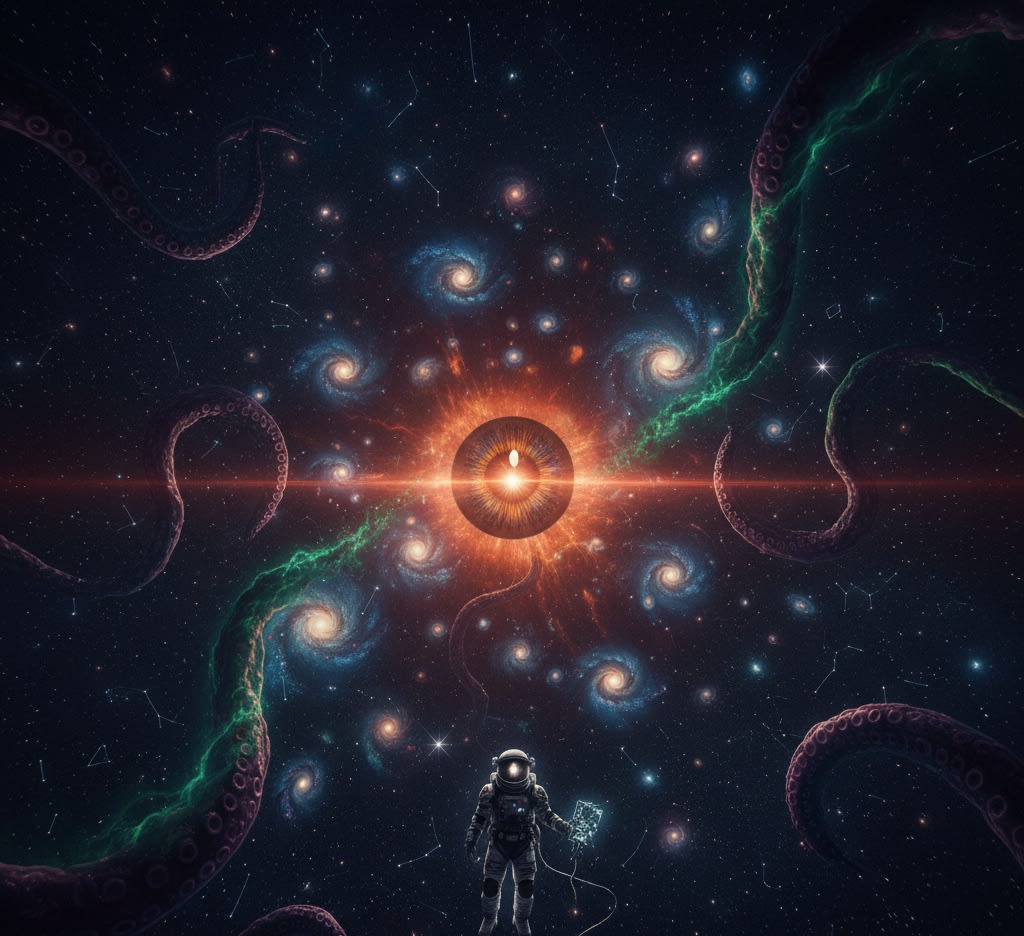
Cosmic Horror Meets Science: When the Unknown Becomes Reality
Humanity has always feared the unknown. From the dark corners of ancient forests to the vastness of the night sky, our greatest fears often come from what we cannot understand. But what happens when science—our most trusted tool for explaining the world—starts uncovering truths that are more terrifying than fiction? This is where cosmic horror meets modern science, and the line between curiosity and dread begins to blur.
---
What Is Cosmic Horror?
Cosmic horror is a genre of storytelling that explores humanity’s insignificance in the face of an incomprehensible universe. Popularized by writer H.P. Lovecraft, it is not about ghosts or monsters, but about the terrifying realization that the universe is vast, uncaring, and beyond human understanding. The fear comes not from what we see—but from what we can’t see or ever hope to understand.
In Lovecraft’s world, the cosmos hides ancient entities and forces so immense that merely glimpsing them could drive a person insane. These ideas, while born from fiction, eerily echo some of today’s most mind-bending scientific discoveries.
---
The Science of the Unknown
Modern science often ventures into territories that sound straight out of a horror novel. Consider black holes—regions of space so dense that not even light can escape their pull. Once dismissed as theoretical, we now have photographic evidence of their existence. They warp time, crush matter, and erase anything that crosses their invisible threshold.
Then there’s dark matter and dark energy, which make up around 95% of the universe—yet we have no idea what they are. We are surrounded by invisible forces shaping galaxies, stars, and even the fate of the cosmos, but we cannot detect or comprehend them directly. That sense of mystery—of being surrounded by the unknowable—is pure cosmic horror made real.
Quantum physics adds another layer of eerie wonder. Particles that exist in multiple states at once, realities that branch off with every decision, and phenomena that only “happen” when observed—all suggest a universe stranger and more alien than anything the human mind was built to grasp.
---
When Science Inspires Fear
The deeper scientists peer into the universe, the more it seems to defy reason. Even the notion of infinity itself—eternal time, endless space, or infinite parallel worlds—forces us to confront our smallness. Cosmic horror is no longer just a literary idea; it’s the emotional response to modern cosmology.
Astronomers searching for extraterrestrial life face the same paradox: we crave discovery, yet the realization that something powerful and ancient might be watching us from the void could unravel our sense of safety. The Fermi Paradox—why we haven’t found intelligent life despite the universe’s age and size—hints that perhaps civilizations self-destruct before making contact, or worse, something else silences them.
---
The Beauty in the Fear
Yet, there is beauty in this terror. Cosmic horror reminds us of the humility we must keep as we explore the universe. Science shows us that we are small, but it also shows that we are capable of understanding the incomprehensible—at least a little at a time.
When the unknown becomes reality, it challenges not just our intellect, but our imagination. We are tiny beings on a fragile planet, peering into an infinite abyss—and still, we dare to ask questions.
---
Conclusion
When cosmic horror meets science, fear becomes fascination. What once belonged to myth and madness now lives in telescopes, particle accelerators, and quantum equations. The more we learn, the more we realize how little we know—and that is both terrifying and beautiful.
Perhaps that’s the greatest truth of all: in a universe filled with darkness, mystery, and infinite possibility, humanity’s most powerful act isn’t to understand everything—it’s to keep searching anyway.
About the Creator
Keep reading
More stories from Muhammad Shahram and writers in Education and other communities.
Mysteries of Wormholes
Wormholes: Myth, Math, or the Future of Interstellar Travel? The universe is vast—so vast that even light, traveling at 300,000 kilometers per second, would take thousands of years to reach the nearest stars beyond our solar system. For decades, scientists and dreamers alike have searched for a way to bridge this cosmic distance. One idea that continues to capture imagination is the wormhole—a theoretical tunnel through space and time that could make interstellar travel almost instantaneous. But is it real science, a mathematical curiosity, or just science fiction?
By Muhammad Shahram4 months ago in Education
The Human Heart of EdTech: My Week at Bett 2026 as a Microsoft Expert
There is a specific kind of hum you only hear at the ExCeL London during the third week of January. It’s a mix of the low-frequency thrum of thousands of devices and the high-pitched energy of educators who have finally found "their people."
By Teacher Ami - Amizur Nachshoniabout 12 hours ago in Education


Comments
There are no comments for this story
Be the first to respond and start the conversation.